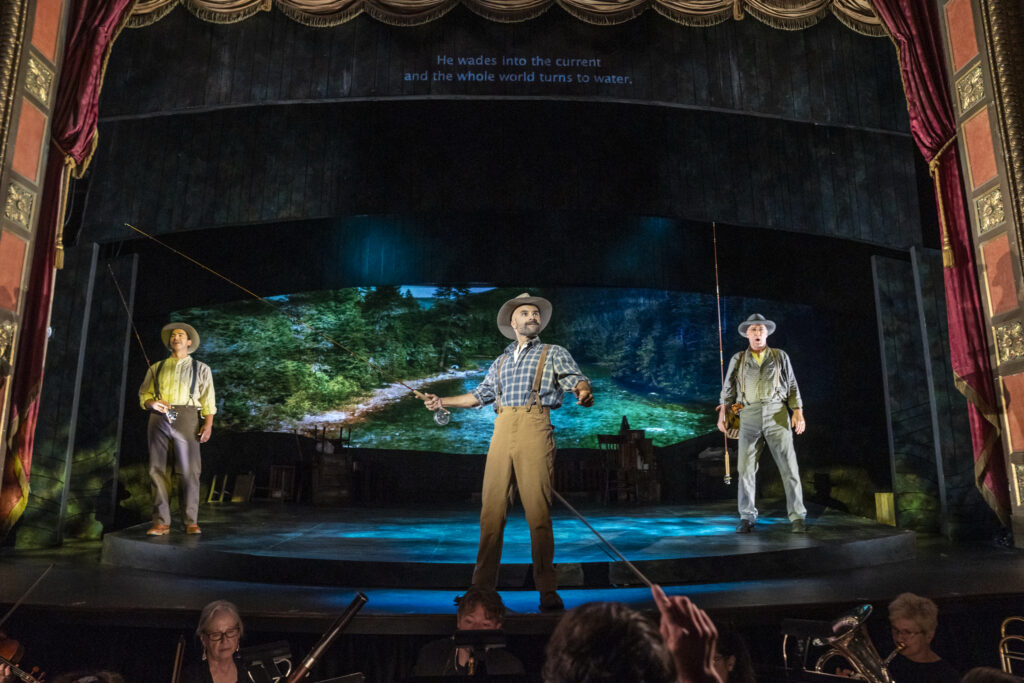
BOZEMAN, Mont. — Outside a rehearsal space in this city ringed by mountains, opera singer Michael Kuhn was practicing fly casting. Stepping forward, he launched the line from a bamboo rod into the air, delicately circling it before it settled on the grass.
“There’s this idea of having it dance over the water,” Kuhn said as he rehearsed.
Of all the planning that has gone into a new opera commemorating the 50th anniversary of the classic Montana novella “A River Runs Through It,” the fly-fishing that will take place onstage has been the biggest challenge.
It’s the centerpiece of Norman Maclean’s famous semiautobiographical book about two fly-fishing brothers that published in 1976 and was made into an Oscar-winning movie by Robert Redford, with Brad Pitt in his first major leading role.
To prepare, writers and producers of Opera Montana’s adaptation took the cast fishing on the Yellowstone River and hired outdoor consultant Jason Borger — Pitt’s fly-fishing stunt double in the movie — to advise.
“I had never held a fly rod,” recalled co-librettist Kelley Rourke. “You can do all the research in the world and watch all the videos in the world, but it is different to feel it in your body.”
Just days before this weekend’s premiere at Bozeman’s Ellen Theatre, stage director Matt Foss was unsure whether the two main characters — Norman (played by Schyler Vargas) and his troubled younger brother Paul (Kuhn) — would be casting with rods at all. Would a projection work better? What if the lines got entangled on the tiny stage?
“It’s a process,” Foss said of the production, which will be performed seven times in Bozeman before traveling 200 miles to Missoula in October. “We’re still figuring out exactly how to do it.”
Beyond the fishing scenes, Opera Montana faced the broader challenge of producing an adaptation of a well-known story, with lines that “people know like a catechism” — especially in Montana, Rourke said.
Opera Montana’s general director, Susan Miller, acknowledged the book’s complicated legacy, the way it transformed Montana into a destination for legions of aspiring anglers and wealthy tourists. And, some argue, helped ruin it.
“It means so much to Montanans and to the nation,” Miller said.
In 2024, John Maclean — Norman Maclean’s son and an author himself — got a call from Foss, a longtime stage director for Montana Shakespeare in the Parks program. Foss was trying to adapt “A River Runs Through It” into a play, he said, and was stuck.
“That’s not a great surprise,” John Maclean said in an interview. “It’s a book that’s a nugget of a tragedy wrapped in one fishing story after another, and if you can’t go fishing in a play, then you don’t have very much left.”
Maclean, who divides his time between Cleveland Park in Washington, D.C., and the family’s cabin in Montana, had just seen “Turandot” at the Kennedy Center and had a moment of inspiration. He said to Foss, “Why don’t you think about an opera?”
The result is a 90-minute show — part opera, part musical theater — about family, loss, guilt, masculinity and, of course, fly-fishing. Composer Zach Redler sets the tone of the relationship between the brothers and their personae in an early duet. The music plods while Norman, a careful fisherman, sings, then soars as Paul takes the water. “Beautiful,” Norman says, observing his brother’s prowess.
Creators also took care to elevate the female characters in the adaptation: Mother Clara has her own aria, and the prostitute called “Old Rawhide” is renamed Heidi and has one of the catchiest songs, a bouncy country tune.
Norman Maclean and his brother Paul were raised predominantly in Missoula, then a rough logging town, where their father served as a Presbyterian minister and gave his sons strict lessons about God, grace and fly-fishing — the latter dispensed on trips to the Big Blackfoot River. Paul became a journalist and Norman an English professor at the University of Chicago.
It took Norman more than 30 years to write about the central tragedy of his life, his son said, the night that Paul was beaten to death in a Chicago alley in 1938.
Paul drank to excess and was mired in gambling debts, which Norman believed contributed to his death. His son is not so sure. John Maclean delved into police and coroner testimony about the murder, which was never solved, for his 2021 memoir, “Home Waters.” He said his uncle may simply have been out “looking for trouble” and gotten into a fight he couldn’t handle.
His father rarely spoke about Paul, and then only in short bursts.
“It was not something that was easy to talk about,” John said. “But it was very present.” Once, when the family went to stay at their cabin on Seeley Lake, John could hear his father calling “Paul, Paul” over the water late at night.
Norman began writing the book in 1973. The University of Chicago Press, which was dedicated to academic fare, agreed to publish it after others passed. Publishers Weekly called it “a stunning debut,” and it eventually drew Redford’s attention.
He proved to be a curmudgeonly creative partner on the film, objecting vigorously to an early draft of a script with a scene where Paul snaps the head of a rainbow trout to kill it. Redford just “waited him out,” John said.
Norman Maclean died in 1990, two years before the movie’s 1992 premiere. It was eventually nominated for three Oscars and won for best cinematography.
The movie is what made fly-fishing a trendy sport and Montana a “destination for the Learjet wealthy,” as John Maclean puts it. He said locals still tell him, ”‘Your dad wrote that goddamned book that ruined Montana.’”
Borger, a fly-fishing educator and consultant, was just a few months out of film school when Redford tapped him to appear as Pitt’s fishing double. It’s actually Borger viewers see in the movie when Pitt’s character is standing on a rock “shadow casting,” Paul’s special term for the method that entices fish to the surface of the water.
As a consultant for the opera, Borger made tapes of himself fly casting that formed the basis of video projections that will play throughout the show. About a week before the premiere, Foss and others decided that the performers would still use the bamboo rods but without fishing lines.
“It took about 11 seconds to discover that lines were a bad idea,” Borger quipped.
Just five days before opening night, Borger put on his waders and took Kuhn and Vargas out on the Gallatin River, at a favorite fishing hole near the Axtell Bridge. It was a brisk, windy morning, and the fish weren’t biting. But he coached the co-stars on their casting, to make the work feel authentic for the audience. Kuhn worked more on the exaggerated big casts, the “shadow casting.”
The morning was “transcendent,” Kuhn said. When the curtain rose, he would be ready.
The post ‘A River Runs Through It’ casts a new line — as an opera appeared first on Washington Post.