KREMENCHUK, Ukraine — Yaroslav Suzanskyi was 16 when he saw an ad on the Telegram messaging app offering “easy money,” about $165, to do an odd job. It turned out to be a want-ad for sabotage: Suzanskyi was paid to set fire to a railway relay cabinet.
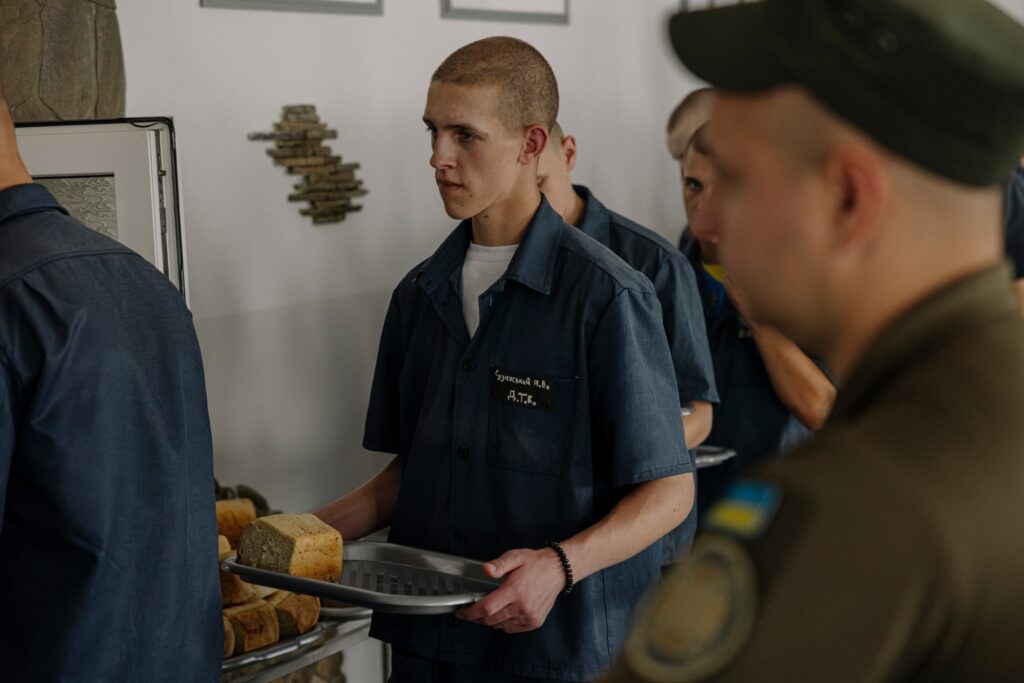
Now 18, Suzanskyi is incarcerated at a juvenile correctional colony, both a perpetrator and a victim of a hidden part of Russia’s war against Ukraine: recruiting vulnerable young people to attack their own country. He is one of eight inmates at Kremenchuk — in a population of 72 — convicted of national security or public safety offenses linked to Russia.
Many of the children recruited by Russia are impoverished and are lured into betraying Ukraine with relatively small offers of money, the authorities said.
After torching the railway equipment, Suzanskyi got a bigger offer involving an explosive, for 60,000 hryvnias, or about $1,430. A man Suzanskyi knew as Artem sent him to a hotel in the Kyiv suburbs, where two backpacks were left outside Suzanskyi’s room. One contained military clothing, the other a taped box with wires that Suzanskyi thought was a jammer but later learned was an explosive device.
He was then sent by taxi to a library. Ukrainian intelligence officers intercepted him there before he could complete the assignment.
“Those 60,000 turned into five years,” Suzanskyi said.
Suzanskyi was 13 when Russia’s full-scale invasion began. His father and stepfather were drafted, leaving his mother to support three children. A bureaucratic mistake stopped the family’s child-support payments, and they fell behind on bills, he said. He began taking whatever work he could find.
In December 2024, with his younger brother’s birthday and the winter holidays approaching, Suzanskyi said he had just 200 hryvnias, or about $5, left. That’s when he responded to the ad on Telegram.
Across Ukraine, 13 minors are serving sentences in Russia-related cases, including five girls, according to the Justice Ministry. In all, more than 300 juveniles have been detained on similar charges, officials said. Some received probation, while others are still under investigation.
A report published last year by the Office of the U.N. High Commissioner for Human Rights noted “a surge in credible allegations that the Russian Federation used Ukrainian children in Government-controlled territory to conduct surveillance and transmit information on the Ukrainian military, or to commit sabotage and arson targeting military objects or public property with links to the military.”
Russia denies the allegations and has blamed Ukrainian intelligence services for recruiting Russian minors to carry out sabotage in Russia.
Oleksii Babakov, now 17, spent about eight months under Russian occupation in Vovchansk, on the Russian border, where he was living in foster care. When he was 15, guardians helped get him to Kharkiv and eventually to live in Poland, which is when he saw a Telegram ad promising easy money.
Babakov was asked to recruit other young people and pass them on to a handler. One was Vikentii, now also 17, a friend of Babakov’s from when they attended a cadet corps together in Kharkiv in 2022.
Vikentii spoke on the condition that he be identified only by his first name because of fear that he will be targeted for retaliation. Babakov told him that he could earn up to $3,000 a month.
At first, Vikentii said, he thought he would only have to make explosive devices. Later, he learned that he was also expected to plant one. He was 15 at the time.
He left the device in a trash bin outside a police station in Kharkiv and walked away. “When I blew up the bomb, I understood that I had done a really bad thing,” he said.
He later saw a report that no one had been hurt. “I felt relieved,” he said. “There’d been a terrorist attack, but no one was hurt.”
From Poland, Babakov saw news reports about people he had recruited. One was Vikentii. Another was a 15-year-old girl who left an explosive device outside a different police station. No one was hurt in that blast either.
Ukrainian authorities tracked down Babakov in Poland, and he was deported to Ukraine. He and Vikentii met again in a pretrial detention center and are now serving their sentences together in Kremenchuk.
Vikentii was convicted of committing a terrorist act and sentenced to three years in prison. Babakov was convicted of inciting and assisting a terrorist attack and sentenced to four years.
Maksym Parshyn, 17, is from Slovyansk, in the eastern region of Donetsk that Russian President Vladimir Putin wants Ukraine to surrender.
Parshyn’s mother has schizophrenia, and his family has struggled financially. Parshyn said legitimate employers were reluctant to hire him because he was too young. For a while, he loaded firewood and worked for illegal call centers scamming people in Russia.
“It’s very easy,” Parshyn said of finding work on Telegram. “You write something like ‘find work,’ and it’s all there.”
Parshyn accepted $300 from an anonymous Telegram contact he described as a “handler” to set fire to a railway relay cabinet. The next day, the same contact offered him more money to burn vehicles used by military recruitment officers. Parshyn said he refused and blocked the account.
A few weeks later, however, he accepted another offer to spray-paint graffiti on a military recruitment office. Months later, he returned to Telegram where a new handler had offered him $3,000 to set fire to a post office. Parshyn filmed while one of his friends set the fire.
Parshyn said he did not realize until he was detained that Russian intelligence services were using Telegram to recruit young Ukrainians for such attacks. He spent about a year in pretrial detention before being sentenced to four years.
“I needed money,” Parshyn said. “If I hadn’t needed it, I wouldn’t have done it at all.”
After turning 18, teenagers can remain in Kremenchuk for education and rehabilitation until age 22 or they may be transferred to adult facilities.
Deputy Justice Minister Yevhen Pikalov said the boys detained in Kremenchuk were motivated by money not treason.
“They did not do it with the motive of destroying the Ukrainian state,” Pikalov said. “They didn’t do it because they love Russia. $500 on Telegram, that’s it.”
In the colony, personal phones are not allowed. Staff hold the boys’ SIM cards, and calls and video calls go through the institution.
Computers and tablets are supervised, and social media is blocked. During free time, the boys play sports, read, watch television or use a PlayStation. Money from family or earned inside the facility can be spent at the colony shop.
In Kremenchuk, as everywhere in Ukraine, life is overshadowed by Russian airstrikes.
Blast waves from nearby missile attacks have damaged the colony three times, but the detainees were in shelters, and no one was hurt, staff said. Air-raid alerts frequently interrupt classes at the school.
When The Washington Post visited on July 20, one room, normally used for table tennis, was set up for Ukraine’s university entrance exam the next day. In another, chess and checkers boards came out. A few sat down to play while others chatted.
A key question for all of the boys is: What comes next?
Pikalov said that judging whether a youth has been rehabilitated depends on each teenager’s risks and needs rather than the offense they committed.
Babakov dreams of a “clean slate.” Parshyn said he wants to hug his family after getting out.
For Suzanskyi, that next step has already begun. He has started an online university degree in agronomy.
After turning 18 in June, Suzanskyi chose to transfer to a more restrictive medium-security prison for adult men, rather than remain in Kremenchuk.
“To try adult life,” he said, “so I definitely won’t want to end up in prison again.” On Aug. 11, he left Kremenchuk.
With 3½ years still to serve, what worries him most is what might happen to his family as Russian attacks intensify.
“I’m afraid there simply won’t be any relatives left by the time I get out,” he said.
The post Russia recruited Ukrainian kids to carry out attacks. They got caught. appeared first on Washington Post.