Four weeks before Britain announced major sanctions on Israeli settlements this month, the British foreign secretary, Ed Miliband, held a tense phone call with his Israeli counterpart, Gideon Saar, that dealt with a contentious construction plan in the heart of the West Bank.
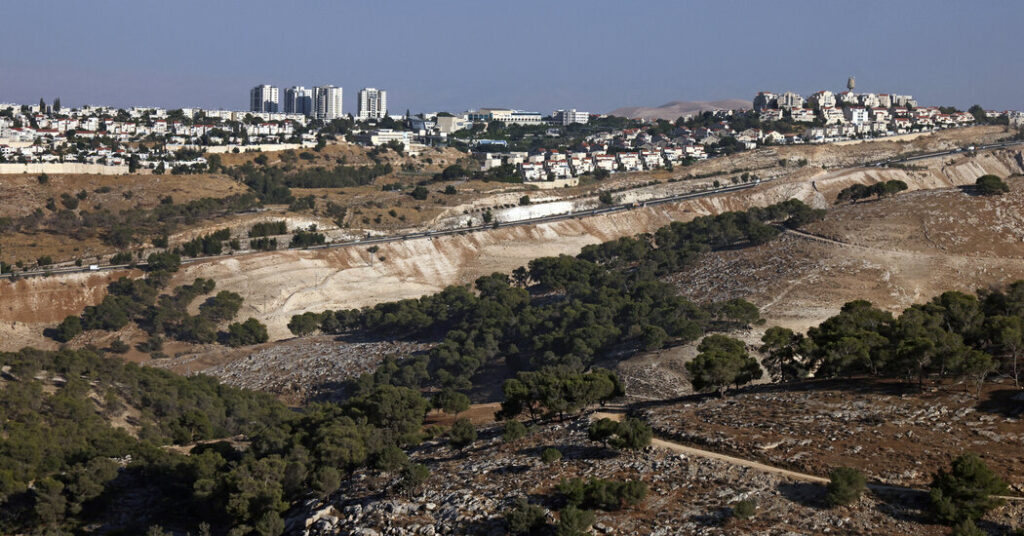
The planned Israeli settlement east of Jerusalem, known as E1, lies on land that Britain and much of the world view as integral to any future Palestinian state. Israel held off on the plans for decades amid international concern that building there would thwart Palestinian statehood, before granting final approval last year.
British officials left the Aug. 11 call believing Mr. Saar had strongly indicated that Israel would not open bids for construction on E1 before the high-stakes Israeli elections in October, according to three officials familiar with the conversation. The officials spoke on condition of anonymity because they were not authorized to speak publicly.
The Israeli foreign ministry rejected that characterization of the call.
A week later, the Israeli government posted tenders for some 1,200 new housing units in E1 — allowing construction companies to bid on the new settlement. British officials saw that as a reversal of what they understood Mr. Saar to have said, according to the officials.
The Israeli foreign ministry said in a statement that Mr. Saar had told “his counterparts” only that there would be “no change on the ground itself in E1” before the elections. The ministry said that the tenders were “nothing new,” given that the E1 plan had been greenlit more than a year ago.
Mr. Miliband’s office declined to the comment on the details of the call. In a statement, the British foreign office reiterated its position that settlement expansion puts “progress towards the two-state solution at significant risk.”
The new tenders were far from the sole factor driving the sanctions. Mr. Miliband had taken office in July in the cabinet of the new prime minister, Andy Burnham, and almost immediately began work on a new policy toward Israel, including possible measures on the settlements. Before entering Downing Street, Mr. Burnham had vowed a major shift on Israel, in a break with the policies of his predecessor Keir Starmer, which many voters in their Labour party had decried as too feeble.
Israel’s decision to push ahead with the sensitive project showed how diplomacy between the two countries had broken down. And it helped galvanize international support for economic sanctions on the settlements, including from Canada, France and nine other nations.
On Sept. 8, Mr. Miliband gave a sweeping address in Parliament in which he accused Israeli settlers of ethnic cleansing; announced a trade ban on Israeli settlements; declared Israel’s occupation of Palestinian territories fundamentally illegal; and said Britain would refuse to export any weapons that would materially support the occupation.
Mr. Miliband cited the E1 settlement as one of the motivating factors, calling it “a longstanding red line for the international community, which is why we saw such an outpouring from our allies.”
About 500,000 Israeli settlers live in the occupied West Bank in communities considered illegal under international law by most countries. Three million Palestinians in the territory live under Israeli military law, in a two-tier system that critics liken to apartheid, although Israel disputes this.
Mr. Saar condemned Britain’s actions in a speech, arguing that Israelis had a right to live in the West Bank. “We did not return to our land after 2,000 years only to lose it under pressure from jihadists, Islamists, antisemites, far-leftists and wokes,” he said. “Not only will you fail to harm us, you will harm yourselves and your own influence.”
Yair Lapid, the centrist leader of the Israeli parliamentary opposition, also criticized the decision, which he argued would “strengthen extremist voices in Israel” right before the national elections.
“It’s clear to everyone that this is a decision motivated by domestic politics,” said Mr. Lapid, adding that Mr. Miliband’s government was using a “cynical attack on Israel to satisfy disillusioned voters.”
After Mr. Miliband’s announcement, Mr. Saar told reporters that Israel would retaliate by shuttering the British consulate in East Jerusalem and removing several British diplomats who work on Palestinian affairs, among other measures.
Britain’s ties with Israel have deteriorated significantly over the past three years. The country expressed its full solidarity with Israel after Hamas-led militants attacked on Oct. 7, 2023, killing some 1,200 people and taking 251 hostages. Britain sent two ships, spy planes and 100 marines to the Middle East to support Israel, and in April 2024 Britain helped Israel defend itself against a large Iranian drone and missile attack.
But as Israel responded with an unrelenting war against Hamas that killed tens of thousands of Palestinians in Gaza and caused an acute humanitarian crisis, Mr. Starmer came under mounting pressure from his own party to act.
After the International Criminal Court issued an arrest warrant for Prime Minister Benjamin Netanyahu in November 2024 over Israel’s conduct of the war in Gaza, Downing Street signaled that the British authorities could arrest him if he entered Britain. The government also suspended some weapon sales to Israel over concerns they could be used in Gaza.
In June 2025, Britain issued sanctions on two far-right Israeli ministers, Bezalel Smotrich and Itamar Ben-Gvir, and in September of that year recognized Palestinian statehood in a coordinated move with Canada and Australia.
Nonetheless, critics in Britain condemned many of those moves as fundamentally symbolic.
Emily Thornberry, a senior Labour lawmaker, hailed her party’s new direction, saying she had been “pushing for a couple of years to do this,” but had been greeted with “foggy thinking” and objections during the previous government.
“Instead of thinking, ‘It’s all a bit hard’ and wringing our hands and standing on the sidelines and saying ‘Isn’t it terrible,’” said Ms. Thornberry, “we actually have, with the new prime minister and foreign secretary, leadership which decides: We are going to do something about this.”
Much of that policy has been driven by Mr. Miliband, a descendant of Jewish Holocaust survivors, who invoked his own family history and personal ties to Israel in his speech to Parliament. Mr. Miliband’s mother, who died this year at age 91, was a signatory of Jews for Justice for Palestinians, a pro-Palestinian advocacy group.
Mr. Miliband belongs to a liberal segment of Britain’s Jewish community that is firmly committed to the existence of the state of Israel as a Jewish state. Its members distinguish between Israel and West Bank settlements, which they argue threaten Israel’s democracy by entrenching Israeli rule over millions of Palestinians without civil and political rights.
As the sanctions were being drawn up in August, some Jewish leaders in Britain, including Rabbi Ephraim Mirvis, the spiritual leader of many of Britain’s Orthodox Jews, met with Mr. Miliband to voice their opposition. Some argued the policies would galvanize support for Israeli hard-liners ahead of the October elections.
“Our theory is that this will embolden the extremists within Israel, and that would be a terrible outcome for Israel and a terrible outcome for Britain,” Michael Wegier, a senior member of the Board of Deputies of British Jews, told the BBC after the announcement.
Mr. Miliband and his colleagues decided to move forward. In a podcast interview this week, Mr. Miliband said that Britain’s decision would probably have relatively little influence on the elections, and he argued that critics would always say that the time was not right to pressure Israel.
The clash helps explain how relations between two longtime allies, already under strain, have now reached one of their lowest points in decades. It also points to the incendiary nature of the E1 project, which Mr. Netanyahu’s government has pursued as it has expanded settlements at a breakneck pace.
Israeli construction in the area would further divide the northern half of the West Bank from the southern half, making it harder to establish a contiguous Palestinian heartland. The project would link Jerusalem with Maale Adumim, a large Israeli settlement to the east.
Mr. Smotrich, the Israeli finance minister and a settler leader, has been explicit about his hopes for E1, saying he believes that it “buries the idea of a Palestinian state.”
While the upcoming Israeli elections could usher in a new political coalition led by Mr. Netanyahu’s opponents, even they would probably struggle to roll back what the government has done. The coalition would most likely be fragile and rely on the support of some settlers and their advocates.
“If it’s not stopped now, I don’t know if the next government will stop it,” said Hagit Ofran, an expert at Peace Now, an Israeli settlement monitor.
In its statement, the Israeli foreign ministry noted that the E1 plan was originally approved a year ago, and said the announcement in August was therefore “nothing new.”
But experts argue that each step in the process makes it harder to reverse. And they note that the bidding to build the 1,200-odd housing units closes on Oct. 19, nine days before the election. This month, the Israeli government said that it would open bidding on Oct. 25 for about 2,100 more units in the area.
The post Inside the Breakdown of U.K.-Israel Relations Over West Bank Settlements appeared first on New York Times.