Psychiatrist Tracy Foose was initially flattered when people started responding to her social media videos — in which she’s speaking directly to the camera — with a strange claim: that she was an AI influencer or a computer-generated persona acting as a human.
“I thought, ‘Wow, I didn’t even use a filter. It’s just light reflecting off of snow that makes me look this glowy,’” she said. But when Foose began to research whether it was possible to create videos like hers using AI, she was stunned to find multiple companies that offer to fabricate AI body doubles. She realized that someone could make a video that so completely co-opted her likeness — her voice, her face — that even she could think it was her. Flattery faded into a form of existential terror.
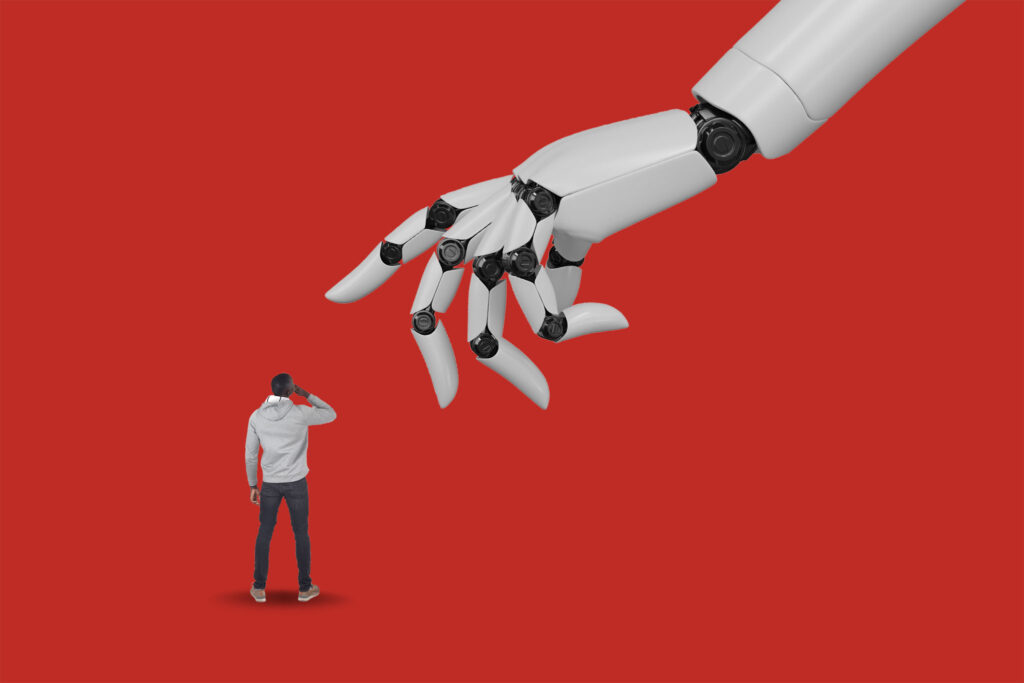
Foose, a therapist in the Bay Area, had experienced firsthand what many of her clients had been reporting: AI anxiety. This phenomenon, which researchers define as feelings of apprehension or fear tied to the accelerated development of AI technologies, is on the rise.
In a 2026 Pew Research Center poll of more than 3,400 U.S. adults, 52 percent of respondents said they were more concerned than excited about the increased use of AI in daily life, as compared with just 37 percent in 2021.
“With wider exposure and adoption comes more of an understanding of what this technology is capable of, which can be very exciting as a tool for many of us, and it can also be incredibly daunting when you think about some of the possible long-term impacts,” said Sha Sajadieh, who leads the AI Index at the Stanford Institute for Human-Centered Artificial Intelligence.
A 2025 Pew Research Center report suggests a similar dichotomy: While about 75 percent of Americans are willing to let AI help with day-to-day tasks, more than half rate the societal risks of AI as high.
Just last week, a post on X from a researcher at Anthropic, the maker of Claude, citing a greater than 10 percent risk that “AI could kill all humans” went viral, reigniting the topic of AI anxiety in a whole new way. Below, therapists explain what’s driving our uneasiness about AI and offer tips for keeping the feeling at bay.
Why people are feeling AI anxiety
Fears of a future superintelligence taking over the world have typically been the domain of AI insiders, not so much the general public, Sajadieh said. That might shift now, as AI researchers get louder about these concerns. But many AI anxieties aren’t so existential, Sajadieh said, they’re more “real in the here and now.”
To start, there’s the fear of AI taking over your job, which poses the risk of losing not only your livelihood but also your purpose, said Vaile Wright, a licensed psychologist and senior director for health care innovation at the American Psychological Association. “Often your identity is wrapped up in the amount of investment you’ve put into” your career.
Witnessing AI do innately human tasks — like creating ideas and problem-solving — can also undermine your self-worth more broadly. “There is this part of us that wants to defend human creativity and intelligence and say, ‘I’m so much better,’ but one-on-one, facing the machine, it may not always feel this way,” Foose said.
The rise of AI-generated content also makes us unable to trust that what we’re seeing or hearing is real, said Thea Gallagher, a licensed clinical psychologist and clinical associate professor of psychiatry at the NYU Grossman School of Medicine.
In the 2025 Pew survey, 53 percent of Americans said they were not too confident or not at all confident that they could detect if something was made by AI versus a person. Not knowing what is real or artificial can be disorienting, Gallagher said, and raises fears of being scammed or targeted by a deepfake.
The sheer pace at which AI is infiltrating so many aspects of society — advertising, hiring, health care — can also provoke anxiety, particularly given how little we understand it.
“For most of us, we don’t actually know how it works. Even developers sometimes don’t know,” Wright said. “Being struck with so much uncertainty reminds us of how little we can control.”
It doesn’t help that AI development is outpacing regulation, leaving many skeptical of the government’s ability to rein in this technology and sparking anxiety about misuse of AI by bad actors.
How to manage AI anxiety
While anxiety can be uncomfortable, know that it’s also an informative response in moments of change. “It tells us that there’s a possible threat that needs to be addressed,” Foose said.
While you can’t convince developers to slow down or stop innovation, there is plenty that is within your control with regard to how AI makes you feel, Wright said, and focusing your attention there can make a big difference.
Inform yourself about AI and its role in your world
Wright pointed to boosting your AI literacy as an important first step in mitigating anxiety. Learning more can help AI feel like less of a looming monster and more of a usable tool.
This might look like experimenting with the free versions of tools like Open AI’s ChatGPT or Anthropic’s Claude, or taking free literacy courses — both companies have offerings. (The Washington Post has a content partnership with OpenAI.)
Then, dig into how AI is operating in your life. Ask your boss about how your company is currently using or will use AI, Wright said. If you fear your job is in jeopardy, reflect on the unique value that you bring to your work and learn about the roles at your workplace in which human intelligence will continue to be prioritized.
If you’re a parent, ask your kid’s teachers or school principal about how exactly AI is being used at school and what measures are in place to promote academic integrity and critical thinking.
Spend time intentionally connecting to your five senses
Remember that, contrary to AI, “you’re a living, breathing thing in a physical world,” Foose said. Tending to your core needs — moving your body, nourishing yourself, spending time in fresh air — can help you return to that reality, feel better and detach a bit from spiraling fears.
Similarly, Gallagher noted the importance of “returning to nature, being out in the world,” and reacquainting yourself with things you can “see, taste, touch and feel.” This does not have to mean a days-long hike in the wilderness. “It can just be a walk down a city street with all the noise of the taxis,” Foose said. Reconnecting with your senses and tending to your physical needs might seem simplistic or fluffy, she admitted, but it can be incredibly grounding, anchoring your mind in the safety of the present moment.
Embrace in-real-life social connection
“Our tendency to feel like we don’t want to burden others is actually a hindrance to us when, in reality, we really need to be seeking out social support,” Wright said.
Humans are naturally social creatures, which means that real connection, “where we can touch, see, smell one another, as funky as that might sound,” can be restorative, Foose said. You can certainly talk to your friends or loved ones about AI and the anxiety it’s triggering, but you also don’t have to. Connecting for any reason can be a reminder that there’s more out here than algorithms and computer models, Wright said.
If you’re struggling to fit social connection into your hectic schedule, create rituals around meetups such as attending a weekly workout class together or setting a biweekly phone date. And if your social circle has shrunk, as they often do over time, consider reaching back out to old friends — you may be surprised how glad they are to hear from you — or join a local art class, run club or volunteer group to find a new one.
Lean into your human talents and skills
It’s easy to feel useless in the face of AI — so remind yourself of your many capabilities. “I’ve been encouraging my patients to create, make, do,” Gallagher said. “That’s one thing that AI cannot take from you.”
If you’re not naturally artistic or handy? Consider problems you might solve in your physical space, Foose said: “For example, cleaning out the Tupperware drawer, organizing the garage or other little things like that to bring order to your environment.” A purposeful activity that you can do on a day-to-day basis can restore your sense of agency, she explained.
And if you start to feel demoralized by AI’s capabilities, take a minute to consider the unique powers of the brain. “It does quadrillions of calculations a minute, and it does not rely on a power plant to do so. We can take it out into nature. We can take it underwater. We can connect it to other brains by simply using language,” Foose said. “AI is just learning how to do that.”
The post AI anxiety is real. Here’s how to deal with it, according to therapists. appeared first on Washington Post.