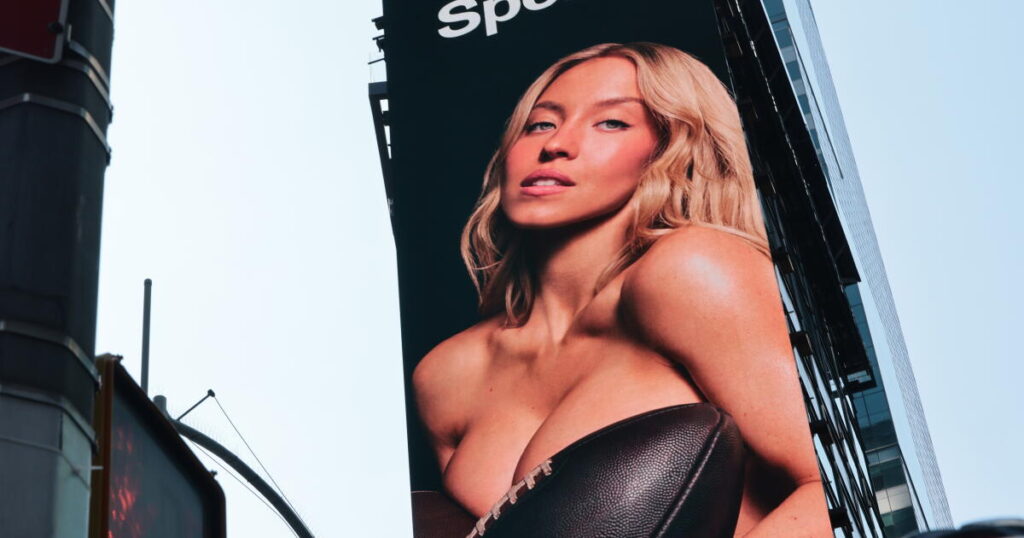
We seem to be missing the point of Novig’s latest campaign featuring Sydney Sweeney pushing the sports betting app while posing nude atop a basketball hoop.
As a marketing executive who’s run campaigns for some of the biggest brands on the planet, I’m confident this strategy is using an age-old playbook very well: The brand knows who it’s actually targeting — it’s not men — and is meeting a cultural moment.
Like it or not — and to be clear, I hate that any part of me likes what Novig is doing — this campaign has been a runaway success. I realized that a couple of days ago when it had entered one of my most sacred spaces in a text thread with five other feminist journalists in my women’s writing group, none of whom are big fans of sports or Sweeney.
A basic rule of advertising: You don’t just want people to see the ad, you want them to talk about it. And it seems Novig knew that getting women talking would be a better bet than offering free parlays to men already signed up for FanDuel and DraftKings.
The sports betting market is perhaps not as male as one might think: According to the American Gaming Assn., women now comprise 26% of the U.S. market, and many predict those numbers will continue to grow. Instead of targeting the 74% male majority, Novig triggered female-led cultural commentary, leveraging debate and outrage to achieve viral reach within the fastest-growing sports betting demographic.
At its most basic level, that is very smart marketing.
The conversation additionally has been buzzing for days among prominent women in sports. When backlash hit, Sweeney defended the campaign by sharing screenshots of women athletes who once graced ESPN The Magazine’s “Body Issue,” implying that her photos were no different than stars like Serena Williams or Ronda Rousey posing bare-skinned.
In response, athletes including boxer Skye Nicolson and track star Amy Hunt immediately pointed out that looking powerful because of your athletic frame and craft is not the same as using nudity as clickbait to launch a betting product. Former UCLA gymnast Gracie Kramer posted a video of her routineson social media with the caption, “idk what Sydney Sweeney was doing, but this is what a woman in sports looks like.”
Twenty years ago, as I started my career, I learned that conversation was the ultimate currency. We used words like “breakthrough” and “virality” to measure attention in a fragmented media economy. In a boardroom presenting marketing ideas for the new Axe Bodyspray campaign, our agency planned to tell consumers they would “get the girl” using images of scantily clad women eagerly draping themselves over guys doused in aerosol (which incidentally smelled like a blend of patchouli and pit odor).
The early 2000s were a different time, surely, and as we’ve progressed as a culture more inclusive to women since #MeToo, I am confident those Novig ads would have been dismissed had they hit the airwaves in, let’s say, 2022.
But the second part of Novig’s playbook worked because they met the moment.
Today, Sweeney’s skin-forward video is working because we don’t know which side owns sex appeal. And because we don’t, the ad is fodder for more conversation. The political left is caught in a paradox, torn between the sex-positive agency of women and calling out corporate exploitation of the male gaze. Meanwhile, the right has weaponized classic, unabashed glamour as an anti-woke middle finger to modern feminist aesthetics.
Novig’s campaign brilliantly exploits this fault line, using sex to monetize political tribalism.
Sweeney’s involvement is further nuanced as she’s an equity partner in Novig, making it even more complicated to evaluate whether she’s being exploited by the male gaze or monetizing it. But getting a cut of the profits doesn’t negate the cultural regression of the tactic. When women’s empowerment gets reduced to “but at least I got a big slice of the pie,” we sanitize the fact that the underlying product is still women selling women’s bodies back to us as clickbait.
Shortly after my time working with Axe, I was assigned a media buying role on the Dove “Campaign for Real Beauty” — a groundbreaking moment that proved brands could empower women, reject hyper-sexualization and still drive massive equity and revenue by featuring real women’s bodies in white bras and panties on billboards hanging over the expressway.
Over the course of my career, I moved on to lead marketing in regulated industries such as alcoholic beverages and cannabis. These sectors were once notorious for using women as decorative props to sell sex, beer and rock and roll in boardrooms that felt like fraternity houses.
But even these industries have evolved toward inclusion with strong women in key roles. In 2018, Constellation Brands, which distributes beer brands including Corona and Modelo, announced a $100-million fund to invest in women-founded businesses over the next decade. In 2014, General Motors hired Mary Barra, their first woman chief executive who aggressively shifted its marketing to highlight women as engineers, as well as electric vehicle innovation and safety, while committing $50 million to support diverse and women-owned media businesses.
Bro culture began to dissolve, replaced by strong women in leadership who understood that tactful craft and community built far more sustainable brand value than a scantily clad model splayed across a billboard. It was as though, over the course of a quarter-century, we were able to come oh so far in tasteful representation.
Whatever way I analyze it, as I look at Sweeney posing with football gear barely covering her nipples, it feels as though I’m right back in a boardroom 20 years ago flipping through a copy of Maxim. Even at age 23, as I was convincing my clients that our strategy would work, I remember hoping that the times I was living in — when the ridiculousness of a closing line like a girlfriend asking her boyfriend “do you want some money for a lap dance?” — would pass.
Of course, here I am talking about it. As a marketer, I give credit to the strategy. But as a woman who spent two decades fighting to move the industry past a sexist era, it’s depressing to watch the door we worked so hard to open get kicked shut by the very gender it was meant to liberate.
The only way the times will change is if we stop taking the bait. Until then, I’ve fallen prey to the exact trap I spent my whole career trying to dismantle.
Andrea Javor is a Chicago-based freelance writer and marketing executive working on her memoir about poker and love.
The post Sydney Sweeney isn’t bringing back sexist advertising — women are appeared first on Los Angeles Times.