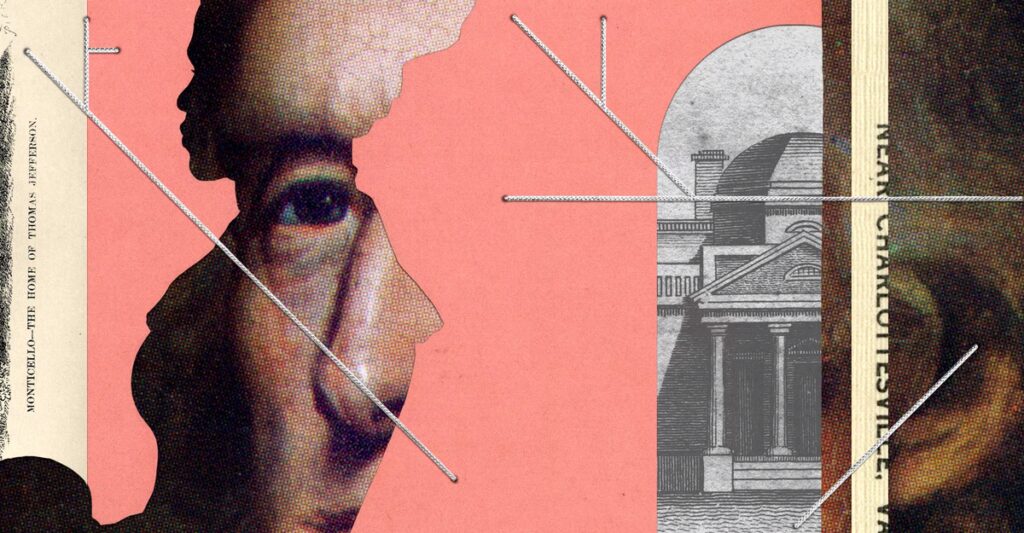
Three hours after Thomas Jefferson died at his Monticello home on July 4, 1826, his personal secretary, Nicholas Trist, snipped a lock of the Founder’s gray hair, still faintly reddish blond. Trist then tied the hair with orange thread and placed it in a paper packet, along with a short note describing what he’d done.
In an era before photography or modern embalming, hair was an easily preserved reminder of a beloved friend or relative who’d died. Trist did not know that he was also securing physical evidence that, two centuries later, would help resolve one of the nation’s oldest and most contentious historical debates: whether the author of the Declaration of Independence, the nation’s third president, had children with Sally Hemings, a woman he enslaved for half a century and never freed.
After a covert and exhaustive 15-year effort led by the Smithsonian Institution, a team of geneticists, genealogists, historians, and anthropologists believe it has found proof that Jefferson fathered at least two of Hemings’s six children. On Tuesday, Richard Kurin, a Smithsonian cultural anthropologist, who led the multidisciplinary research effort, will publish a book detailing the team’s findings. A scientific paper is currently under review for publication in Proceedings of the National Academy of Sciences (PNAS). The researchers, who agreed to speak with me about their results before publication, relied on the latest genetic techniques to reassemble Jefferson’s genome from the Founder’s hair. They then matched that sequence with DNA from descendants of two of Hemings’s sons, Madison and Eston. (Of her other four children, two died in infancy, and the other two didn’t have any known offspring.) Not only did the researchers find that Madison’s and Eston’s descendants share Jefferson’s DNA; many of them had more of it than do his known descendants by way of his wife, Martha Wayles.
[Read: When slavery is erased from plantations]
For many Americans, the matter was already laid to rest years ago. In 1998, the scientific journal Nature published a two-page peer-reviewed paper titled “Jefferson Fathered Slave’s Last Child.” Newspaper stories declared the case solved, and Oprah Winfrey staged a tearful family reunion of Jefferson’s descendants. Most historians came to accept the finding when it was combined with other evidence from the era.
But a vocal minority has continued to doubt that the two had a sexual relationship. Some have pointed out, correctly, that the limited biological data used in the Nature study did not definitively prove that Jefferson was the father of Hemings’s children—only that he was one of several candidates in the Jefferson male line. These doubters also disparage as unreliable or wishful thinking the oral histories passed down by Hemings’s descendants who have placed Jefferson in their family tree.
Some detractors saw a more nefarious agenda. One researcher called the 1998 study “a deliberate attempt to select and mold the evidence to fit a pre-selected theory.” Other critics, many of them white Virginians, joined in the defense of the Founder. “Jefferson’s personal reputation has been all but assassinated,” wrote William G. Hyland Jr., a lawyer and author. “The face on Mount Rushmore has been vilified as a slave-owning hypocrite, misogynist, and racist.”
Though the new results might convince some holdouts, the backlash has already arrived, and more will likely follow. The Heritage Foundation has previously criticized Monticello’s depiction of Jefferson in part for failing to tell visitors “that historians disagree about Jefferson’s relationship with Sally Hemings.” The Thomas Jefferson Heritage Society, a nonprofit formed in response to the Nature report, still accuses “historical revisionists” of inaccurately portraying Jefferson as a “liar, fraud, hypocrite, and child molesting slave rapist.” The Trump administration has made clear that it wants to present a version of American history that doesn’t disparage the Founders. In a report released on the Fourth of July, the White House condemned what it asserted is “extreme political activism” guiding the 180-year-old Smithsonian, which President Trump has said is too focused on “how bad Slavery was.”
For Clara Nutt, though, the results are simply confirmation of a long-known fact. Her African American father told his freckled daughter at an early age that she was a direct descendant of Jefferson through Madison Hemings. Nutt provided the researchers with saliva samples that found 5.1 percent of Jefferson’s genetic makeup in her DNA—nearly twice the amount expected by genetic averaging. She was delighted but not surprised to have scientific proof. “I have always known who I am,” Nutt told me.
That the very person who made famous the phrase “All men are created equal” repeatedly impregnated a woman he held in lifetime bondage first surfaced in a Richmond newspaper in 1802. The writer, a Scottish-born journalist named James Callender, had once been a Jefferson champion, and had received financial support from him. But when Jefferson won the 1800 election, he denied a government job to the volatile Callender, who had been jailed during John Adams’s administration for sedition. Ally turned enemy. “By this wench Sally, our president has had several children,” Callender wrote in The Recorder. “The AFRICAN VENUS is said to officiate, as housekeeper at Monticello.”
The Hemings-Jefferson matter became one of the nation’s first major political scandals—and one of its most enduring. “This engaged six of the seven first presidents,” Richard Kurin told me. “You could call it the longest-running American soap opera”—one, he notes, that involves the issues of race, inequality, and liberty.
Jefferson, after all, declared in 1814 that “amalgamation with the other color produces a degradation to which no lover of his country, no lover of excellence in the human character can innocently consent.” By that date, his youngest child with Hemings, Eston, was 6 years old. Jefferson’s granddaughter Ellen Randolph Coolidge, in an 1858 letter to her husband, referred to the possibility of a relationship with Hemings as that which “will not bear telling. There are such things, after all, as moral impossibilities.” The Founder went to his grave without publicly acknowledging the relationship or any children he’d had with Hemings.
A 1974 book by the historian Fawn Brodie reignited the debate with fresh historical evidence of Jefferson’s long-term liaison with Hemings, but Brodie’s assertions gained little traction among scholars and intellectuals. If the Hemings story was true, one skeptical historian wrote in 1977, then Jefferson “deserves to be regarded as one of the most profligate liars and consummate hypocrites ever to occupy the presidency.” Gore Vidal summarized the prevailing sentiment in an interview: “No gentleman would have gone to bed with a slave. Since Thomas Jefferson was the greatest gentleman of his period, he could not have done so either. That takes care of that.”
Two decades later, the Harvard law professor Annette Gordon-Reed sharply criticized the academic community for spending “generations either ignoring or explaining away” the nearly four-decade relationship and accepting white narratives denying the tie while dismissing those left by Black families that asserted otherwise.
The 1998 Nature report brought the new tools of genetics to bear on the dispute. The authors based their biological data on the Y chromosome, passed down by Jefferson’s male descendants. But some researchers accused the authors of misleading the public, and the authors were forced to acknowledge that Jefferson could “neither be definitively excluded nor solely implicated” by their data. Other candidates included his younger brother, Randolph, a frequent visitor to Monticello. One enslaved informant had called Randolph “a mighty simple man” who “used to come out among black people, play the fiddle & dance half the night.”
A month after the Nature study’s publication, the Thomas Jefferson Foundation, which owns and operates Monticello, convened a group of scholars to examine the genetic and historical data. A 2000 statistical analysis by a Monticello archaeologist strengthened the case made in Nature by examining the timing of when Jefferson was present at Monticello and when Hemings’s children were conceived. A majority of the foundation’s panel found “a high probability” that at least one of Hemings’s children had been fathered by Jefferson, and likely all six. A minority, however, rejected the conclusions, calling the research a cynical campaign by academics and the media “to denigrate and destroy the legacy of one of the greatest of our founding fathers and one of the greatest of all our citizens.”
Critics united to form the Thomas Jefferson Heritage Society, which undertook a second independent review of the findings in the Nature study, and declared the Thomas Jefferson Foundation’s report “the product of shallow and shoddy scholarship” that had ignored exculpatory evidence “in order to achieve an apparently desired conclusion.” John Works, a Jefferson descendant and founding member of the society, wrote that defending the author of the Declaration “has come to mean defending what America means, and we feel compelled to rise to that defense.” The report that the society’s panel of scholars released in 2001 found the Nature results “almost certainly false,” and insisted that “Sally Hemings appears to have been a very minor figure in Thomas Jefferson’s life.”
The controversy spawned books with subtitles such as An American Travesty, and Fallacies, Omissions, and Contradictions in the Hemings Genealogical Search, which expanded on critiques of the genetic study and the historical data. “Jefferson is completely innocent of this sordid charge,” William Hyland maintained in his book In Defense of Thomas Jefferson, citing “an obsessive agenda on the color of Sally’s skin, and slave status.” Another doubter, David N. Mayer, a law and history professor in Ohio, fingered “‘political correctness,’ radical multiculturalism, and postmodernism.”
Hemings was born in 1773 as the youngest child of the enslaved Elizabeth Hemings, described by one enslaved man at Monticello as “a bright mulatto woman.” Sally, he recalled, was “mighty near white” and “very handsome; long straight hair down her back.” One of Jefferson’s grandsons described her as “light colored and decidedly good looking.” Both enslaved and free contemporaries reported that her father was John Wayles, the father of Jefferson’s wife, Martha. If true, then Hemings was Martha’s half sister.
On her deathbed in 1782, Martha is said to have made her husband promise not to remarry. Five years later, he was in Paris serving as the minister plenipotentiary when his daughter Maria arrived, accompanied by the 14-year-old Hemings. Madison Hemings later claimed that Jefferson and his mother began a sexual relationship while in France, where she was legally free, and that she agreed to return to the United States on the condition that any future children would be freed at age 21.
In an interview with a journalist, Madison stated that his mother was pregnant by Jefferson on their return to the United States in 1789, though it is unclear whether any child from that time survived. Hemings went on to serve in the main house of Monticello while her owner joined George Washington’s Cabinet as the nation’s first secretary of state, and then became president from 1801 to 1809. As he did with all of his human property, Jefferson recorded the birth of Hemings’s six children, including a son, Beverly, in 1798; a daughter, Harriet, in 1801; a son, Madison, in 1805; and another son, Eston, in 1808. Two other daughters, one born in 1797 and another in 1799, died in infancy. The three sons trained as carpenters, and Harriet spun and wove cloth.
Both Beverly and Harriet fled Monticello in 1822. Jefferson, who often posted rewards or hired slave catchers to return those who escaped, did not attempt to recover either. By Madison Hemings’s account, Beverly went to Washington, D.C., passed as white, and married a white woman. Monticello’s former chief overseer later claimed that Jefferson had arranged for Harriet’s departure, giving her spending money and stage-coach fare to Philadelphia. She “married a white man in good standing” in the capital, Madison recalled in his later years.
In Jefferson’s will, made out months before his 1826 death, he granted Madison and Eston Hemings their freedom once they reached 21, and gave both men “my last, solemn, and dutiful thanks.” He also asked the Virginia government—which required those emancipated to leave the state—to allow the Hemings brothers to remain “where their families and connections are.” Sally Hemings was never officially freed, although Jefferson’s daughter Martha later let Sally live with the freed Madison and Eston in Charlottesville until her death, in 1835. Her burial location, like that of so many enslaved African Americans, is unknown.
Both Madison and Eston later moved to Ohio. Eston died in 1856 in Wisconsin. His two sons fought for the Union in the Civil War, and the family obscured its African American heritage. “We identified as white,” Arthur Westerinen, Eston’s fifth-generation descendant, told me. Westerinen’s mother, Julia, learned of the connection when she stumbled on it while doing a college ancestry project.
Madison’s branch, however, retained its African American identity and passed down the story of Jefferson’s paternity. When a teenage Clara Nutt visited Monticello on a school trip in the early 1970s, she was eager to see the home of her famous ancestors. “I got off the bus with my head held high,” she recalled. Shown Jefferson’s bedroom, she asked a docent where Sally Hemings had slept. “That woman never stepped foot in this house,” the docent snapped. Nutt was devastated. “With every breath,” she said, “I silently sobbed.”
In his new book, the Smithsonian’s Kurin tells the story of how he and his fellow researchers tracked down Jefferson’s DNA. In October 2011, Kurin was reviewing a film to accompany a Smithsonian exhibit displaying what is known as The Jefferson Bible. After retiring to Monticello, Jefferson compiled the volume by painstakingly cutting and pasting sections of the New Testament that were focused on morality and stripped of what he called the “artificial vestments” of miracles and superstitions. The film included a segment featuring a reenactor working with a sharp penknife under candlelight. Kurin, then the Smithsonian’s secretary for history, art, and culture, mused to himself that if he had taken on such a delicate task, he would have repeatedly cut himself. That idle thought prompted him to contact a curator who had worked on the bible’s conservation to see if he had encountered any blood splotches that might contain Jefferson’s DNA.
The curator told Kurin that he had found no blood but had encountered a couple of hairs. One was pasted down on page 73 and was light red, like Jefferson’s hair. At the time, extracting DNA from old hair was cutting-edge science; light and humidity can quickly degrade genetic material. Only in the previous year had a Danish team succeeded in sequencing an ancient genome using a clump of 4,000-year-old human hair that had been well preserved in the ice of Greenland.
With approval from Smithsonian leaders, Kurin launched an investigation to reconstruct Jefferson’s genome using the hair found in the bible, while also gathering saliva samples from dozens of living individuals who were known or suspected descendants. By comparing the first with the second, he hoped to produce unequivocal evidence of the paternity of Hemings’s children.
From the start, the ambitious effort was kept secret from the public. “We didn’t want people to assume results until we were really, really sure,” Kurin told me. A colleague of his reached out to a couple in the genetics field, the molecular biologist Beth Shapiro and her husband, Richard Green, a computational expert who had made a name sequencing the Neanderthal genome. They were starting a paleogenomics lab at UC Santa Cruz. “We knew the technology was getting better,” Shapiro told me. “And this looked cool, interesting, and fun.”
Years into the project, Shapiro and Green’s lab determined that the bible hairs had not, in fact, belonged to Jefferson. A reliquary at the Smithsonian’s National Museum of American History, purporting to contain hair from the first 14 presidents, also proved a dead end. “I thought that was it,” Shapiro said. Kurin, however, had already begun to scour other collections. Monticello’s storage areas yielded several samples of Jefferson’s hair encased in gold lockets, glass ampules, and the packet assembled by Nicholas Trist. Kurin also found additional corroboration of the latter’s validity: In 1899, Trist’s daughter had mailed the packet to her cousin, writing that the hair was “in the same paper in which they were placed on that day nearly 74 years ago,” and which “I know to be authentic.”
With the permission of the Thomas Jefferson Foundation, the geneticists examined the hair strands and found viable DNA. “We’ll exhaust it and sequence the crap out of it,” Shapiro assured Kurin in 2017. Lab workers gradually assembled a library of Jefferson’s genome. “We went from a long-shot fishing expedition to a slam dunk,” Green said. “From then on, it was pretty straightforward. We spend a lot of time getting DNA out of difficult things like hair.” (Many of the lab’s recent projects have centered on identifying victims and suspects in cold cases, including the Gilgo Beach murders.)
Kurin, meanwhile, traveled the country to meet with known and possible Hemings-Jefferson descendants, including Julia Westerinen and Nutt. He explained his mission, gained consent, collected saliva samples, and secured promises that they would keep the matter private. This second library of material allowed the geneticists to compare the DNA from descendants of Madison and Eston Hemings with DNA from Jefferson.
The match proved indisputable. On average, a fifth-generation descendant retains 3.125 percent of their ancestor’s genetic material, though the precise amount can vary considerably. Two fifth-generation descendants of Jefferson and Martha Wayles showed 2.6 percent and 2.7 percent of Jefferson’s genetic material. Nutt’s percentage was nearly twice that. Other Madison relations shared significant amounts of the third president’s DNA, as did descendants of Eston. The scientists had found their proof, thanks to Jefferson’s hair. “Once you have a common ancestor,” Green said, “the accuracy is absolutely stunning.”
The research effort has begun to face criticism even before it is publicly released. One descendant of Madison Hemings, Mary Brady-Atkins, provided DNA samples for the study, but criticized Kurin this week in an interview in The Chronicle of Higher Education. Brady-Atkins said she was concerned that Kurin’s book would be published before the scientific paper.
Last month, the 98-year-old Brady-Atkins asked that her saliva samples be destroyed. “It was her right to withdraw from the study,” Kurin told me today. “And yes, we destroyed her DNA, and withdrew data from the study, but the findings are still the same.” He acknowledged that the book would come out before PNAS has accepted the paper, and noted that Brady-Atkins’s request to be removed from the project came after the book was already printed. But Kurin and Green insisted that the study was undergoing appropriate peer review. Green added that a draft of the paper with detailed data will be released on Tuesday, at the same time as the book.
According to the Chronicle, Brady-Atkins supports a competing research effort led by Works, the Jefferson descendant who helped found the Heritage Society; he has long argued that Randolph Jefferson, rather than his brother Thomas, was the father of Hemings’s children. Last year, Works petitioned a county court in Tennessee to exhume the body of Randolph’s son from a Nashville cemetery, with the goal of extracting DNA that Works believes might clear Thomas Jefferson’s name. The city opposes the petition.
Some descendants worry that the new research from Kurin and his colleagues will only infuriate die-hard Jefferson apologists further. “It will be ugly,” Nutt predicted. Unlike during her first Monticello visit, however, she now feels supported. After the Nature paper came out, she attended a reunion of her late father’s family and was drawn into the community of Hemings’s descendants. In 2001, she participated in a White House event hosted by President George W. Bush that brought together Jefferson’s progeny on both sides of the color line. “Whatever comes, I can lean into my family—and my new family,” she said, including the researchers who gathered the hard data confirming her family’s ties.
One likely flash point will be the policies of the Monticello Association, a private organization that oversees the Jefferson-family cemetery at Monticello. The group has long refused to allow Hemings’s descendants to join the association, much less be buried alongside their white relations. “They are invested in this idea of Thomas Jefferson on a pedestal,” Arthur Westerinen said. He told me that he has been in contact with several association members who have pressed for the acceptance of the Hemings branch of the family, though without success. (Lucy Taylor, the association’s president, did not respond to requests for comment.)
[From the June 2021 issue: Black America’s neglected origin stories]
Another “giant question,” Green said, is what becomes of Jefferson’s genome. According to Green, two major National Institutes of Health–funded genetic-data banks recently rejected the team’s request to submit its detailed sequence. This is in part because Jefferson is a known figure; if Jefferson’s genome is made public, then his descendants’ privacy will be at risk. “The descendant community will need to weigh in,” Green said. “My lab worked hard on this, but I don’t want to be the one who decides who gets access.”
At the same time, the data, were they publicly released, could allow individuals to determine their own relation to the third president—and, perhaps, pinpoint descendants of Beverly and Harriet Hemings to see if they, too, were born of the Hemings-Jefferson relationship. By recovering the genome of Jefferson’s wife, Martha, researchers also could confirm whether she is Sally Hemings’s half sister.
More broadly, the UC Santa Cruz team’s success might spark a rush to recover the genomes of other famous people—Beethoven’s, for example, was recently sequenced from locks of his hair. Such an effort would have intriguing but unsettling implications. “You could search to see if Abraham Lincoln’s melancholy was genetic,” Kurin suggested. Green fears that rapid technological advances might lead to a genetic Wild West. “Genes are not necessarily fate; most simply create a predisposition,” he said. He worries that members of the media will fail to convey this complexity, much as the 1998 Nature headline was misleading. He also fears a backlash that might result in unreasonable barriers to research.
When it comes to Jefferson and Hemings, Kurin is confident that the team’s careful work over a decade and a half will convince doubters of the accuracy of their finding. “For me, it had nothing to do with an ideological or political agenda,” he writes in his new book. “I was using evidence, logic, and the available tools and methods to follow a trail.” He also takes Jefferson at his word. “There is not a truth existing which I fear,” the Founder wrote two months before his death, “or would wish unknown to the whole world.”
The post Researchers Say They’ve Found the Truth About Thomas Jefferson appeared first on The Atlantic.