After the battle the heavens above Gettysburg wept, the rain falling hard upon the blood-dappled fields, the bullet-shorn trees, the tens of thousands of dead, dying, maimed. It was the Fourth of July, the foundational anniversary for a nation now at war with itself, and all was mud.
A war correspondent for The New York Times named Samuel Wilkeson Jr. trudged through the violated Pennsylvania landscape on a solitary quest. The weary journalist was searching for one particular Union soldier who was said to have had his leg blown off. His teenage son.
Wilkeson believed the end of slavery could be achieved only through the Union Army’s defeat of the Confederacy, but the human cost of the war he deemed necessary was now strewn before him. The corpses in blue and gray bloating in the July heat. The wounded begging for the mercy of death. And here, in the muck at his feet, the bold lieutenant of Battery G, Fourth U.S. Artillery, his son Bayard.
In that moment the mourning of a father could have eclipsed the duty of a journalist, just as deadline pressure might have kept the raw pain at bay. Instead, grief and duty melded into a singular force, and Sam Wilkeson began to write.
Two days later, The Times published his eyewitness account, regarded now as a singular piece of American reportage: a dispatch entwining the intimate and the universal, laced with an eloquence that may have informed the Gettysburg Address delivered four months later by President Abraham Lincoln.
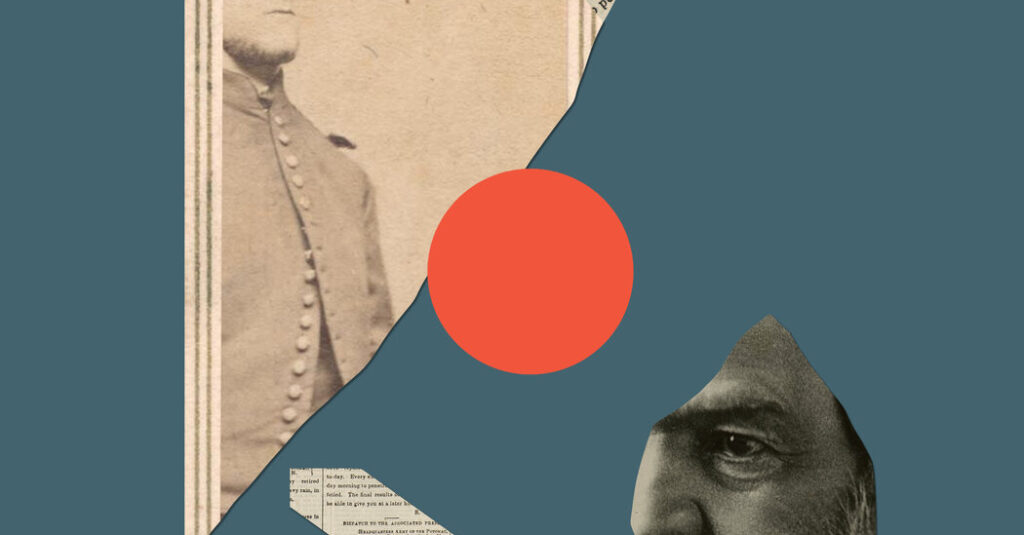
The front page of that New York Times edition, July 6, 1863, is kept in the company archives, safe and preserved. The dimpled impressions left by the typesetting process in the bone-white newsprint lend a tactile urgency to every word, as if Wilkeson were reaching through the folds of time to shake us by the shoulders and share what he had witnessed and felt.
“My pen is heavy,” wrote the journalist and father.
In the raucous pantheon of 19th-century American reporters, Sam Wilkeson stood out. He had a sly facility with words, a mercurial disposition — he had at least one fistfight with a colleague — and a gift for insinuating himself into the inner sanctums of power.
Having connections came naturally to Wilkeson. His father, Samuel the elder, had been a successful merchant and politician who helped to establish the city of Buffalo. His wife, Catherine, was the sister of Elizabeth Cady Stanton, of the women’s rights movement.
After giving up the practice of law to become a newspaperman, Wilkeson rose to become a star reporter for The New York Tribune, founded and edited by the renowned Horace Greeley. His promotion to Washington bureau chief, in 1861, prompted a competing newspaper to describe him as a “fanatical, impertinent, revolutionary fellow who will bear watching.”
When the Civil War broke out that same year, Wilkeson became a must-read, undaunted in questioning government policies, holding generals to account, decrying press censorship — and using his journalistic role in ways that would be unacceptable today.
“He cultivated access to people in power not only to record events, but to try to shape them,” wrote Chuck Raasch in “Imperfect Union,” his 2016 book about the Wilkesons at Gettysburg. “He used that access to inform and contextualize his reporting, but also to protect and reward his sources and punish his enemies.”
Determined to bear witness to the war, Wilkeson left Washington to follow the action, sleeping outdoors and wearing the same clothes for weeks. He scorned the dilettante journalists he encountered along the way.
“No man who in any way talks about his living — alludes to it as a subject which rests on his mind, is fit to follow an army in an enemy’s country,” he wrote. “Reporters must be earnest and devoted.”
The war first scarred the Wilkeson family at the Battle of Seven Pines in the spring of 1862. In the mayhem of that engagement in Virginia, Sam Wilkeson aided the Union Army by rallying the rattled troops and serving as a go-between among the officers. Military officials later commended him for his bravery.
After writing his account of the battle, the journalist tracked down the body of a beloved nephew, a Union soldier killed in the conflict. After that shattering experience, he came down with dysentery, and the required months of rest at his upstate New York home came as a blessing. Throughout his recuperation, Wilkeson’s thoughts must have turned to another young soldier: his oldest son, Bayard. The gangly boy he had once watched plowing the family field with such dedication of purpose was now just as determined to join the fray.
Bayard had presented his well-connected father with a difficult choice. Either watch his son enlist as an Army private or help him secure an appointment as a second lieutenant. For the concerned father and journalist, the latter option seemed less dangerous.
In October 1861, young Wilkeson sent a letter to the Army to accept the commission, his earnestness evident in every handwritten loop and curl. “I am 17 years and six months of age,” he noted.
A series of battles pulled the young man northward through Virginia, drawing him closer to his fate. Fredericksburg, in December 1862. Deserted House, in January 1863. Chancellorsville, in the spring of 1863, where his battery, a tactical artillery unit of six cannons and 10 dozen men, took part in a devastating Union Army defeat.
Bayard Wilkeson, now a first lieutenant, often felt on the periphery of meaningful action. In a letter dated June 22, 1863, he begged his father to call in more favors to get him reassigned.
“I want to have a name at the end of this war,” he wrote.
Nine days later, the Union officer known to his family as Bay sat on a white horse, exposed to the enemy. It was cloudy the afternoon of July 1, and all around him raged the beginning of the war’s bloodiest conflict: the Battle of Gettysburg. He was 19 years old.
Following orders that would later be questioned, Lieutenant Wilkeson had positioned his battery on a knoll overlooking the fields where the Confederate infantry and artillery were bombarding an undermanned Union line of defense. The Union soldiers wheeled into position their Napoleon cannons, capable of shooting 12-pound balls nearly a mile. But the enemy had them as well, and in greater number. Cannonballs rocketed through the air, tearing through field and flesh.
Tall in his saddle to inspire his inexperienced men, Wilkeson moved back and forth, calling out commands and assurances, urging his gunners to shoot straight and true. A little more than a half-mile to the northeast, Confederate soldiers aimed their barrels toward this conspicuous target, who almost seemed to be daring them to fire.
A shell tore through the white horse and mangled the lieutenant’s right leg below the knee, sending wounded man and dead animal tumbling to the ground. He was carried to a spot between two cannons where, remaining composed, he continued to issue commands.
What happened next lingers in that mysterious space between fact and legend. According to a display at the Gettysburg National Military Park Museum, Wilkeson then “tied a tourniquet with his sash and used a penknife to amputate what remained of his shattered leg.” But family letters and military reports do not refer to a self-amputation occurring in a harrowing scene in no need of embellishment.
The one-legged lieutenant maintained a cheerfulness perhaps rooted in shock. Cradled in a blanket, he was carried a quarter-mile to a building on the grounds of the county almshouse, where the poor, disabled and mentally unwell were given shelter. He was placed beside other wounded soldiers on a damp basement floor, in the cool of imminent death.
Hour by hour, he lost blood and strength as the Union forces, including its surgeons, retreated south through Gettysburg town. Two women, their identities lost to time other than that one was Black and the other Irish, tended as best they could to his needs.
The Irishwoman would recall how beautiful the wounded officer looked as she wiped blood from his face, while the Black woman would say she could tell that he was a gentleman. They would both remember hearing the faltering young man call for his mother and father.
Sam Wilkeson did not arrive in Gettysburg until late that night or early the morning of Thursday, July 2. He was greeted with the news that his son had lost a leg in battle and was out there somewhere in the summer darkness, wounded and unlikely to be under medical care. Possibly a Confederate prisoner. Possibly dead.
But the elder Wilkeson had a job. He was now covering the war for The Times and an editor he admired, Henry Raymond, who had co-founded the newspaper in 1851. Wilkeson was following the Union general George Meade, commander of the Army of the Potomac, who had set up headquarters at a farmhouse just two miles south of where his suffering son lay.
The shedding of blood continued through Thursday, as Gen. Robert E. Lee failed to capitalize on the Confederacy’s first-day success. In once-obscure places now part of Civil War lore — Little Round Top and the Wheatfield, the Peach Orchard and Devil’s Den — an estimated 15,000 soldiers were killed, wounded or missing.
In the stifling afternoon of the next day, Friday, July 3, Wilkeson and other exhausted correspondents collapsed on the grass outside the farmhouse being used as Meade’s base. He had already filed brief dispatches for The Times, describing the erratic rhythms of gunfire as “slack and scattering for a while, and then heavy and continuous.”
Birdsong coming from a peach tree was suddenly overtaken by a screaming shell, Wilkeson later wrote, “followed by another, and another, and in a moment the air was full of the most complete artillery prelude to an infantry battle that was ever exhibited.” The barrage killed 16 horses, wounded several officers, splintered parts of the farmhouse — and sent the correspondents scrambling for safer ground.
General Lee’s army began to bombard the Union stronghold in hope of securing victory, but the battle — and the war — was taking a turn. In midafternoon, the Confederate general George Pickett led a mile-long stretch of more than 12,000 soldiers on an audacious gambit to break through Union lines, their central target a slight rise appropriately called Cemetery Ridge.
The Confederate calamity known as Pickett’s Charge played to its blood-soaked conclusion, with thousands of the South’s soldiers mowed down in open fields and overwhelmed in hand-to-hand combat at the Union line along the ridge. General Lee soon retreated to Virginia, leaving the North to celebrate a pivotal victory.
A late-afternoon thunderstorm augured the heavy rain to come, its rumbling a pale echo of the din of artillery fire that had defined the day. As dusk was settling, Wilkeson filed a four-paragraph dispatch. “While I write the ground about me is covered thick with rebel dead, mingled with our own,” he wrote.
The journalist’s duty done for the moment, the father set out at the dawn of the Fourth of July to find his son.
Wilkeson made his way through transformed Gettysburg, past the fields of dead. Past the shattered cemetery monuments, the obliterated fences, the sheared trees, the spent shells and bullets so numerous they would be found for generations to come.
At some point Wilkeson’s brother John, whose own son had been killed at the Battle of Seven Pines, arrived in Gettysburg to join the search for Bayard. Toward the end of a long day’s hunt, he encountered Sam, who, it appears, had finally found what he had been looking for, yet hoped not to see.
“What a picture of grief and despair he presented,” John Wilkeson later wrote.
Bayard Wilkeson had died around 10 on the night of July 1. After some time, his body was wrapped in a blanket and buried in the shallow mud. When it was exhumed, John Wilkeson wrote, there was a cotton bandage wrapped around the right knee, one he imagined Bayard had tied with “his own hands in the vain hope of stanching the flow of blood.”
Somehow, at some point, Sam Wilkeson began to compose an extended dispatch from Gettysburg. He wrote both as a journalist providing an eyewitness account and as a believer in the Union cause now reckoning with the profound expense of that belief. He began:
“Who can write the history of a battle whose eyes are immovably fastened upon a central figure of transcendingly absorbing interest — the dead body of an oldest born, crushed by a shell in a position where a battery should never have been sent, and abandoned to death in a building where surgeons dared not to stay?”
Wilkeson proceeded to deliver a vivid, almost impressionistic account of the three-day battle, providing “such details as I have the heart for,” he wrote.
The “marvellous outspread upon the board of death of dead animals — of dead soldiers in blue, and dead soldiers in gray.” The “silence as of deep sleep” that fell upon the battlefield between breaks in the fighting. The shells that “shrieked, whirled, moaned, whistled and wrathfully fluttered over our ground.” The Union soldiers who “died with the peculiar yells that blend the extorted cry of pain with horror and despair.”
In his final paragraph, Wilkeson stepped back once again, briefly removing the reportorial mask to note that “I rise from a grave whose wet clay I have passionately kissed.” But he never mentioned Bayard Wilkeson by name, choosing instead to channel the North’s communal grief and communal resolve.
“My pen is heavy,” he wrote. “Oh, you dead, who at Gettysburgh have baptized with your blood the second birth of Freedom in America, how you are to be envied!”
Wilkeson’s dispatch, probably sent by telegraph from the nearby town of Hanover, appeared on the front page of The Times on Monday, July 6, and was widely reprinted, including in pamphlet form. It is conceivable, even likely, that Lincoln read the essay, as he was familiar with Wilkeson and his reporting.
Four months later, Lincoln would famously refer in his Gettysburg Address to “a new birth of freedom” — perhaps in echo of Wilkeson’s “second birth of Freedom in America.” For Matthew Pinsker, a Civil War scholar and the director of the House Divided Project at Dickinson College, it is “the most inspiring paraphrase in American history.”
I stood one late spring afternoon on the ground where Bayard Wilkeson had once commanded from atop a horse. The grass was lush, the air still. A few monuments sprouted like small trees from the raised spot now known as Barlow’s Knoll, after the general who had ordered Wilkeson’s battery to take position here.
Beside me was Tim Smith, a local historian who knows more about the Battle of Gettysburg than just about anyone alive. He motioned southward down the hill. Past that Weis supermarket and across from that bank building, he said, was the almshouse, long gone, a county building dedicated to agriculture in its place.
We headed northeast about a half-mile, past plowed fields and stands of trees, across Old Harrisburg Road. There, beside a Lutheran retirement village, part-replica cannons marked the spot where the Confederates had taken aim.
“He would have been exposed a mile away,” Smith said of Bayard Wilkeson, before indicating that he did not hold Gen. Francis Barlow in high regard.
Neither did Sam Wilkeson, who never stopped believing that his son’s death resulted from military mismanagement. He ended his journalism career not long after Gettysburg, eventually becoming a railroad executive and, later, a real estate entrepreneur who helped to establish the city of Tacoma, Wash.
In 1889 he returned to the state of his birth, New York, and died soon afterward; he was 72. His wife, Catherine Cady Wilkeson, died a decade later, at 79.
They are buried on a small rise in a bucolic Buffalo necropolis called Forest Lawn Cemetery, their graves flanking a monument depicting a cannon barrel aimed heavenward. It marks the gravesite of the ambitious young soldier who called for them as he faded away on a damp Gettysburg floor.
The post At Gettysburg, a Reporter Captured a Nation’s Loss, and His Own appeared first on New York Times.