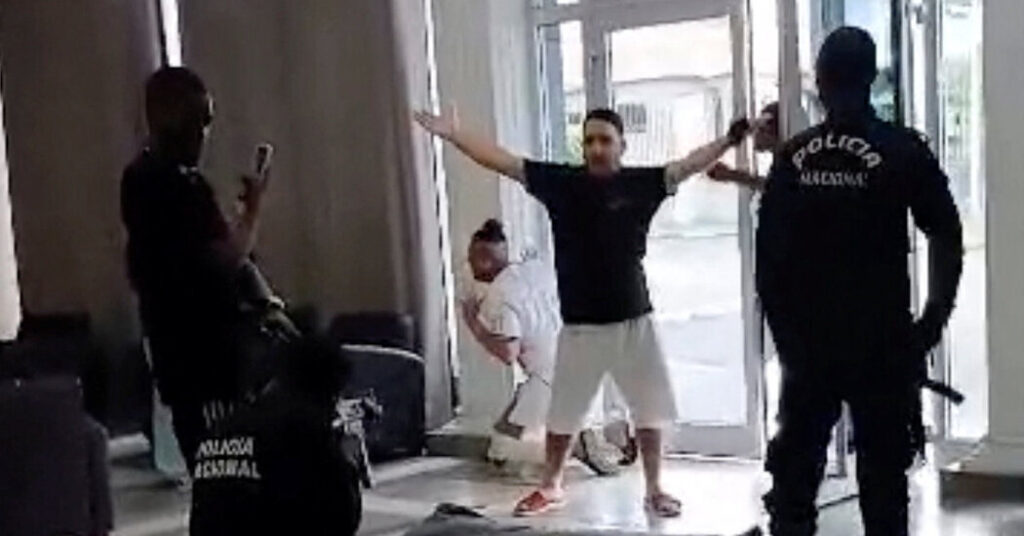
Two men deported to Equatorial Guinea by the Trump administration were hooded, bound, beaten with guns and shoved down a flight of stairs recently by police officers at a remote hotel where immigrants are being held indefinitely, according to witnesses and lawyers.
The deportees said the beatings and subsequent arrests were intended to stop them from telling the outside world about the deteriorating conditions and growing violence inside the hotel, which has become a de facto prison for 29 men and women from different countries.
Experts and human rights advocates predicted such abuse after the Trump administration began deporting people to authoritarian countries where they had no ties or, in many cases, legal rights. Equatorial Guinea, like other countries cooperating with the U.S. deportation program, is notorious for human rights violations, including torture and arbitrary arrest, according to the State Department.
Equatorial Guinea, a small autocracy on Africa’s western coast, is one of many countries that have agreed to accept immigrants deported from the United States. With no legal status in the country, the deportees are being held in the Hotel Bamy — a dilapidated building on the outskirts of the city of Malabo. Armed police officers stand guard 24 hours a day and frequently harass and intimidate people there with impunity, deportees said.
“We are in imminent danger now and can’t keep living like this,” Ahmed Soliman, a deportee at the hotel, said in a text message to The New York Times this month. “I’m tired and genuinely afraid for my life.” He was one of the two men who were later beaten and hooded, witnesses and the human rights group Amnesty International said.
Though the hotel operates as a prison, none of the immigrants are charged with a crime in Equatorial Guinea. The indefinite detention reflects a contradiction at the heart of many arrangements between Washington and foreign governments. Equatorial Guinea agreed to take people but has given them no legal rights or documents that would let them live or work there, even temporarily.
American judges had ruled that a majority of the immigrants in the hotel could not be deported to their home countries because they were likely to be tortured or persecuted. For years, officials allowed many such people to stay in the United States by default, despite their lack of legal standing. The Trump administration ended that policy and is working to find countries, like Equatorial Guinea, willing to accept them.
Videos and interviews show that police aggression inside the hotel escalated in recent weeks and peaked on Sept. 11. The police put burlap sacks over the two men’s faces, tied their hands with rope, beat them with guns and shoved them down the stairs as several deportees watched. The beatings were recounted by multiple witnesses and lawyers.
The police officers shouted: “Where is the phone? Where is the phone!” witnesses said. The immigrants had been using cellphones to speak to journalists and lawyers about the lack of running water, nutritious food or medical care. The beating, witnesses said, followed the release of a video, first reported by Reuters, showing the deteriorating situation in the hotel.
Police also ransacked hotel rooms, searching for cellphones, deportees said.
The deportees spoke only on the condition of anonymity because of the threat of retaliation. Western lawyers including Bella Mosselmans, Alexandra Smolyar and Meredyth Yoon, who represent some of the deportees, discussed details of the beatings and arrests. A local lawyer spoke on the condition of anonymity for fear of retribution.
Messages seeking comment from the government of Equatorial Guinea, left with its embassies in London and Washington, were not returned.
The police arrested the two men, Mr. Soliman, originally from Egypt, and Samson Birhane, of Eritrea, ostensibly over a broken mirror in the hotel’s elevator. Ms. Mosselmans said that the authorities were retaliating because the two had tried to make their mistreatment known to the public. They were held in a local jail and then vanished for two days, their lawyers said, before being returned to jail.
The State Department did not respond to a message seeking comment early Friday morning. The government has said little about these so-called third-country-deportation deals. In court documents, the Trump administration has argued that once someone is deported to a foreign country, it cannot control what that government does.
Equatorial Guinea had promised the United States, in a diplomatic note, that it would not subject the deportees to torture or other maltreatment.
The New York Times interviewed four deportees in recent weeks who described abusive treatment from armed police officers. The officers, mostly young men, carry semiautomatic firearms and periodically arrive at the hotel. Sometimes, two of the deportees said, the guards are drunk.
In July, police officers stormed five hotel rooms, grabbed people by the necks and tackled them, according to deportees and lawyers. The officers took the immigrants outside the hotel, pointed guns at them and threatened to have them killed — and buried in a field across the hotel property — if they did not voluntarily return to their home countries, they said.
“They are telling us, ‘America doesn’t know where you’re at,’” one witness said. “They say, ‘We will put you on a plane, kill you all, throw you in prison, and nobody will see you again.’”
A video shared with The Times shows a separate incident in which a government official tells an Ethiopian man that his options are to “go back to your home country” or “go to prison.”
The government has already returned a least a dozen people to their home countries, despite the U.S. legal protections and the risk of abuse there, according to lawyers. Many of these deportees have since disappeared or gone into hiding, the lawyers said.
In May, United Nations experts appealed to Equatorial Guinea’s government for access to medical care and basic necessities at the hotel.
One video shared with The Times shows a bathroom tap that does not dispense water. A local lawyer who recently visited said he found no medical supplies even though several people had serious health conditions, including diabetes and a severe hernia.
The government also recently used the hotel to quarantine a suspected Ebola patient, one of the lawyers said. Videos shared with The New York Times show health workers in hazmat suits appearing to move patients to the hotel. Mr. Soliman, in interviews with The Times before he was arrested, said nurses and police officers told him that the patient had Ebola.
The two men who were beaten and arrested, Mr. Birhane and Mr. Soliman, were taken to a detention center that is called La Luna and known to be deeply overcrowded. A lawyer who was in touch with the men said they had been denied food and that their bodies were covered in bruises.
Mr. Soliman, 31, held a green card in the United States, where he had lived since he was 3, according to records submitted to the African Commission. He lost that status after being sentenced to prison in 2023 for drug possession and aggravated assault. While Mr. Soliman was serving a prison sentence, a judge ruled that he could not be deported to Egypt because, as a gay man, he would most likely be tortured there. He was deported to Equatorial Guinea this year.
Mr. Birhane, 47, came to the United States America as a refugee at 13. He was deemed deportable after a second-degree robbery conviction in 1998, while he was in high school. A judge ruled he could not be returned to Eritrea given the risk of torture there.
He had lived in the United States since then, checking in regularly with immigration officials. At one of those check-ins this year, he was arrested and then later deported.
Lawyers have sent several emails to David Gilmour, the U.S. ambassador to Equatorial Guinea, and others at the U.S. Embassy, according to correspondence they shared with The Times. The emails have not been answered, they said.
On Sept. 11, the day that Mr. Soliman and Mr. Birhane were beaten and arrested, Mr. Gilmour met with the vice president of Equatorial Guinea, who is also a son of the president.
The vice president, Teodoro Nguema Obiang Mangue, also made a phone call to Stephen Miller, a White House adviser and key driver of the Trump administration’s immigration policy. The two discussed “different issues related to migration,” according to a statement posted on the ruling party’s website.
Hamed Aleaziz contributed reporting.
The post A Central African Hotel Has Become a Nightmare Prison for U.S. Deportations appeared first on New York Times.