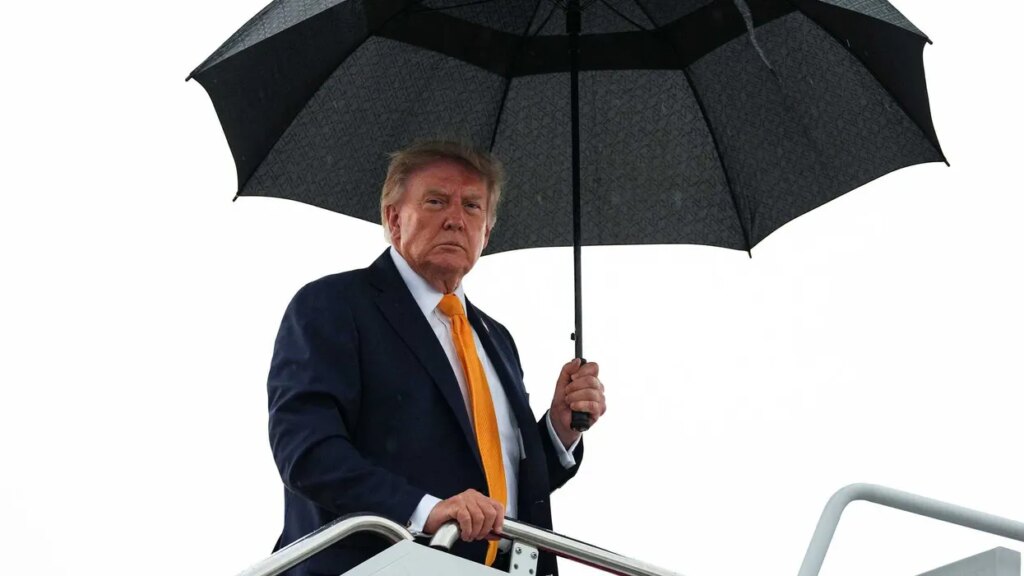
Just months after federal officials joined Chesapeake Bay states in December to renew their pledge to restore the nation’s largest estuary, President Donald Trump on Wednesday rescinded an Obama-era executive order that called for federal leadership in the effort.
Trump’s executive order also railed against stormwater management fees, which he labeled “rain taxes” — a refrain from Republican Larry Hogan’s successful 2014 campaign for governor — arguing that they “impose hundreds of dollars in annual financial burdens on residents and small businesses,” with “little to no measurable benefits to the Chesapeake Bay.”
Some jurisdictions in the bay region, including some Maryland counties, collect fees from property owners to fund projects like rain gardens, tree plantings and permeable pavement installations that slow down runoff.
Maryland’s entire congressional delegation — including lone Republican Rep. Andy Harris (R-1st) — released a statement Thursday opposing Trump’s executive order.
“The 2009 Executive Order that the Trump administration just revoked provided vital federal resources that support state-led efforts to improve the health and productivity of the Chesapeake Bay and its surrounding area,” read the joint statement. “This decision is shortsighted and harmful to our communities. Make no mistake: the Chesapeake Bay is a national treasure. And we will continue to fight for it.”
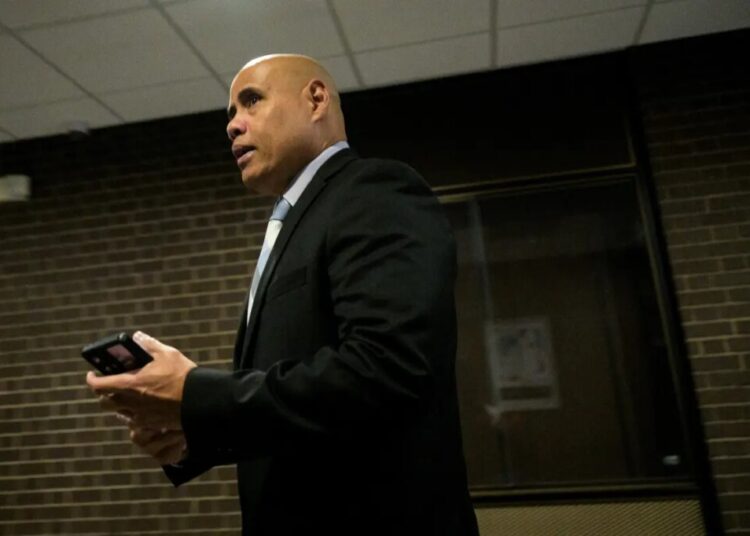
Maryland Natural Resources Secretary Josh Kurtz said the timing of the order “is a little bit bizarre,” after December’s meeting.
“We just saw strong support from all of the partners involved to continuing the work that we’ve been doing,” Kurtz said.
Maryland officials are in a “wait-and-see” mode, he said, wondering precisely how Trump’s executive order could affect the federal government’s role in the decades-long effort to clean up the Chesapeake. Could some federal agencies step back from the restoration effort, rescinding personnel or funding?
“This now is going to require us to have individual conversations with each one of those agencies, get a sense for how they’re interpreting the [executive order], and then how they’re going to be turning that into their own policies,” Kurtz said.
Trump’s order also calls on federal agencies to “encourage the repeal or rescission of stormwater management fees imposed by States or localities.” But the power to levy fees — and consider rescinding them — rests with state and local governments, said environmental attorney Jon Mueller, who manages the University of Maryland’s Environmental Law Clinic.
“You can’t take away state sovereignty,” said Mueller, a former vice president for litigation at the Chesapeake Bay Foundation. “The Clean Water Act recognizes state sovereignty — and the fact that states can do more than the federal government as far as pollution goes.”
Maryland Department of the Environment spokesperson Aimena Lipscomb said in a statement that, because Maryland’s stormwater programs are established under state law and the federal Clean Water Act, Trump’s rescission of the 2009 executive order “will not alter our goals — nor will it derail our momentum, having already completed nearly 50,000 acres of local stormwater restoration.”
Rep. Rob Bresnahan Jr. (R-Pa.), who joined Trump during the executive order signing, said in a news release that he believes Obama’s 2009 executive order “created” the “rain taxes.” He praised Trump for “listening to the people of Northeastern Pennsylvania.”
Maryland first required certain jurisdictions to collect stormwater remediation fees in 2012, a move that became a political flashpoint in the 2014 gubernatorial campaign when Hogan decried the “rain tax” on his way to a stunning defeat of then-Lt. Gov. Anthony Brown (D) in deep-blue Maryland.
In 2015, Maryland removed the requirement that certain jurisdictions collect the fees, instead requiring that they submit periodic plans for how they will handle, and pay for, stormwater improvements. The goal is to reduce harmful flows of nitrogen, phosphorus and sediment that can cause oxygen-poor “dead zones” in the bay, harming underwater wildlife.
In fiscal 2024, seven Maryland counties were still levying the stormwater fees, out of the 10 largest counties in the state that were once required to do so, according to a state report. Two others were using tax revenue, and one — Baltimore County — repealed it altogether.
Most of the counties decided to keep the fees because they recognized the projects’ benefits, said Kristin Reilly, director of the Choose Clean Water Coalition, which represents 325 environmental organizations in the bay area, including riverkeepers, land trusts and park advocates.
“They help improve flooding issues, they help beautify communities, they address potential health challenges related to dirty water, and they are put toward fixing our water infrastructure — which is failing,” Reilly said.
Stormwater pollution is considered the fastest-growing category of pollution affecting the bay watershed, compared to categories such as agricultural pollution and discharges from sewage treatment plants and industrial facilities.
Bay states have struggled to curtail diffuse sources of pollution, including stormwater runoff, and they failed to reach a 2025 goal for reducing nitrogen, phosphorus and sediment by specific amounts.
New pollution goals, by way of a new computer model, are in the works. In the meantime, the bay states and the Trump administration signed a new bay agreement last year with a host of other goals for wildlife, coastal habitat restoration and more.
“The Bay states and federal partners just signed a new watershed agreement committing to bay restoration goals. There are a host of new challenges the bay is facing, from climate change to population growth and development. This is absolutely not a time to step back,” Chesapeake Bay Foundation President and CEO Hilary Harp Falk said Thursday.
She said the foundation, a leading nonprofit advocating for the bay, is “most concerned about the loss of federal leadership, accountability and cross-agency coordination that were flagships of the original executive order.”
Reilly said Trump’s executive order was another example of the administration’s “actions not reflecting” its approving words about the bay cleanup effort.
“Repeatedly, the administration has proposed the termination of critical federal funding for the Chesapeake Bay region and now this Executive Order aims to strip away the right of local governments to make decisions based on the needs of their community,” Reilly wrote in a statement.
But Mueller argued there are reasons for optimism.
The president did not signal an attempt to rescind the TMDL, or Total Maximum Daily Load — the legally binding “pollution diet” that the Environmental Protection Agency established in 2010.
In fact, the president “doubles down” on the bay restoration effort, Mueller argues. In the order, Trump calls on his federal agencies to focus their resources on “more direct, on-the-ground projects, in areas of highest need, that would result in the most impactful water quality improvements.”
“In the past there have been a lot of best-management practices — both in agriculture and in urban, suburban settings — that look good on paper and they got credits for them, but … are not as effective as they could be,” Mueller said.
But Kurtz pushed back against what he called the “implication” in Trump’s order that cost-effectiveness isn’t a priority.
“That’s just patently inaccurate here in Maryland,” Kurtz said. “Cost-effectiveness is really central to what we do, because we know that the cheaper the projects are, the more projects we can do.”
Even if the exact long-term impacts of Trump’s executive order for Maryland remain unclear, Kurtz said that the order has a negative impact in the short-term.
“Any confusion is only going to slow us down, and I think we’ve all recognized that we need to be going faster,” Kurtz said.
This story was originally produced by Maryland Matters, which is part of States Newsroom, a nonprofit news network which includes Pennsylvania Capital-Star, and is supported by grants and a coalition of donors as a 501c(3) public charity.
Pennsylvania Capital-Star is part of States Newsroom, a nonprofit news network supported by grants and a coalition of donors as a 501c(3) public charity. Pennsylvania Capital-Star maintains editorial independence. Contact Editor Tim Lambert for questions: [email protected].
The post Rage as Trump’s ‘bizarre’ rain-tax ruling roils waters on Chesapeake Bay appeared first on Raw Story.