It’s hard to remember this, but before “The Social Network” came out in 2010, there was plenty of snickering. Would anyone want to watch a movie about a website?
The answer was yes. It was a major success at the box office and won three Oscars, including one for Aaron Sorkin’s screenplay. In the years that followed, it would consistently be ranked among the top films of the decade, landing at No. 10 on The New York Times’s best of the 21st century list.
Something about this movie about a website — and, more important, the psychology of its founder — resonated with pretty much everybody. You might even say it gave us a whole new genre: the tech founder movie.
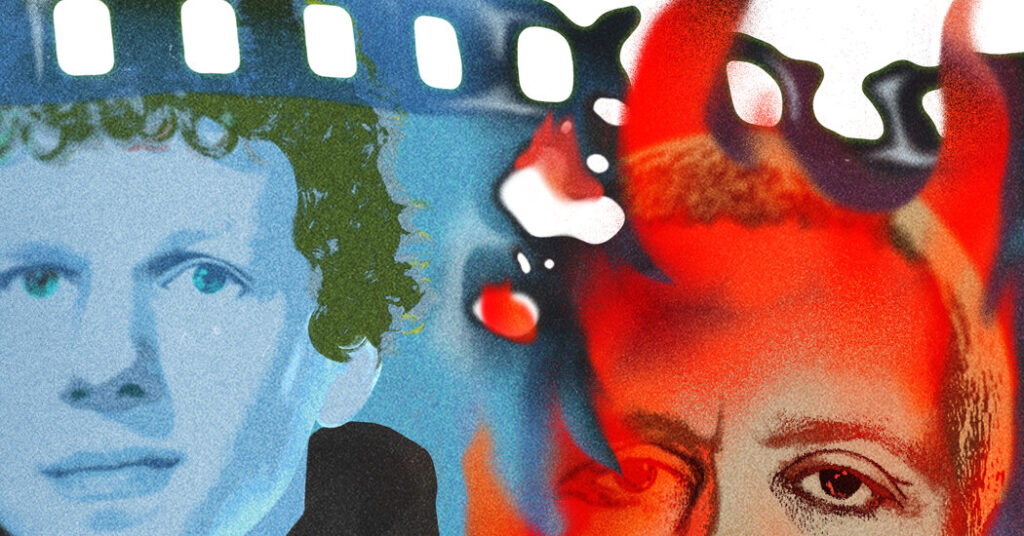
This fall, that genre graduates into a new phase, one that reflects a mounting suspicion of and anger toward tech founders. In October, Sorkin’s follow-up, “The Social Reckoning,” will open in theaters, the TV show “Cupertino” will premiere on CBS and Luca Guadagnino’s “Artificial” will make its world premiere at the New York Film Festival. All three take a far darker view of Silicon Valley than “The Social Network” and its progeny did, and that’s a telling evolution. Entertainment used to celebrate founders — or at least respect their talent and drive. But now they’re often portrayed with mockery, disgust and even rage.
While they’ve been busy with, as Zuckerberg would put it, moving fast and breaking things, we’ve been getting increasingly upset about the world they’re building. But as tech takes over Hollywood, it’s uncertain — as we’ve learned in the case of “Artificial” — whether that reality will be onscreen in the future.
THE TECH FOUNDER ARCHETYPE of an eccentric countercultural genius had been established decades before “The Social Network.” Books like “Fire in the Valley: The Making of The Personal Computer” and “Hackers: Heroes of the Computer Revolution,” both published in 1984, told stories of obsessive young computer enthusiasts, mostly men, who holed up in labs and garages to create microcomputers, meant for ordinary folks’ use. Bill Gates at Microsoft and Steve Jobs and Steve Wozniak at Apple were happy to keep spinning their own legend while building their empires.
All three men were the focus of perhaps the only pre-“Social Network” film in the genre, the 1999 made-for-TV movie “Pirates of Silicon Valley.” In an early scene, the longhaired Wozniak and Jobs (played by Noah Wyle and Joey Slotnick) run across the Berkeley campus during a clash between police and students at a 1971 antiwar protest. They are interested in an uprising, just not that kind.
“Those kids think they’re revolutionaries. They’re not revolutionaries, we are,” says Jobs. These young rebels, with their hacker ethics extolling open systems and readily accessible information for all, were bent on the belief that they would change the world, and that this change would be good for us all.
As played by Jesse Eisenberg in “The Social Network,” Zuckerberg is a version of these guys, one generation on. The movie treats him as equal parts infuriating and intriguing; you’re kind of rooting for him. Like Gates, Wozniak and Jobs, he will drop out of college to build his company in Silicon Valley. And like them, he’s a braggart, a show-off. But he’s not interested in money. He’s in it for the love of the game.
In the sequel, “The Social Reckoning,” due in October, Jeremy Strong is Zuckerberg. The movie covers the lead-up to a bombshell 2021 document leak showing that company leaders knew about a variety of harms their platforms were causing to users’ mental health and social stability. It’s safe to say the semi-admiring mood of the first film has drifted toward something darker.
This vibe shift might be representative of the whole tech founder genre. The success of “The Social Network” set off an avalanche of TV shows and movies about people inventing computers and software and apps, some fictional, some not. In April 2014, HBO’s “Silicon Valley,” a satirical comedy about a start-up, made its debut. Two months later, “Halt and Catch Fire,” set at the dawn of the personal computer revolution, premiered on AMC. Meanwhile, Jobs, who died in 2011, was the subject of two movies: “Jobs” (2013), starring Ashton Kutcher, and “Steve Jobs” (2015), starring Michael Fassbender (and written by Sorkin).
These and other stories worked along the same mythological lines, following the pattern of “The Social Network.” Brilliant, eccentric and often abrasive (or abusive) founders talk about radically changing the world, usually in altruistic terms. They’re often treated as problematic faves. Even “Steve Jobs,” perhaps the most openly critical of its subject, still ends up polishing his image and certainly not deconstructing it.
THESE ARE ARTIFACTS of a time, probably the last time, when it was still possible to say that social media was a net good without sounding too naïve.
The public’s souring on tech giants might be pegged to the scandal involving the consulting firm Cambridge Analytica. In 2014, the company used a Facebook quiz to collect data without users’ consent. Facebook discovered the breach and asked Cambridge Analytica to delete the information but failed to inform users, and the data was used to assist the 2016 presidential campaigns of both Donald Trump and Ted Cruz. When a former Cambridge Analytica employee blew the whistle two years later, there was outrage.
You can spot the storytelling turn right around then. There was “The Circle,” a 2017 movie based on Dave Eggers’s dystopian novel about a company loosely mashing up Google and Facebook. Then came a flood of documentaries and scripted shows depicting tech founders: Hulu’s “The Dropout,” about Elizabeth Holmes of Theranos; Apple’s “WeCrashed,” about Adam Neumann of WeWork; and Showtime’s “Super Pumped” (based on the nonfiction book by the Times reporter Mike Isaac) about Travis Kalanick of Uber, were all released 2022. The three executives had fallen hard by the time these shows aired.
The new archetype was a narcissistic, amoral menace unbothered by things like ethics and laws, as long as the stock price goes up. The conclusion remains the same: We, the audience, are the victims here. The founder as genius had curdled into the founder as grifter.
THE GENRE IS AT an inflection point now. Pop culture is no longer lionizing founders to the extent that characters who do are played as sycophants or lemmings.
The 2025 satire “Mountainhead” is emblematic of the moment: Written and directed by the “Succession” creator Jesse Armstrong, it centers on four fictional billionaire founders who fancy themselves masters of the universe, set against the backdrop of worldwide chaos caused by an A.I.-powered image generation app. As they make boasts and quote philosophers to one another, certain of their own power, we see just how hollow and ridiculous they are. Similarly, the 2026 AMC show “The Audacity” is far tonally bleaker than its predecessors. And “The Social Reckoning” is arriving just as Meta, the parent company of Facebook, has agreed to pay up to $17.1 billion in penalties for violating federal child privacy and states’ consumer protection laws. Zuckerberg’s company will be making big changes to its products, as part of a landmark settlement with 47 states.
But if attitudes have soured toward figures like Zuckerberg or Elon Musk, another force remains at play.
In 2010, no major movie studio was owned by a tech company. Sony, which distributed “The Social Network,” came the closest, an electronics company with a media division. Netflix hadn’t made original content yet and was only a few years into streaming. Amazon Prime Video existed, as did Hulu, which mainly focused on next-day broadcasts of network TV episodes. But the big streaming push wouldn’t come until 2020.
Now, though, the line between Hollywood and Silicon Valley seems to have blurred so much it’s nonexistent. Algorithms rule the day. A.I. is alternately embraced and feared. Netflix joined the Motion Picture Association — the trade association for major Hollywood studios — in 2019. Other members of the M.P.A. have ties to big tech (like Paramount Pictures, owned by the Oracle chief executive Larry Ellison and his son, David) or simply are tech companies, like Amazon MGM, formed when Amazon acquired the storied studio. Even Disney, Universal and Warner Bros., which still run robust-enough theatrical businesses, focus energy on their streamers, powered by user data and proprietary algorithms.
This transformation has consequences. In June, Amazon MGM confirmed it had dropped Guadagnino’s “Artificial,” starring Andrew Garfield as the OpenAI co-founder Sam Altman. Trade publications reported that the film was nearly finished and had tested well with audiences. An Amazon spokesperson told Variety that “Artificial” would “be better served if it were released by a different studio.”
The timing was telling. In February, Amazon struck a deal to expand OpenAI’s use of Amazon’s web hosting services, as well as develop custom A.I. models; Amazon had invested $50 million in the A.I. company.
Several other studios considered buying “Artificial,” including the indie A24, which seemed like a natural fit. But among that company’s backers are Josh Kushner’s firm Thrive Capital — also one of OpenAI’s backers — and, as of June, Google’s DeepMind A.I. division, which invested about $75 million in A24. Ultimately, Neon picked up the film, which will open in limited theaters at the end of this year before a wider release in early 2027.
So on the one hand, the genre seems to be on the rise this season. But the “Artificial” saga is instructive. In the future, if big tech keeps investing in entertainment, could platforms afford to tell unflattering founder stories, now that so many of them answer to founders?
Jobs, Gates, Woz and Zuck all considered themselves revolutionaries, subverting authority and changing the world. But the shift from “The Social Network” to “The Social Reckoning” shows us what happened next. Now the renegades have become the autocrats, and they’re trying to take over everything. Tech founders changed the world, all right. But the movies about them reveal, more often than not, that we’re mad as hell about the world they built.
The post As Big Tech Takes Over Hollywood, the Picture Onscreen Gets Darker appeared first on New York Times.