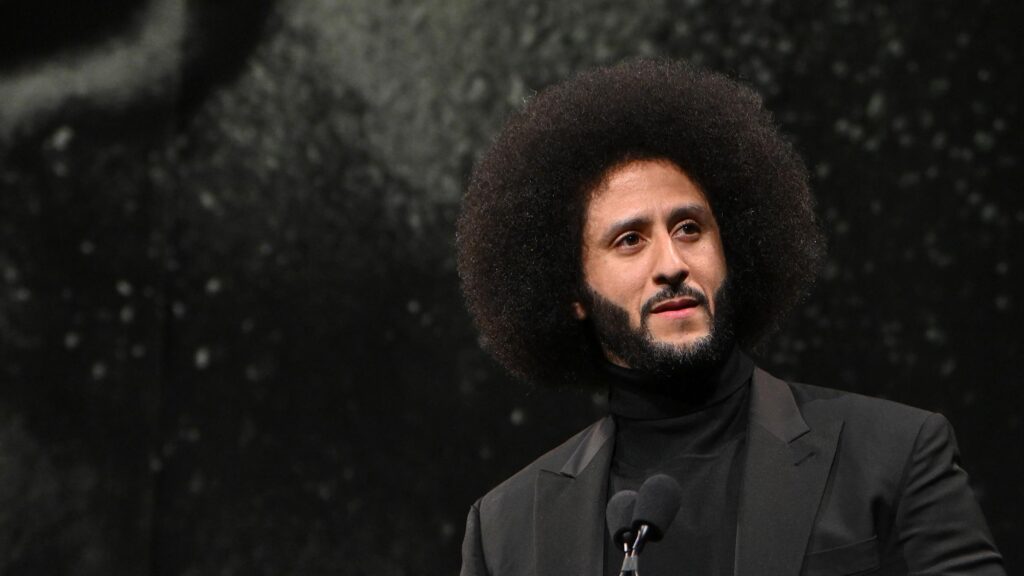
Following a string of high-profile police shootings of Black men 10 years ago, San Francisco 49ers quarterback Colin Kaepernick began protesting such incidents by sitting during the national anthem at preseason games. What began as a quiet action turned into a fevered national debate about freedom of expression, patriotism, and so much more.
In Kaepernick’s new memoir, The Perilous Fight, the quarterback explains that his action was spontaneous. He wasn’t even in uniform on August 13, 2016, the first time he sat during the anthem. “I hadn’t given the anthem a second’s thought before I walked out onto the field that day, but it hit me in that moment that I should find a seat,” Kaepernick writes. “I didn’t want to stand up while that song was playing. Rosa Parks had refused to give up her seat on the bus to a white person in 1955. Muhammad Aliwouldn’t step forward when his name was called by the draft board for the Vietnam War in Louisville in 1967. Tommie Smith and John Carlosraised black-gloved fists in the air during the playing of the anthem at the 1968 Olympics. They didn’t like what they saw, the way this nation touted its commitment to justice and at the same time showed little interest in it, and they took action. Those inspiring Americans had the courage of their convictions and literally changed the world in the process.”
Kaepernick, despite leading the 49ers to the Super Bowl in 2013 and throwing 16 touchdown passes, against just four interceptions, for a bad 49ers team in 2016, hasn’t played in the NFL since that season. In 2019, he and former teammate Eric Reid, who joined Kaepernick in kneeling during the anthem, settled a collusion lawsuit against the NFL. In late August, a decade after he etched his name in history, Kaepernick sat down with TIME to talk about why he hasn’t spoken up much about his protests, his relationship with the anthem today, his differences with Jay-Z, and the state of policing in the United States.
(This interview has been edited and condensed for length and clarity)
You’ve released a book, The Perilous Fight. Why tell your story now?
One, it’s 10 years since the protest. I’ve gotten so many questions about why did I protest, what happened, what led up to it, the details behind the scenes of all of the moments. Not just the protest, but owners in the NFL, the conversations that were happening there, the workout in 2019 and all the things that transpired around that. Then also just the work that we’re doing directly in the communities. It felt like it was a great time to be able to go out, answer some of those questions, and also be able to give insight into how we build, how we move forward together. I think it’s especially critical in a moment like this.
The book starts with a harrowing incident of racial hostility involving the N word that you experienced as a child—one you weren’t comfortable sharing with your parents, who adopted you and are white. Why start there?
One of the reasons we wanted to start with that moment of going through the neighborhood, being tied to a rose tree, and the dynamic of not feeling comfortable telling my parents is it really sets the stage for the rest of the book, and sets the stage for the rest of my life. I had to navigate the realities that you face when you are Black in predominantly white spaces. I had so many questions around, “You lived a privileged life. Everything was all good. Middle-class white family. What are you upset about?” And from the outside looking in, I understand how it can look that way. But also the reality of the experience, and what I went through, is also something that’s important to put in context.
You didn’t really do any interviews during the heat of 2016 and 2017, and in the aftermath. What was your thinking on not doing these types of interviews then?
Yeah, it’s interesting because I get both sides of that question. During the 2016 season, it was like, “Why are you talking so much? Be quiet.” As an NFL quarterback, you’re required to speak three times a week. So reporters can ask you whatever they would like. I’m happy to answer any questions as part of that. But post that moment, one thing I realized was, it felt like there was a very, very intentional effort to make me the sole figure, or the sole voice, of the movement. I thought it was important to create space for other voices to be able to step up. And one of the reasons that I thought that approach was so important is looking back historically, yes, we need strong leaders, but we need strong people collectively. That’s actually what allows us to be able to sustain over time. Also, as part of that, I thought it was very important as they were very intentional attacks to try to discredit me, discredit what I was capable of on the field, discredit my character. In those efforts of trying to discredit me, they were also trying to discredit the broader movement.
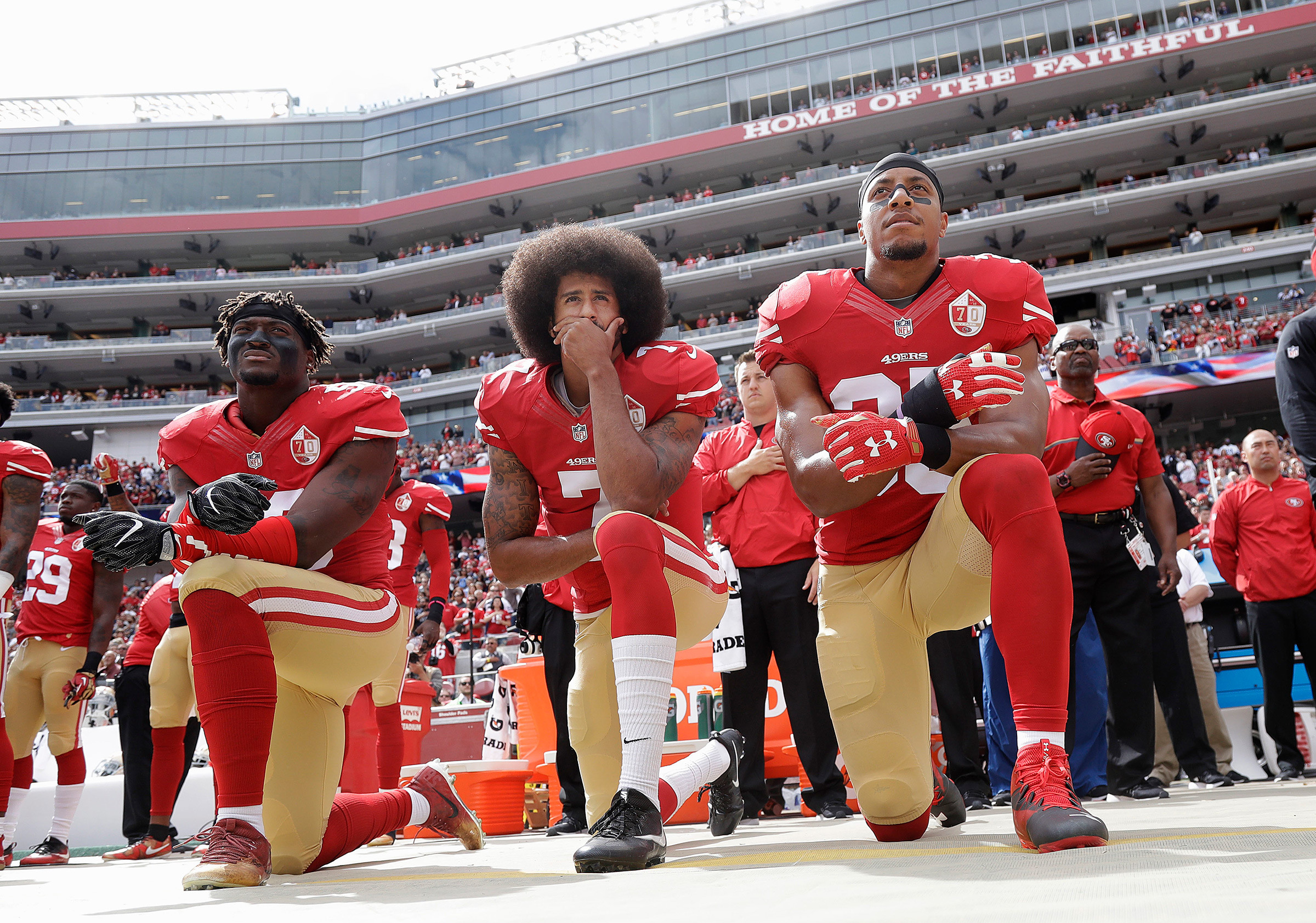
If there’s one athlete who has stepped up in the way that you wanted, who would that be?
I think there are voices across the board that have stepped up. I would say my brother Eric Reid. I’m always going to bring him up. Love Eric. He continued the protest after I was blackballed. He himself went through the same reality. His final season, [he] went out, set two franchise records, was cut, and never saw the field again. We had voices throughout the NBA step up. Whether that was LeBron, we saw Steph Curry, we saw Carmelo, we saw KD, all stepping to the forefront. We saw this with Megan Rapinoe,doing that on an international stage. We’re seeing it to this day throughout Europe. I would not have had the insight that this would have had the lasting impact internationally the way it does, and that’s just within the sports realm. More broadly, what I think it’s done is created opportunities, whether it is on a national stage, international stage, or within local communities. People saying, “Oh, this actually opened the door for me to be able to do the work in a way I previously wasn’t able to.”
In 2016, when you first started sitting, and then kneeling, during the national anthem, you’re in this national spotlight and firestorm. Was there one surreal moment you experienced that we didn’t see during this time?
One surreal moment early on, we had a high school, Castlemont in Oakland. After I took a knee, they went out the next week and took a knee, and I went to go visit them the following week at their game. I had a moment where I was in the locker room with them before the game. They’re hyping each other up. It’s going to be a big game for them. And one of the players says, “We don’t get to eat at home. So we’re going to go eat on this field.”
That is too often a reality within communities. Not only navigating threats against their life, but navigating whether or not they’re even going to have a meal. For me, that was such a surreal moment that athletes in high school and students in high school are going out, trying to chase their dreams and compete at the highest level. They are willing to stand up and risk themselves to go out and advocate for their community, while at the same time not knowing whether or not they’re going to have a meal when they get home. That really encapsulated and painted a surreal picture of how dire this is. While the broader national conversation was happening, this is just the reality on the ground.
Were you physically or psychologically threatened while protesting?
Threats became so normalized that I didn’t really think about them too much. You get attacked from the President of the United States. You’re getting attacked from senators. You have people trying to send bombs to your home. Online threats and mail threats. My now wife Nessa, as I was getting these threats, was like, “You can’t be staying at your house alone.” She was in New York at the time. But that ultimately led to me staying at [manager Tony Ng’s] house for the rest of that 2016 season, just so people didn’t know where I was at.
Were you ever scared?
No. I also think you get a little bit of the football mentality. If someone is going to try to do something, they’re either going to try to do it or aren’t. My responsibility is to be prepared for whatever that is.
Did you ever worry that what happened to you served as a warning to other athletes? That as a result of you not playing in the NFL anymore, they were quiet rather than speaking up?
Absolutely. I know the intention was to send that message: If you try to advocate for the Black community, if you try to fight against the status quo and create a different and better environment, we will take everything we can from you. And this actually showed up in one of our Know Your Rights camps in Las Vegas. One of our young high school students pulled me aside in the middle of the camp. “Hey, I really love football. I also really want to fight for my community and for that to be better. Which one do you think I should choose?”
The fact that they have made that a conversation, that people feel like they have to choose, that is the very thing that I have to continue to fight against. I don’t think there is an either-or. We can be phenomenal at our profession. We also can advocate for our community and a better society, better conditions for our people.
In the last nine years of NFL exile, did deciding to stand for the anthem in order to get signed ever cross your mind?
No.
Why not?
Because I set out with a clear goal and clear objective, and the conditions in our society have not changed. There’s been progress made in some areas, but holistically, when we look at the climate and environment that we are living in today, those conditions largely have not changed. There is never going to be a moment where I take a position of, “Hey, I’ll stand up so I can get my career back.” Because that then becomes a moral concession: If you threaten my career, or if you threaten my money, I will actually say I don’t care about the people, and I will look at this just from an individual perspective. That was a line I was not going to cross.
In the book, you detail conversations you had with a few teams around the league. Which team did you feel closest to signing with?
There were three teams that I thought were close. The first was the Seattle Seahawks. In 2017, flew up there, met with Pete Carroll, John Schneider, the head coach and GM of the Seahawks. When I got there, basically the conversation was, “We know you’re a starting quarterback.” I didn’t do a
workout while I was there. They’re like, “We know you can play. We’ve game-planned for you the last few years. That’s not a question for us.” The entire conversation while I was there was just around my politics, taking the knee,how I thought about policing, how I thought about the military, what their community would think, what potential players would think.
In retrospect, it was fascinating to me on a few different fronts. One, the NFL claims it’s a meritocracy. So walking in a building and telling me you know I’m a starter, and not walking out with an offer makes that fall flat on its face. The second part is I just think about it from a labor-laws perspective. Being the owner of a business, a company, I would never be able to ask those questions and get away with it.
They didn’t sign me that year. Reached back out the following year to have me come in for a workout. Had booked the flight, was ready to go out there, and prior to getting on the flight, they called my agent. Said, “Well, before he comes out to work out, will he commit to not taking a knee?” I said no. I won’t commit to that. Canceled the flight. Canceled the workout. Never heard from them again. [A spokesperson for the Seahawks did not respond to TIME’s request for comment.]
The second one was the Ravens, and this one came about because we played against the Ravens in the Super Bowl. Jim Harbaugh was my coach during that time. His brother John Harbaugh was head coach of the Ravens, and I reached out to Jim and wanted to get his perspective. “Is there anyone that you know that would be interested? Do you think your brother would be open to a call?” John was on board and was like, “Yeah, let’s do it.” John went back, advocated for it, wanted to sign me. “It got shut down from above me. I don’t have the power to just outright make that decision. But if it was my choice, you would be here.” [A Ravens representative referred TIME to a 2017 quote from Baltimore general manager Ozzie Newsome—now an executive vice president with the team—who said, “(Ravens owner) Steve Bisciotti has not told us we cannot sign Colin Kaepernick, nor has he blocked the move. Whoever is making those claims is wrong.”]
Then the third one was the Raiders in 2022. Had run into [Raiders owner] Mark Davis at an airport. This was actually the first time I had been face-to-face with one of the owners blackballing me. It was a very interesting conversation because it was almost disconnected from the reality of what was going on. Saw me and was like, “Hey, what’s up? How are you doing? What you been up to?” I was like, “What? What are you talking about? I’ve been trying to play, and you’ve been keeping me out.”
That led to a follow-up conversation about me trying to play. He came and sat in my living room, and we talked about playing for the Raiders. That led to a workout with the Raiders and Josh McDaniels. Workout went great. Josh McDaniels, after the fact, was like, “He looked bigger, stronger, faster than last time saw you.” Mark Davis came in the room after. “So proud of you. That was great workout.” One of the scouts on the way back said, “I’m surprised they let you walk out of the building without signing you. That’s the best workout we’ve had in years from a quarterback.” Never heard from him again. [The Raiders declined to comment.]
When Jim, who coached Michigan to the 2023 national title, got the job with the Los Angeles Chargers in ‘24, did you reach out to him? Was there any conversation there?
Yeah.
What happened?
He told me that was a table he was not willing to stand on. It was disappointing because prior to that he had been advocating for me. Said I should be a starter. I can help a team win championships. Had a conversation with him and said, “Look, I don’t even care what the role is. Like I know Justin Herbert’s there. I know the reality of what you have to navigate as a head coach. Let me take the No. 2 spot then. Let me come in, just show you, show everyone else what I can do.” Wouldn’t do it. No opportunity, no workout.
Has that affected your relationship with him?
Yeah. And I’ll say, also in part because there was a conversation that was put out that he had offered me a coaching job, which just wasn’t true. I don’t know where and why that came out. That’s made the relationship a little bit different since. [When asked to respond to Kaepernick’s comments to TIME about joining the Chargers as a player or coach, Harbaugh, through a Chargers spokesperson, pointed to a 2024 press conference, in which he said he “pulsed” Kaepernick’s interest in coaching.]
Why are you confident that you are ready to be an NFL quarterback right
now?
Because I train for it. I rely on my training and preparation for any moment. I’ve grown confident in my ability to continue to stay ready because I’ve shown that the training works, and I’ve shown that I’ve been able to go out and perform.
What’s your relationship with the national anthem today? When you go to sporting events, what do you do?
I don’t go out for the Star-Spangled Banner. I’m either seated where I’m at, or I’m not out there at all, and then show up when it’s time for the actual game to come on.
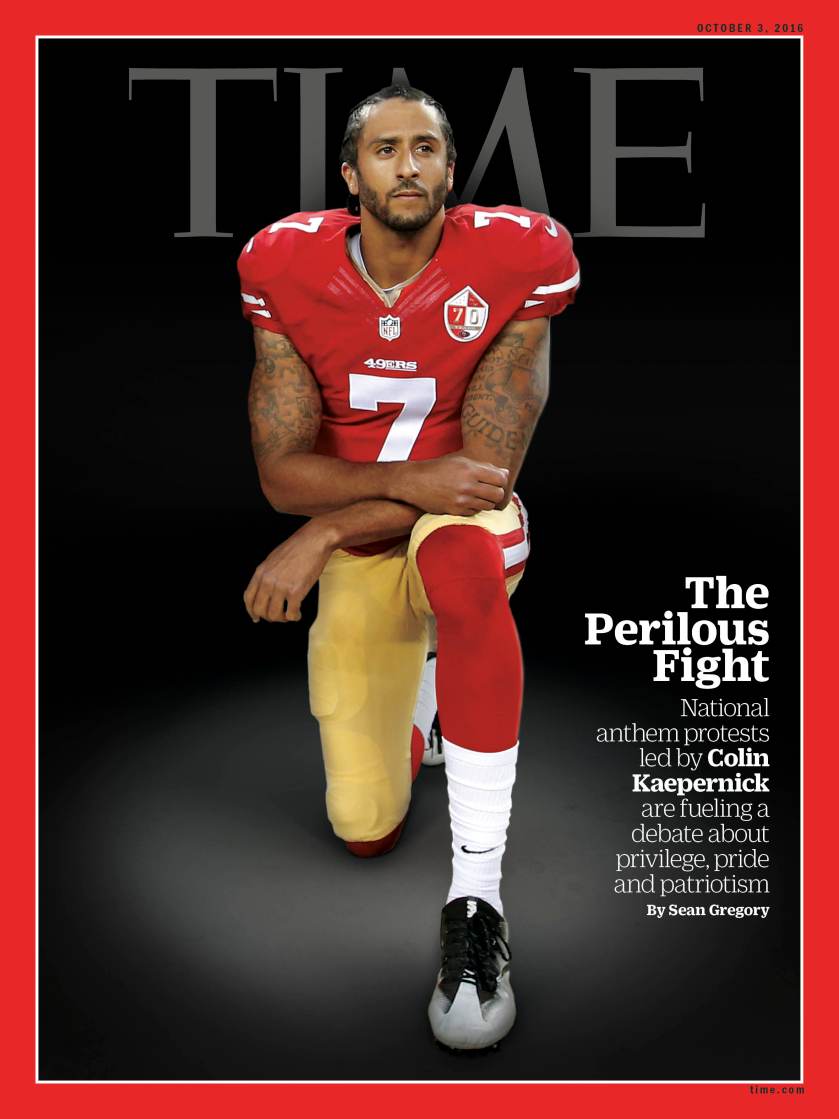
Your daughter is 4. When this time is right, what will you say to her about the national anthem?
This is actually a funny and timely question. We just went through the process of moving. We’re putting some of the artwork up and pictures up. We have the TIME cover framed. I don’t like having any of my stuff in rooms that I’m in. Feels weird to me. But my wife wants to have stuff up. And my daughter found it, and she grabbed it and was like, “Oh, this is going to my room.” But she was like, “Baba, why are you taking a knee like this?” She’s showing me how I’m taking a knee. Not a conversation I was expecting to be having at 3 ½ years old.
What did you say to her about it?
“Well, Baba was protesting to try to create a better life for everyone. Thought all people should be able to be successful and have good lives and be treated fairly.”
What are you going to tell her when she asks about why you stopped playing in the NFL?
It’s going to be an honest conversation, in part because I also know I have to prepare her for the reality that she’s going to walk into rooms and they’re going to see her last name is Kaepernick. She’s going to get asked questions and she’s going to have to have to navigate things that she never asked for. Part of my responsibility as a father is making sure that she’s prepared and equipped for that.
Going back to your early life a bit – you credit your parents with raising you and having your back. But there were many moments where they weren’t as sensitive to your racial experience and awakenings as you would have liked. You make that very clear in the book and don’t spare your feelings about it. Have your mom and dad read the book?
They have not read it yet.
How do you anticipate they’ll react to it?
There’s moments that they just don’t know about. It is also something that, for me, in thinking about a white couple born and raised in Wisconsin, adopting a young Black boy, it is very difficult for them to understand the reality of what that’s going to be for me growing up. As far as raising me on strong fundamentals and morals, teaching me to work hard, teaching me to treat people well regardless of what their position or status may be in life, all of those things they did extremely well. But when it comes to understanding being Black, being a Black man, what that means, navigating society, that part largely didn’t exist. That’s where a lot of the conflicts come in around culture, around perception, around who I actually was. I knew they always loved me as their son. I don’t know if they always loved my Blackness. And I think that’s an interesting nuance to be able to navigate.
How would you characterize your relationship with them now?
I think we’re in a good place. My daughter loves calling them during dinner. That is part of her routine now. They come out, they visit. But there is still some of the complexities there.
At several points in the book, you talk about the business of the NFL in the same breath as slavery. Of being photographed in compression shorts at the draft combine, you write, “My mind immediately went to the scenes I had witnessed in numerous movies depicting slave auction blocks.” You also write, “I fully believe what happened to me was a form of buck breaking. That’s a slave term to describe how masters used to whip and sexually abuse enslaved men in front of a crowd to dehumanize them and warn other slaves that they better not step out of line. I was made into a warning to other NFL players and professional athletes: You better not challenge the league’s authority.” Were you ever worried that people might be offended by that?
No. I know people would take things in the context that they want to. But the parallels between the two are undeniable. Bill Rhoden wrote a whole book around it, Forty Million Dollar Slaves.This came up for Curt Flood when he was fighting for free agency for professional players. “Well, you’re making $90,000 a year, Curt Flood. How can you compare this to slavery?” And I believe his quote around that was, “A well-paid slave is a slave nonetheless,” or something to that effect. Which speaks more to the institutions and practices around how you are treating people and the process that they’re going through, and the systems that they have to navigate, as opposed to just taking something in isolation.
Two news stories weren’t addressed in the book. One is your decision to wear socks depicting police as cartoon pigs in 2016, before you took your public stance. That offended law enforcement personnel, and police unions in particular. Why don’t you, or why do you, regret that specific decision?
When I wore those socks, we were seeing police killing Black people with impunity across the country. This is something that has systemically been in place. It came out of slave patrols, built into modern-day policing. Now, policing in the U.S. exists in a way that we don’t see in other areas throughout the world, so to me, that was sending a message around the inhumane practices that police were practicing.
It seemed to have an effect where some people would never forgive you after that. But you knew that was a risk?
The same people who are offended, in a way that, “hey, we’re never going to forgive you for that,” why are you so remorseful for police killing Black people? Why are you so accepting of that? A pair of socks is so offensive to you, but the killing of a human life you’re OK with. So, if we’re really going to have a conversation around it, let’s actually put it in contrast to the conversations that we’re having. I’m going to choose valuing human life in every instance.
The other story is the shelving of the ESPN documentary about you, directed by Spike Lee. About a year ago, ESPN said in a statement that “ESPN, Colin Kaepernick and Spike Lee have collectively decided to no longer proceed with this project as a result of certain creative differences.” What were those creative differences?
We had approved for the documentary to go out, and that was not something that fit within their timeline. So the documentary is finished. It’s ready to go. We’re looking for potential partners to be able to place it.
Why didn’t ESPN want it?
It’s a great question. I know they have shifting priorities, as we’re seeing publicly right now. We also know they were, I believe, at that point in time in the midst of negotiating their deal with the NFL. So I can’t say that those things are connected. But I believe they’re all factors. [An ESPN spokesperson sent TIME a statement: “Two years ago, the three parties involved in this project came to a mutual decision, based on creative differences, not to move forward. Creative differences are not uncommon when several entities collaborate on a project of this kind. Because multiple parties were involved, we are limited in what we can share publicly. This is not new as the decision not to move forward was agreed upon Monday, July 29th 2024. We are grateful for the work that went into it.”]
In a recent interview, Alexandria Ocasio-Cortez seemed to agree with the sentiment that “Woke 1.0 was crazy.” She was referring to the period, after the murder of George Floyd in 2020, where there were calls, for example, to defund the police. You wrote in a 2020 essay “in order to eradicate anti-Blackness, we must also abolish the police. The abolition of one without the other is impossible.” What is your response to AOC’s characterization and other political characterizations that sentiments like you expressed went too far?
I understand the political realities that politicians are navigating. I’m not naive to that. I also think the reality is, if we are trying to create better communities that allow us to thrive, our resources shouldn’t be going towards policing. They should be going towards resources that allow the community to thrive. When you invest in communities, they get safer. People do better. Crime rates drop. I would not discredit the work that was done around the country during 2020, because that has laid the foundation for the movement that we’re seeing now. We’re seeing a different wave of politicians show up: “Am I providing direct benefit to the people that I’m serving?” I think that is the most important priority to be able to keep in mind.
Do you still support abolishing policing?
Yes. I think that’s the work that we should be doing. Reallocating those resources to directly benefit communities and give them the resources that they need to be able to thrive.
You write in the book about how, in 2016, you met with your San Francisco 49ers teammates to explain in more detail why you were protesting during the anthem. You write: “I told my teammates how law enforcement in this country has always been an enemy of Black people.” In 2026, do you still feel that law enforcement in this country is an enemy of Black people?
The institution has not changed. It still exists in the same form it did in 2016. We’re still seeing the same issues come out of it. We’re still seeing that fuel and funnel into the prison industrial complex. So until those systems are dismantled and those resources are allocated to benefit communities, the institutions are serving the purpose that they were laid out to do.
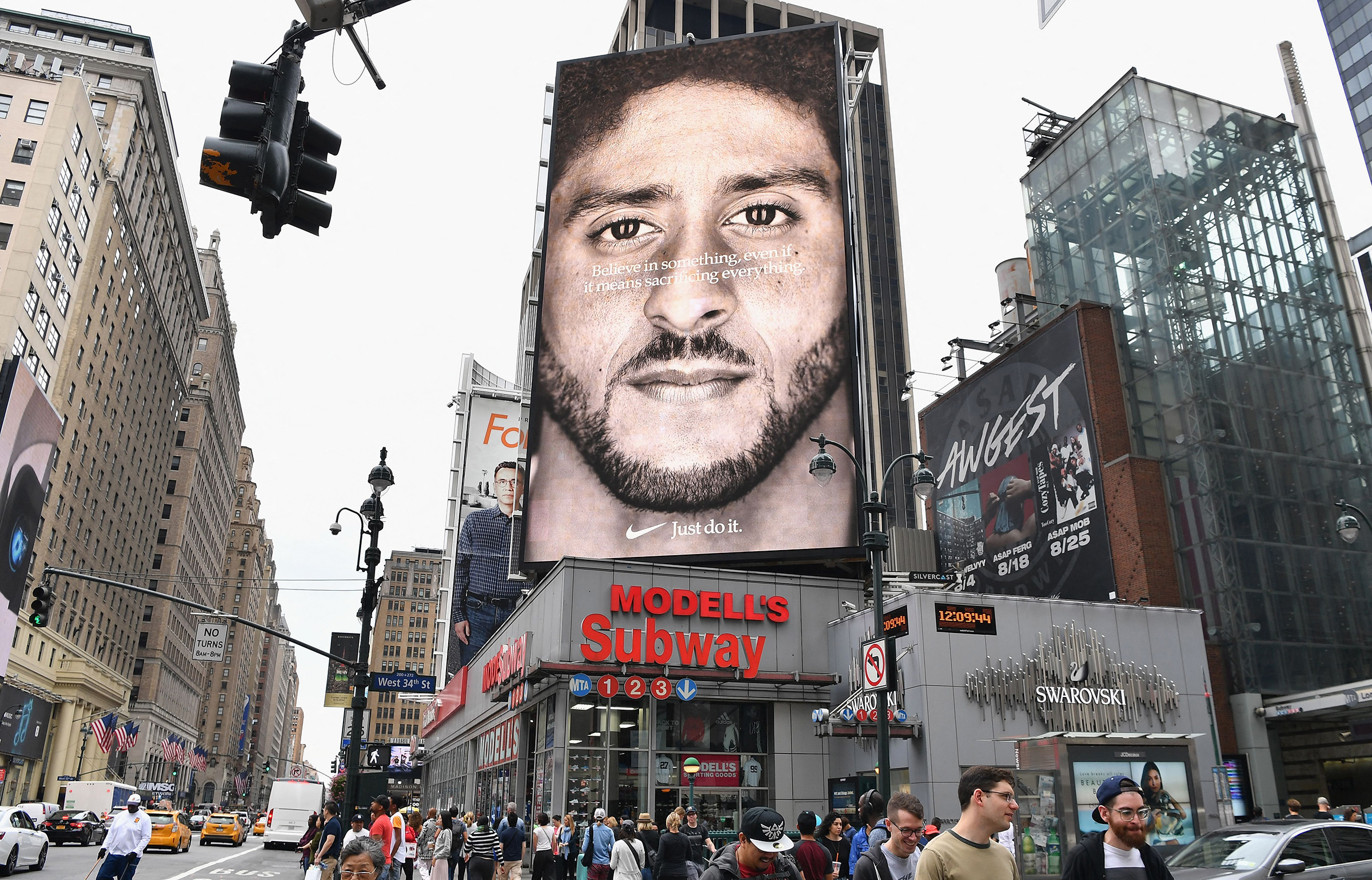
How would you characterize how Donald Trump has treated you?
At least to my knowledge, that was the first time I had seen a President use their position and political power to target an individual citizen. And I think that laid the foundation and set the stage for a lot of what we are seeing now. And in many ways, I feel like that was an initial test to see how far things could go. I obviously do not agree with his political views or approach. I do not believe that the work he is doing is actually to benefit people other than himself.
The NFL has reported giving more than $450 million to grassroots organizations to benefit communities in need. Do you see that as a sincere response to your protest or a PR play?
I view that as a PR play. There was a player-owners meeting. Bob McNair, who was the owner of the Texans at the time, said, “You need to tell your compadres to stop that other business,” meaning the protests. Bob Kraft was in that meeting and said, “We need to talk about the elephant in the room and ending the protests.” And Terry Pegula, the owner of the Bills, just saidexplicitly, “We need a Black face to be at the forefront of this to help us stop this.” If it was actually to try to create change and benefit Black communities, the NFL’s response holistically from the start would have looked drastically different. I would have a job. Eric Reid would have a job. The other players that were targeted throughout that process wouldn’t have had to navigate that.
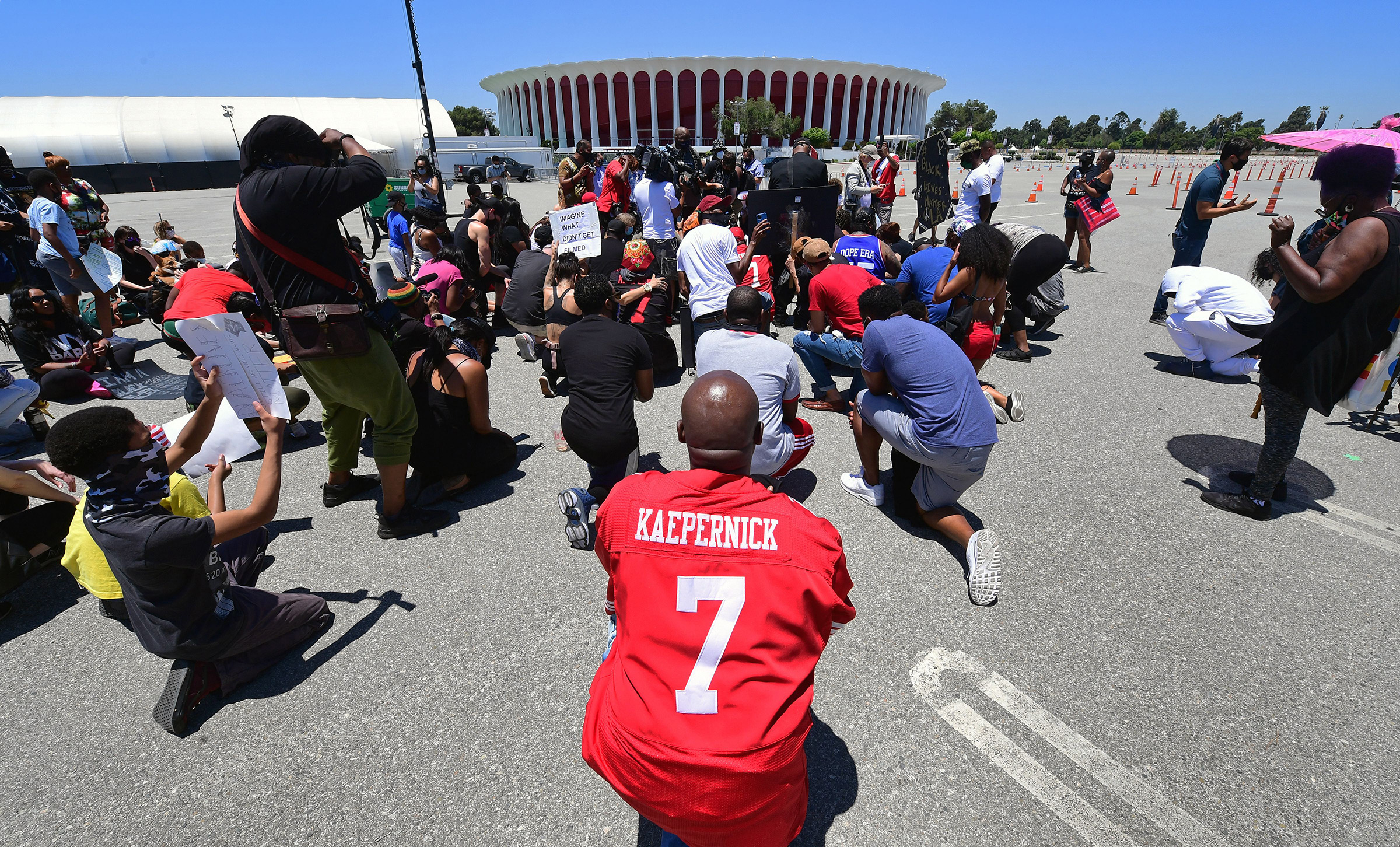
NFL commissioner Roger Goodell admitted, in 2020, that the league was wrong for not listening more closely to the message and meaning behind protests like yours. He encouraged a team to sign you. Do you forgive him?
No, because he’s still taking those actions to this day. That they have not changed their practices. The NFL just went through navigating race-norming, where they were assessing that the baseline intelligence or cognitive abilities of Black players was lower than white players, so that they could deny them medical benefits after playing in the NFL. It’s important to put it into broader context. This isn’t a practice that just exists in relation to me and the protest. [The NFL declined to comment.]
The book details your relationship with Jay-Z, whose company, Roc Nation, partnered with the NFL in 2019 to consult on Super Bowl halftime entertainment and other performances and initiatives. Jay-Z recently brought you up in a rap lyric at Yankee Stadium, saying, “Buddy took a check, I ain’t even mad at him, but along with that check you gotta sign a non-disparagement. I’m the one they can’t control.” How would you characterize how Jay-Z has communicated with you, and used you or brought you up?
The fact that seven years after him cutting a deal to undermine the protest, unprompted, [he] brings me up, sounds like a guilty conscience to me. I would also say, just to make very clear, the distinction here. One, I did not sign a non-disparagement. But the second part of this is these are very different situations. He’s trying to create a false equivalency around being blackballed by the NFL and having to go through the grievance process, the legal process that’s already laid out by the collective bargaining agreement between the NFL and the players’ union–going through that process, and then reaching a settlementat the end of it, because that is your path towards reconciliation, is very different than cutting a deal with the NFL to create personal benefit and undermine the protests. Trying to conflate the two is very disingenuous. [A representative for Roc Nation and Jay-Z did not respond to TIME’s request for comment.]
Are you surprised that DEI is under fire?
I’m not surprised it’s being attacked by this Administration. What I am surprised by is the capitulation by corporations, by organizations to go along with it. What I’ve seen is when you show weakness, that you’ll bow down to them, that you’ll capitulate to them, they’re going to try to take that further and further.
Did you make any mistakes over the past 10 years?
One that I think about a good amount is, I had intentionally taken an approach of I’m going to do my best to not call out or attack people who I disagree with. I did not want to create an environment or narrative that was centered around Black people fighting and distracting from the intention of the protest. Even with Jay-Z, I didn’t go out and do interviews around that. I believe people will see the work, and my hope is in seeing the work, people will look at and say, “Oh, that’s how it should be done.” But I don’t know if that created additional space for people to take the narrative in places that shouldn’t have gone. It’s one of those things that I’m very mindful of as I move forward.
The post Colin Kaepernick on Threats He Faced, His NFL Exile, and That Jay-Z Lyric appeared first on TIME.