Over the past decade, the gene-editing technology known as CRISPR has become a familiar scientific tool, used to create lifesaving cures, make more productive crops, and even engineer allergy-free dogs.
But scientists didn’t invent CRISPR from scratch. They discovered it in bacteria and other microbes, which use it as a defense against invading viruses. On Thursday, scientists reported that they had found another gene-editing defense in nature, this one in viruses themselves.
This system, called VIPR, appears to be more than four billion years old, and it seems be the evolutionary ancestor of CRISPR, the researchers wrote in two papers published in Science.
It may prove to be the more powerful gene-editing tool, with certain advantages over CRISPR. VIPR seems able to target a wider variety of genetic sequences, allowing it to alter more of the genome.
And these molecules are smaller, making them potentially easier to deliver into cells.
“The incredibly small size of VIPR makes these systems transformative tools for genome engineering,” said Philip Kranzusch, a microbiologist at Harvard Medical School who was not involved in the research.
Jennifer Doudna, a biochemist at the University of California, Berkeley, who is an author of the studies, shared the Nobel Prize in 2020 for harnessing the power of CRISPR. After that breakthrough, she began wondering how the natural version of the gene editor evolved.
“It had to come from somewhere,” she recalled thinking. “Maybe it was being used to do something else before, and maybe there’s still evidence of what it might have been doing.”
CRISPR is made up of proteins and RNA molecules that join together to shred viral genes. The RNA molecule consists of a sequence of building blocks that exactly matches the gene sequences of certain viruses.
The RNA locks on to viral genes, and the protein it has brought along cuts the DNA strand, disabling the virus.
Since the first CRISPR systems were discovered in the 1990s, scientists have found them in an ever-growing number of microbes.
By comparing their genes, scientists have gained insight into CRISPR’s evolution. In 2024, researchers concluded that the common ancestors of all living things carried CRISPR molecules.
But where did this DNA-shredding defense come from?
When biologists try looking back that far, the picture gets fuzzy. It’s like peering through a telescope: The farther away you look, the blurrier the stars become.
Two years ago, Peter Yoon, then a graduate student working with Dr. Doudna, set out to build a better telescope. Instead of examining CRISPR genes, he studied the molecules encoded by those genes.
A gene serves as a blueprint for a protein. When a gene mutates, the protein it encodes may also change — but sometimes, a gene mutation will have no effect. Its protein may still retain the same overall shape, even over billions of years.
The shape of a protein determines the chemical reactions it can carry out. Once a protein evolves to do something, it usually just keeps doing it. “Nature is very lazy,” said Dr. Yoon, who is now a member of the technical staff at Anthropic, the A.I. company.
Working with Kenneth Loi, a graduate student, Dr. Yoon sifted through 2.3 million proteins, finding hundreds that had resembled CRISPR molecules but were not part of that gene-editing systems in microbes.
No one had figured out what any of these CRISPR-like proteins were doing. But Dr. Yoon and Mr. Loi did discover one astonishing fact: Almost all of them came from viruses.
“It was a total inversion of what we were expecting,” Dr. Yoon said. CRISPR is a weapon that microbes like bacteria use against viruses. Now the scientists were finding viruses that seemed to carry a version of it themselves.
Dr. Kranzusch noted that this discovery would have been impossible just a few years ago. Artificial intelligence systems now allow scientists to uncover ancient connections between proteins that were hidden until now.
“It’s a beautiful demonstration of the power of these methods,” he said.
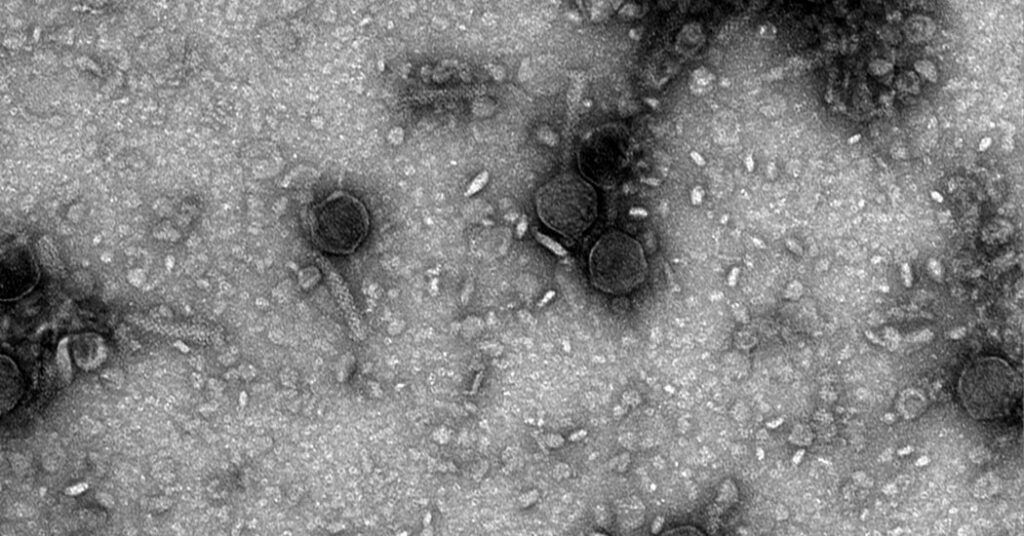
Dr. Yoon and his colleagues named these proteins VIPR and set out figuring out how they worked. That required running experiments on real viruses.
On their list of candidates, they noticed a strain that Dr. Doudna happened to have stored in her lab freezer for other experiments.
“We were so lucky,” Mr. Loi said. “We just thawed the virus and infected some cells and said, ‘Let’s just see what we find.’”
The infected cells made VIPR proteins, which then joined together with viral RNA molecules. And like CRISPR, these molecules targeted viral DNA, the researchers found.
While CRISPR proteins chop up genes, VIPR proteins wrap around them. The effect is the same: The targeted genes shut down.
Dr. Doudna and her students see in this biochemistry a weapon that viruses must be deploying against other viruses. “The whole thing starts to make sense,” she said. “This is some kind of ancient viral warfare.”
The idea is that when two viruses infect the same cell, they have to compete for control of the cell’s molecular machinery. A virus that carries VIPR genes can shut down its rival. The triumphant virus alone gets to replicate within the host.
Dr. Doudna and her colleagues propose that VIPR arose early in Earth’s history, well over four billion years ago. As viruses competed to infect the first microbes, they battled one another with gene-targeting molecules. That struggle continues today.
CRISPR arose from this viral weapon, the researchers suggest, when microbes seized the system for their own use. It’s fairly common for viral genes to accidentally wind up in the genomes of their hosts. (Our own DNA is rife with them.)
“You can imagine VIPR is a gun that viruses are pointing at each other,” Dr. Yoon said. “If the bacteria just steal that, it becomes an immune system.”
It remains to be seen if VIPR can be turned into a gene-editing tool. But its discovery has left scientists wondering if the long-running battle between viruses has produced other genetic weaponry not yet found.
“I would be very surprised if VIPR were the last unexpected targeting system we discover,” said Rafael Pinilla-Redondo, a virologist at the University of Copenhagen who was not involved in the studies.
Dr. Doudna said she felt humbled to think that an ancestor of gene-editing systems was sitting in her lab freezer for years: “It’s a great reminder of how little we still understand about biology.”
The post The Next Gene-Editing Technology May Also Be the Oldest appeared first on New York Times.