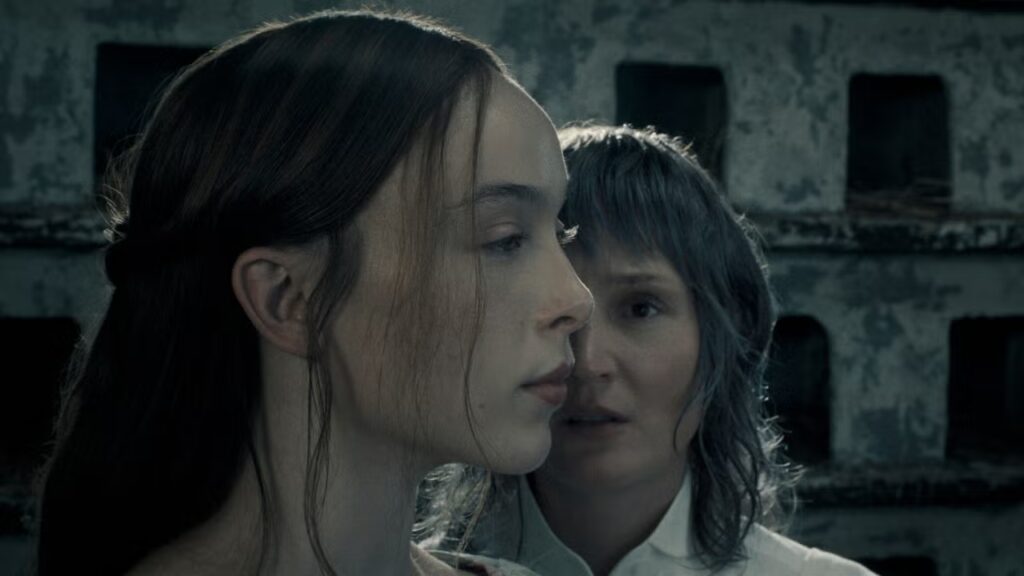
“If you think you’re too small to make a difference, try sleeping in a room with a mosquito.”
Ryan Murphy and Ian Brennan have never been particularly interested in letting a little historical fact get in the way of a good story. With “Monster: The Lizzie Borden Story,” their latest controversy-baiting entry in Netflix’s true-crime anthology, the creative team takes one of America’s most infamous murder cases and gleefully blends it into gothic horror, sexual melodrama and blood-soaked camp. The result is hardly a conventional retelling of the Lizzie Borden case.
Calling it “The Lizzie Borden Story” feels almost deliberately misleading. The real Borden was a 32-year-old woman when her father, Andrew, and stepmother, Abby, were murdered with an axe in their Massachusetts home in 1892. She was tried for the killings and acquitted, yet no one knows what exactly happened inside that house.
Murphy and Brennan have a different question: What if we just make up what happened before the axe came down?
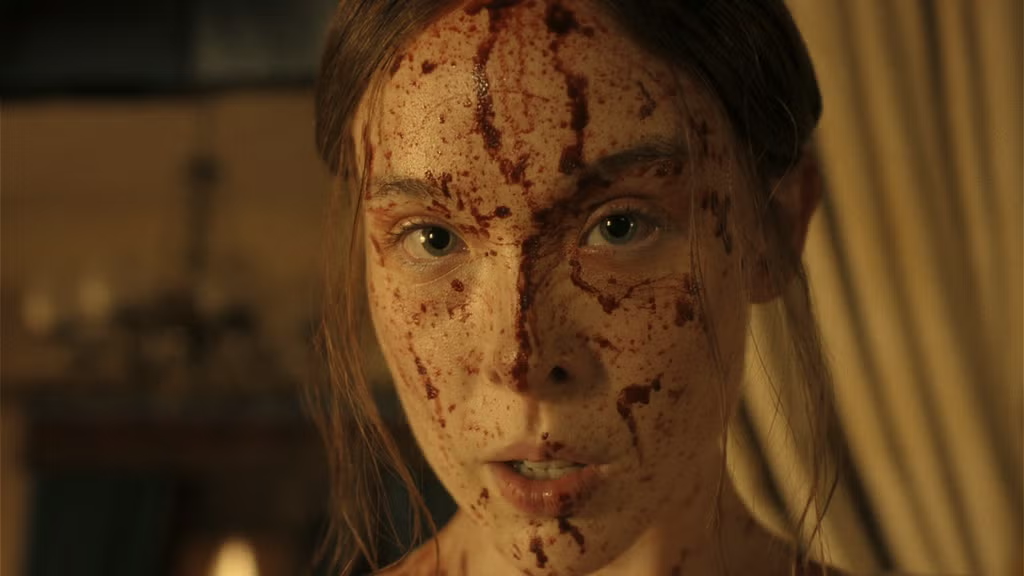
“The Lizzie Borden Story” opens with the murders before rewinding four months, introducing Lizzie (Ella Beatty) as an isolated, peculiar girl living under the thumb of an abusive family. Her father (Charlie Hunnam) is a wealthy coffin-maker who loves his pipe, his axes and the various household maids. Abby (Rebecca Hall), meanwhile, has little patience for her stepdaughter, and when she dismisses her new maid, Bridget (Vicky Krieps) as “Maggie,” the name of the previous maid, it becomes clear that basic human consideration isn’t high on Abby’s list.
Bridget changes Lizzie’s world as the soft-spoken but calculating maid. Krieps gives the character an almost deceptively gentle quality as she becomes Lizzie’s confidante, lover (what’s a Ryan Murphy series without fabricated homoerotic tension?), and eventual partner in rebellion. Together, they occupy a strange little corner of the Borden household where female friendship, sexual curiosity and murderous intent become increasingly difficult to separate.
Murphy and Brennan are not shy about any of it.
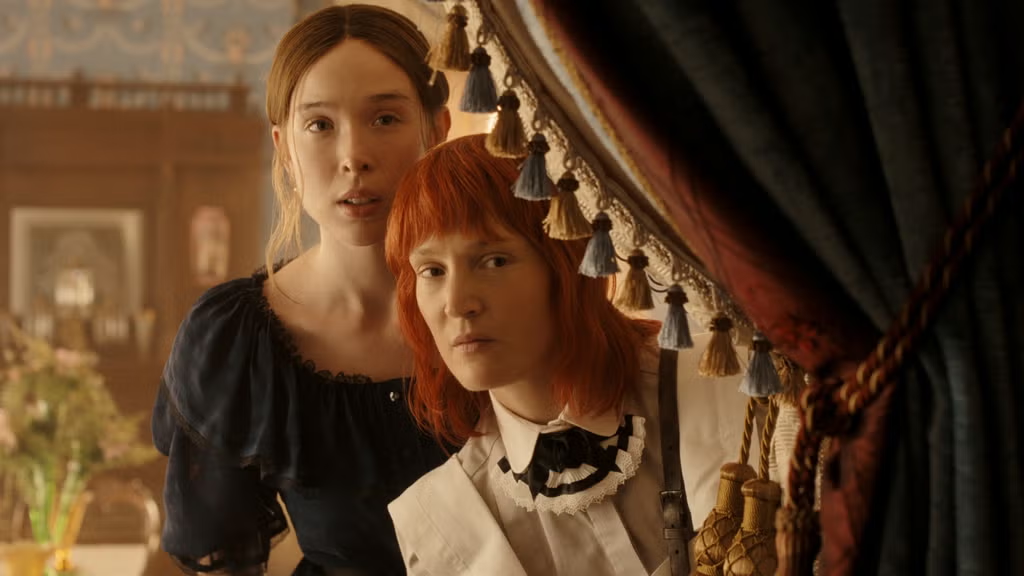
Menstruation, sexual repression, abortion, lesbian desire, and the mythology surrounding women who kill all become central to the show’s increasingly elaborate stew. There are poisoned meals, bloody corpses, severed heads, birds meeting unfortunate ends, and enough axes flying around to make Andrew’s business seem like the least interesting thing happening in his home. All of this makes “The Lizzie Borden Story” frequently hilarious, even when it isn’t necessarily trying to be.
The production has a heightened quality with ornate period interiors and a visual style that occasionally makes it feel less like a real Massachusetts town and more like a deranged fairy tale. The music incorporates modern overlays with a Kate Bush song working far better than the aggressively obvious use of “Bitter Sweet Symphony” during trial sequences. Then there’s the Lambrini Girls’ “Cuntology 101” blasting during a poisoning sequence … a choice so unsubtle that resisting it would almost defeat the creators’ point.
This is not a show interested in subtlety.
Beatty plays Lizzie with an inscrutable blankness that makes her difficult to read even as the series piles trauma upon trauma around her. That restraint is useful because everyone else seems to be operating several decibels above normal. Hunnam’s Andrew is a swaggering patriarch whose casual cruelty makes him an easy target for the show’s feminist revenge fantasy.
Rebecca Hall is the real scene-stealer as Abby is a shrill, vicious delight, and Hall attacks every ridiculous line as if it were Shakespeare. She understands that the only way to survive material this embellished is to commit completely. She lets Abby chew through every word and every opportunity to make herself even more insufferable.
Then, halfway through the story, “Monster” does what “Monster” increasingly does every season: It brings another famous killer into the picture for absolutely no reason.
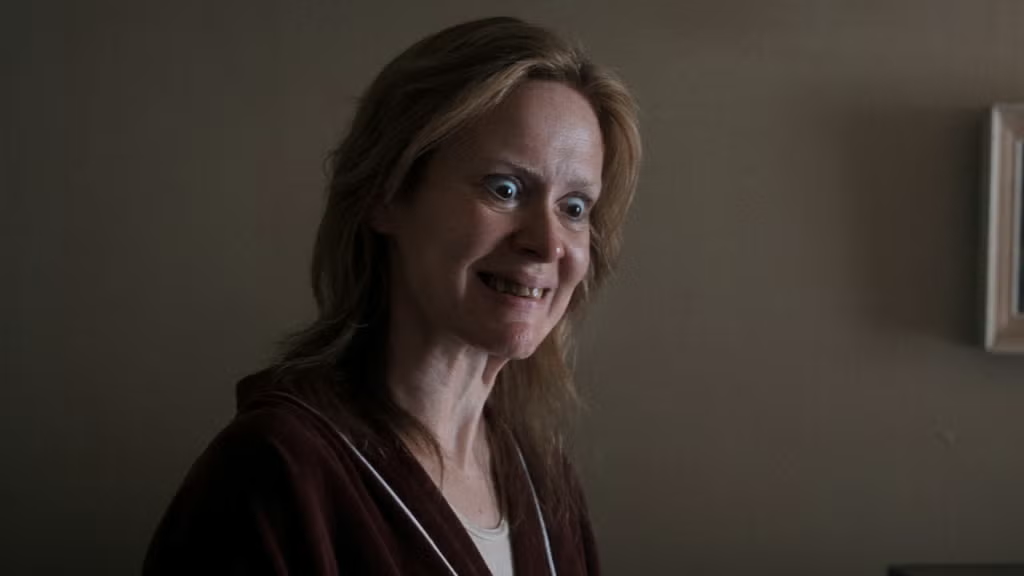
Sarah Paulson suddenly appears as Aileen Wuornos, the Florida serial killer whose story was previously adapted in the aptly titled 2003 film “Monster,” which won Charlize Theron an Oscar. Wuornos lived nearly 100 years after Borden and has no obvious connection. In the series, Wuornos becomes part of Murphy’s strange conversation surrounding female violence.
Paulson’s performance is manic, twitchy and unnerving, capturing the physicality associated with Wuornos without making the character another true-crime caricature. Netflix’s “Monster” anthology has previously tried to connect notorious killers across time, but the Wuornos scenes feel particularly detached from the Borden story. It is also difficult not to notice how much more compelling Paulson’s scenes can be (why not just do an Aileen Wuornos season and leave Lizzie Borden to rest?).
At times, “Monster: The Lizzie Borden Story” feels like a bunch of talented performers turned loose in an exceptionally expensive gothic playground. Hall is having a ball, Krieps is terrific and far more interesting than Beatty’s Lizzie, while Paulson seems to be playing in an entirely different, equally compelling show. The blood flows freely, the dialogue gets increasingly outrageous, and the production never seems particularly concerned with whether any of it could have happened.
“The Lizzie Borden Story” doesn’t solve the mystery of what happened in that Massachusetts home. It doesn’t really seem interested in solving the crime, but rather in showcasing the many women involved so viewers can make their own interpretations. Ryan Murphy and Ian Brennan, along with frequent collaborator and director Max Winkler, have created their own bloody mythology around the axe at the center of the action. It’s one where patriarchal cruelty meets female revenge, with history merely the jumping-off point.
If that sounds like a mess … it is.
“Monster: The Lizzie Borden Story” is now streaming on Netflix.
The post ‘Monster: The Lizzie Borden Story’ Review: Netflix’s Most Grueling Season Yet appeared first on TheWrap.