Every so often — quite often, in the convulsive 20th century; less often, in the algorithmic 21st — an artist attuned to the tremors of the times can sense a new style in culture, and reap a windfall if they move early and go big.
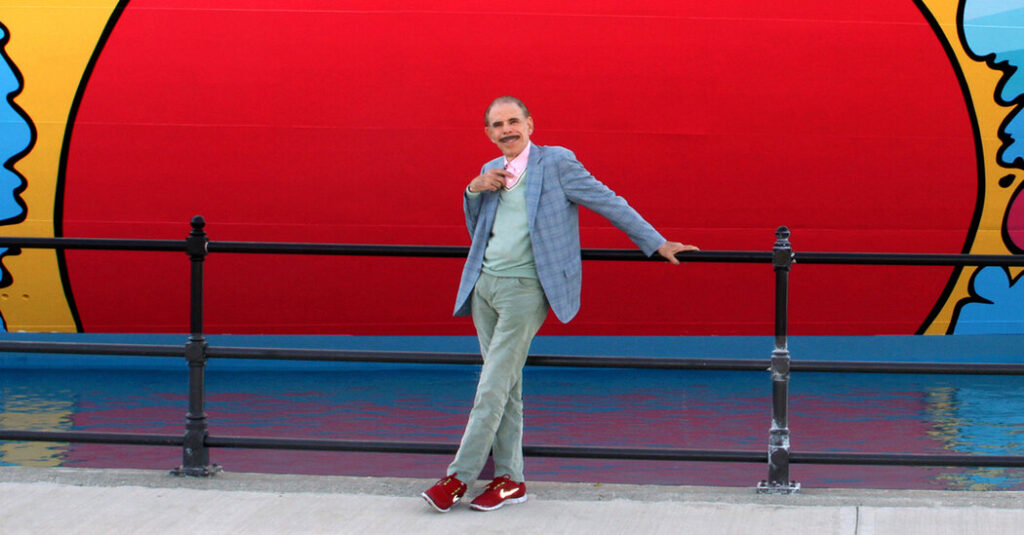
For a time in American art, the most attuned cultural seismologist was Peter Max, who produced feel-good psychedelia on an industrial scale starting in the late 1960s, and who died on Monday at the age of 88 after a yearslong struggle with dementia. His colorful illustrations and graphics became omnipresent in the idealistic haze of the counterculture, and not only via Peter Max posters of cosmic sunrises and rainbow-hued acoustic guitars. There were also Peter Max high-top sneakers in the hallway, Peter Max bedsheets on the mattress, and Peter Max inflatable plastic pillows, festooned with falling stars or butterflies — the kind you might need as you came down from a high.
Visually, he was a quick study and a fine mimic; where he was really a trailblazer was in commerce. His graphics of the mid-1960s drew heavily, even brazenly, on the examples of Milton Glaser, Seymour Chwast and Edward Sorel, among the founders of PushPin Studios, whose heavy ornament and flat planes of high-contrast colors revolutionized graphic arts in the late 1950s and ’60s. That Max’s work was derivative was no trouble for ad agencies, and in any case he would quickly leave his design company, become an early practicer of yoga, and channel the new spirit of the age into peace-and-love motifs.
Rather than confine himself to individual paintings or even limited-edition prints, Max cannily founded a poster company that ground out millions of these hot-colored images — the first of many distribution businesses and licensing linkups that would eventually use his name without his input. It was mass distribution, rather than the museum, that made his name and his fortune. His disembodied head floated on the cover of Life magazine, shaggy hair down to his ears, Day-Glo stars and planets behind him, and dollar signs in the lower right corner. The headline was “Peter Max: Portrait of the Artist as a Very Rich Man.”
Museums in America today endeavor to unearth Pop’s angry side; the Guggenheim is currently exhibiting Pop artists in the light of war and violence of the 1960s, while the Whitney Museum of American Art will soon open a Roy Lichtenstein retrospective zeroing in on the alienating effects of mass media. Max, who immigrated from Germany to Shanghai, then Israel, then Brooklyn, substantiated a more enduring truth of Pop: It was, like the American counterculture more generally, entirely assimilable to capitalist consumption, and peace and love were just two more consumer goods.
“Peter Max was just a businessman trying to be an artist,” Andy Warhol wrote in his diaries, “and now he gets $100,000 for a portrait.” He earned more than that producing trippy clocks for General Electric and advertisements for the New York City Marathon, the Grammy Awards and several Super Bowls. By 1981 he would set up his easel on the White House lawn, painting the Statue of Liberty and inviting President Reagan to insert a final flourish.
For the cultural establishment all this was beneath notice; for the public it was popular enough that the Postal Service got in on the act. But his was a business you could only run at another cultural time, and another economic time too. Max typified an American era of generally increasing prosperity and optimism for the future, when the pink-and-green sheets you bought at the department store could make you feel something new was dawning. When the economy goes K-shaped, when the mall closes, you need a different distribution model than the mass market. In this century, Max’s art would be found on cruise ships making round-trip voyages from Fort Lauderdale, Fla., on which travelers bid on “Peter Max” products created, in many cases, by battalions of day laborers paid the minimum wage. As dueling accusations of fraud and maltreatment swirled throughout his later years, Max’s wife, Mary Max, died by suicide in 2019.
But he never lost his appeal to a certain sort of observer, the sort who sees America shining. “His art is like another world to me,” Taylor Swift said in 2010 when Max painted her portrait — or, more precisely, painted an adaptation of the photograph on one of her album covers. In her youth, Swift remembered, on family vacations to Cape May, she would walk past a commercial gallery with pictures in the window, “and stop in my tracks whenever there was a Peter Max painting on display.”
What Swift saw in Max’s painterly products, encountered not in snooty museums but through cash-and-carry dealers at the Jersey Shore, was a benign and still enduring fantasy of individual expression at corporate scale. She knows better than most of us what is a true American art form.
The post Peter Max Franchised the Cosmic ’60s Into Commercial Success, Without the Museum appeared first on New York Times.