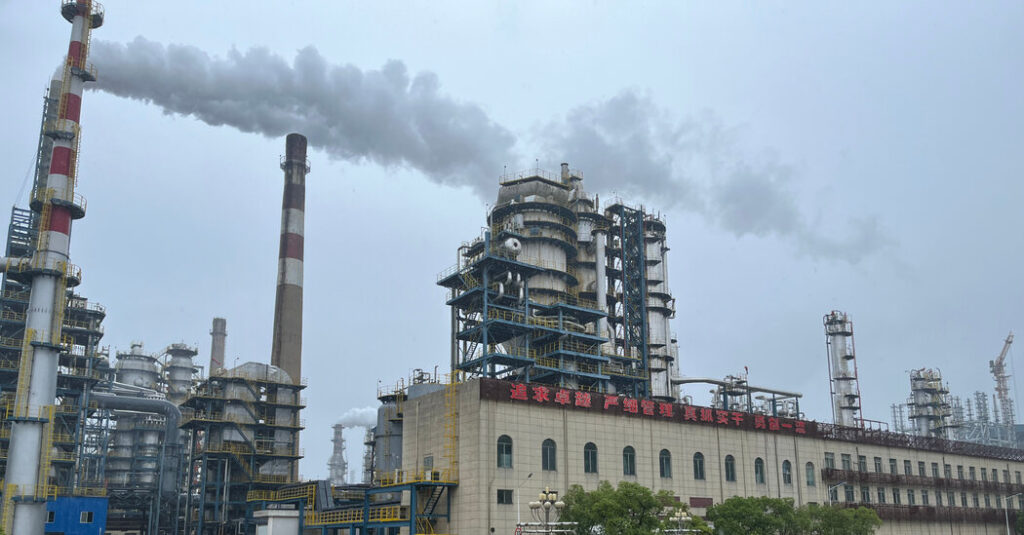
One of the most important lessons from the war with Iran is one that few saw coming.
The conflict has made clear that China, which has long been highly vulnerable to oil supply shocks, has managed to transform that weakness into a surprising source of geopolitical power. The country made that big shift by stockpiling huge amounts of oil, building extra oil refining capacity and investing in coal and other alternatives. And in the early months of the war, it flexed that power by cutting off supplies of jet fuel, gasoline and diesel to neighboring countries.
That has big implications for the global energy industry, where oil producers like Saudi Arabia and the United States — not importers like China — have traditionally held most of the cards.
Already dominant in solar panels, batteries and electric vehicles, China now appears to have an unparalleled position across the energy landscape. As a result, the threat that a foreign power would restrict the country’s access to oil may no longer deter leaders in Beijing from taking aggressive steps like invading or blockading Taiwan, former U.S. officials said.
“If they come to feel that in this domain, they are less vulnerable than they and many others may have assessed previously, that is a profound and important shift in one of the key inputs to how China makes decisions about its global strategy,” said Julian Gewirtz, a former White House and State Department official who worked on China issues in the Biden administration.
China’s massive oil reserves and refining capacity, paired with its ability to run its economy on a variety of energy sources, allowed the country to slash oil purchases by 23 percent in the first six months of the war with Iran compared with the same period the year before, customs data show. Other countries that rely heavily on crude oil from the Middle East didn’t have those options and were forced to use less energy or pay much more for it.
China’s ability to throttle oil imports caught nearly everyone in the oil industry by surprise. And it’s a big reason crude oil prices have not risen nearly as much as most energy executives and analysts thought they would once Iran severely restricted the passage of ships through the Strait of Hormuz. As of late August, crude oil cost roughly $10 a barrel less than it would have had China continued buying at prewar levels, according to Daan Struyven, who leads oil research for Goldman Sachs.
“This is a power that nobody thought China had,” said Erica Downs, a senior research scholar at Columbia University’s Center on Global Energy Policy. “Going forward, it’s going to be really interesting to see: What does China do with this newfound power?”
Next week’s scheduled meeting between President Trump and China’s leader, Xi Jinping, at the White House, may provide some clues.
China’s actions, even in just the past few months, suggest it will not be shy about using energy as a political tool. The country depends heavily on foreign crude oil, but it is one of the world’s biggest oil refiners. And early in the Iran war, the country ordered severe restrictions on exports of refined fuels like gasoline and diesel, both to conserve domestic supplies and to punish countries at odds with China’s foreign policy.
What little China did export this spring, when supplies were especially tight, went mainly to countries that maintain close ties to Beijing, like Vietnam and Thailand. Australia and the Philippines, which have been at odds with China because of its territorial claims in the South China Sea, were among those that lost out. Such actions echo the restrictions that China has placed on exporting rare-earth metals used in magnets and computer chips.
China resumed wider exports of jet fuel, gasoline and diesel in early July. But the last shipments of Iranian oil, sent before the United States imposed a blockade, now seem to have arrived at small refineries in China that operate separately from state-owned giants, said Tom Reed, a longtime specialist in China’s oil industry at Argus Media, a commodity pricing firm in London. He warned that China might reimpose a ban on fuel exports soon. Taking yet another source of diesel off the market could cause a further jump in prices, which are at a record of $6.40 a gallon in the United States.
China’s sway over the crude oil market is different from that of oil-producing countries because China imports more than it produces. The country tends to reduce oil price volatility, lifting prices when it is stocking up — as it was last year — and easing them when it is not, as has happened since the war started, Goldman Sachs analysts wrote recently.
China is uniquely influential because it is such a big buyer and its autocratic government exerts the kind of control that policymakers in democratic countries lack. The extent of Beijing’s sway is becoming clear as fractures develop in the Organization of the Petroleum Exporting Countries, an oil producers’ cartel that has long been the most powerful force in the oil market.
“Have they fully wrested control? No,” Dr. Downs said of China. “But are they a force for OPEC to reckon with? Yes.”
China’s steep drop in oil imports this year reflects two main changes. The country is no longer stockpiling oil and has begun using some reserves. And its refineries have cut back sharply on turning oil into gasoline, diesel and other fuels.
That is partly because Chinese demand for oil has weakened so much that consumption most likely peaked last year, ahead of forecasts, Sinopec, the country’s biggest refiner, has said. Electric vehicles now make up around 14 percent of the passenger cars on the road in China, a large enough share that the country used 1.5 million barrels a day less oil in the second quarter than it would have with only gasoline or diesel cars, trucks and buses, according to the International Energy Agency. That shaved more than 1 percent off global oil demand.
China also has a robust high-speed rail system and the ability, not widely shared by other countries, to use coal, rather than oil, to make chemicals.
The precise mix of tools China has used to reduce oil imports has been the subject of intense debate because Beijing discloses very little. “I try to follow every little piece of data, and all of it is conflicting and all of it is maddening,” said Rory Johnston, an oil market researcher.
China recognized the value of establishing government oil reserves relatively late, after becoming a net oil importer in 1993. The United States and others set up large reserves after the energy crises of the 1970s.
China caught up quickly, however.
“Every effort must be made to conserve and substitute oil, accelerate the exploration and development of oil and natural gas, actively utilize overseas resources, and establish a reserve system for oil,” China’s premier at the time, Zhu Rongji, told the country’s legislature in 2001.
That energy security strategy was motivated partly by fears that the U.S. or Indian navies could block oil shipments from getting to China from the Middle East through the Strait of Malacca, a small channel between Indonesia and Malaysia.
Mr. Xi has maintained those priorities, overseeing the growth of stockpiles that now represent roughly a third of known oil inventories worldwide.
Low interest rates triggered by a severe housing market crisis since 2021 facilitated the recent buying spree by Beijing and its state-backed oil companies. When interest rates are high, the costs for buying and storing oil are steep. Unlike bonds or dividend-paying stocks, oil does not generate income unless it is sold. But when interest rates are very low, governments and companies see little difference between holding cash and holding commodities like oil.
Among the big questions now, with the main global oil price hovering around $103 a barrel, is how much China will buy in the coming months, as well as how much of that crude it will turn around and sell in the form of diesel and other fuels. Oil imports climbed 6 percent in August from July but remained well below prewar levels.
“Think about how much geopolitical influence Saudi Arabia has had over the decades because of its ability to modulate production,” said Meghan O’Sullivan, a deputy national security adviser for Iraq and Afghanistan under President George W. Bush. “If China has that ability on the demand side, then they become an actor that the U.S. and others will go to and ask them for that behavior in exchange for potentially something else.”
Ruoxin Zhang and Murphy Zhao contributed research.
The post As a New Oil Power, China Gains More Sway Over Energy Markets appeared first on New York Times.