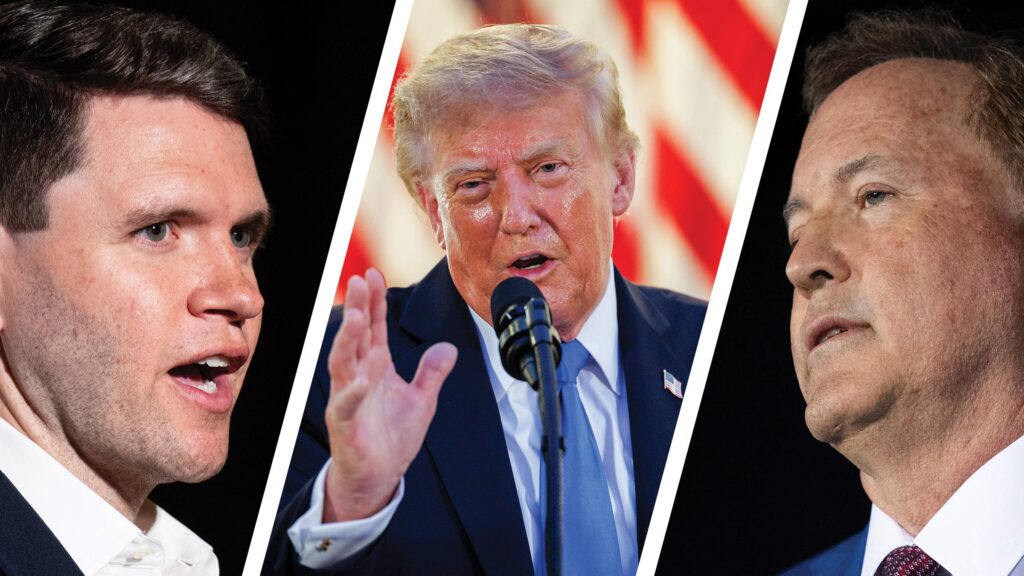
If the GOP squanders this fall’s U.S. Senate race in Texas, some Republicans argue privately that President Donald Trump would bear part of the blame.
Trump’s sagging approval ratings, his handling of the GOP primary, and his early hesitance to use his enormous war chest to defend his preferred candidate, the scandal-scarred attorney general Ken Paxton, have boosted Democrats’ chances to win a statewide election in Texas for the first time in more than 30 years. Paxton lags slightly behind his Democratic opponent, state representative James Talarico, in several recent polls. More alarming to party strategists, Talarico has outraised Paxton by enormous margins, giving the Democrat the resources to compete in a huge and expensive state that the GOP did not plan to defend so fiercely.
Mark Jones, a Texas politics expert at Rice University’s Baker Institute for Public Policy, describes the contest as a “perfect storm” for Democrats. “You have a very unpopular Donald Trump in the White House,” Jones says. “You also have an economy that is viewed negatively by a majority of Texans. The most flawed major statewide candidate that the Republican Party has had in modern memory. And we have a Democratic candidate who, while not ideal, is a very credible politician.”
Trump has the resources to help rescue Paxton: his affiliated super PAC, MAGA Inc., was sitting on more than $400 million this summer as the Republican begged for help. Initially, the President didn’t want to invest heavily in the race. According to three sources familiar with Trump’s thinking, including a senior White House official, Trump harbors doubts about the GOP’s midterm outlook. In private conversations, he has mused about how the money would simply be wasted, citing the history of a President’s party suffering defeats in midterm elections. A senior Trump adviser tells TIME that the President’s political operation has plans to spend tens of millions in the coming election cycle but won’t telegraph their strategy to the press and the opposition. “People are clutching their pearls because we’re not giving away our grand strategy,” the adviser says.
Other aides say there is another reason Trump has been careful to disburse funds: he wants to save as much as cash as he can for 2028 and even 2030, when his presidency would be ending or over, seeing the money as a means of exerting continued influence over the party. “He wants to have as much money in his account as possible when he’s no longer able to raise the kind of money he can now,” one Trump aide says. “He doesn’t seem to care that much about the midterms, thinks they’re a lost cause anyway, and wants to preserve future possibilities.”
Only after weeks of pressure from allies did Trump’s super PAC finally intervene, committing $10 million on Sept 5. to bankroll ad campaigns in Texas to promote Paxton and attack Talarico. When Republicans gathered in Dallas for an extravagant two-night midterm convention this month, Trump’s endorsement of Paxton and praise for his record came wrapped in jabs at his appearance, his sense of fashion, and his shortcomings as a television performer.
The result is a race Republicans once assumed would be easy becoming one of the most competitive and costly in the nation. For Trump, more than a Senate seat hangs in the balance. “I don’t think they fully understand what’s going to happen when we lose the House and Senate,” says Steve Bannon, Trump’s former chief strategist. “It’s going to be ‘Fort Apache’ everyday: subpoenas, investigations, impeachments, criminal referrals—the Democrats are perfecting the playbook they ran starting under Pelosi and Biden. Get ready for a near-death experience “
The Texas Senate race occupied an unusual amount of attention inside Trump’s political operation as far back as late 2024. The four-term incumbent, John Cornyn, was a Senate stalwart and close ally of the chamber’s top Republican, John Thune. But he had grown less popular with the party’s base, and Trump wanted him gone. Despite Cornyn’s record of voting with Trump 99% of the time, the President had not forgotten Cornyn’s pointed criticism of Trump’s culpability over the January 6 riots, or his hesitance to endorse Trump during the presidential primary.
But Cornyn only had one serious challenger at the time: Ken Paxton. And Paxton had obvious vulnerabilities.
Indicted on felony securities-fraud charges months after taking office in 2015, Paxton spent nearly nine years fighting the case before prosecutors dropped it in a deal requiring hundreds of thousands of dollars in restitution, as well as community service and legal-ethics courses. In 2023, the Republican-controlled Texas House impeached Paxton over separate allegations that he’d abused his office to benefit a wealthy donor—charges he denied and was later acquitted of by the state Senate. In 2025, his wife filed for divorce, accusing him of adultery. Paxton had already admitted to an affair in 2018, after having recommended the woman for a job at one of his top donor’s real estate companies.
All that made Wesley Hunt see an opening. The 44-year-old congressman—a West Point graduate, combat veteran, and one of the few Black Republicans in Congress—went to the White House in March 2025 to pitch himself for the job as an alternative who brought MAGA credentials without Paxton’s baggage. Hunt had commissioned polling that showed Cornyn was unpopular with Texas Republicans. He told Trump that the incumbent couldn’t win a GOP primary in Texas but that Paxton would struggle to win a general election. Republicans, Hunt argued, needed a third option—or to find a way to remove one of the two men from the race.
Trump was reluctant. Few voters statewide knew Hunt, and Trump needed Cornyn in the Senate to help enact his domestic agenda and confirm his nominees. While Trump’s advisers saw that Paxton’s political and personal liabilities threatened to make the general election considerably more difficult, the President viewed him as a loyal foot soldier. A source close to Trump encouraged him to offer Cornyn a graceful exit, perhaps a cushy job in the administration or ambassadorship. But Cornyn made clear he intended to seek another term.
With Cornyn in the race, some of Trump’s own political operatives enlisted in the effort to help him stave off Paxton and protect the seat. Chris LaCivita, a senior adviser on Trump’s 2024 campaign and top official at MAGA Inc., signed on with Texans for a Conservative Majority, the super PAC supporting Cornyn. Trump’s longtime pollster Tony Fabrizio joined as well. Their argument was simple: get Cornyn through the primary and avoid Republicans having to spend a fortune defending Texas in November.
It made little impression on Trump. Again Hunt, who launched his campaign in October 2025, pressed his case. A JL Partners poll conducted in January showed Paxton, Cornyn, and Hunt in a statistical tie, with Hunt leading either man in hypothetical head-to-head contests. Another poll from the GOP polling firm Cygnal showed Paxton narrowly ahead of Hunt with Cornyn behind both of them. Hunt’s aides took the numbers to Trump’s and Thune’s teams, arguing that if Cornyn could be persuaded to step aside, Hunt could beat Paxton and spare Republicans the general-election risk they feared. They were dismissed. But Hunt was becoming enough of a threat that Cornyn’s allies began treating him like one, spending nearly $13 million attacking Hunt. A Paxton-aligned PAC spent another $1.4 million.
As the March primary approached, LaCivita pressed Trump to endorse Cornyn. “He was practically begging him,” a senior White House official tells TIME. (LaCivita declined to comment.) Trump still wouldn’t do it. Texas allies warned that rescuing Cornyn could damage his standing with the base.
Cornyn’s allies continued the persuasion campaign after the primary, which advanced the senator and Paxton to a runoff. According to a White House aide, Thune spent hours on the phone with Trump after the primary, trying in vain to persuade him to endorse Cornyn in the runoff. For more than two months, Trump resisted choosing between them. By May, however, Paxton had pulled decisively ahead. Trump’s own pollsters concluded that even his endorsement was unlikely to save Cornyn. Trump finally endorsed Paxton a week before the runoff, and took credit for the victory.
Since then, Paxton has struggled to raise funds necessary for a competitive Senate race in one of the nation’s largest states. Neither the Senate Leadership Fund, aligned with Thune, nor MAGA Inc., run by LaCivita, was eager to fill the gap. Despite its enormous cash reserves, by late August, MAGA Inc. had spent just $800,000 overall; its most conspicuous intervention was to help Darline Graham win the Republican nomination to succeed her late brother, Lindsey Graham, in South Carolina.
That left Paxton’s camp looking to Elon Musk as a possible savior in a race Republican officials believed could cost north of $120 million. Musk had pledged to help Republicans in the midterms, but in Texas his money presented political complications. He is a prominent champion of AI data centers, a political flash point in Texas—the state’s governor, Greg Abbott, recently declared a moratorium on data-center development amid vehement backlash—and of H-1B visas, which are unpopular with parts of the Republican base. “Elon’s money is tainted,” says a Texas Republican operative working on the Paxton campaign. Musk’s super PAC has funneled roughly $1.6 million into the race to help Paxton. A spokesperson for America PAC declined to comment for this story.
It wasn’t until recently that Trump finally opened his wallet with a $10 million Texas ad buy—one of its first general-election expenditures of the cycle. “I’m going to help Ken Paxton,” Trump told reporters, “and I’m going to be spending a lot of time in Texas.”
The Senate Leadership Fund shelled out $54 million to help save Paxton. “The Republican Party is united to elect Ken Paxton and keep Texas red in November,” says the PAC’s executive director Alex Latcham. “Senate Leadership Fund’s investment through Texas PAC affirms our commitment to maintaining the Republican majority.”
When Trump brought his midterm convention to Paxton’s home state, the hope among allies was that it might give one of the party’s most vulnerable candidates the attention and momentum he needed. But the gathering proved less of a windfall than Republicans might have hoped. Some lawmakers balked at the steep price of admission—tickets ran from $5,000 to $250,000. Empty seats were visible inside the arena. When it came time to promote Paxton on stage, Trump urged Texans to elect him—and promised to return to the state “twice or three times” if necessary.
But even his endorsement came packaged as a roast. “He may not dress right. He may not talk perfectly. He may not be the best-looking guy I’ve ever seen,” Trump said. “But you know what he is? He’s the greatest attorney general in America and he deserves to be your next senator.” Trump then looked around for the candidate he had just finished insulting. “I’m sorry, Ken,” he riffed. “Where the hell is he?”
The post How Trump Helped Put a Texas Senate Seat In Play appeared first on TIME.