Across the South, from the Mississippi Delta to Georgia’s suburbs, Black Democratic candidates are imploring Black voters to rise up and secure the representation this November that they were expected to be denied with the gutting of the Voting Rights Act.
The hill is high, and Republicans remain supremely confident, but Democrats are trying to contest races typically seen as too far out of reach.
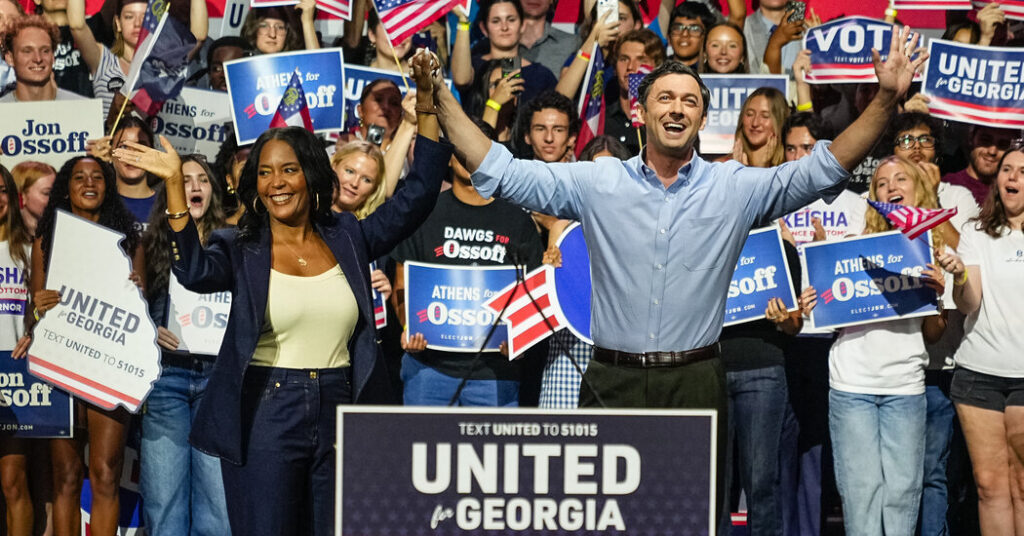
Keisha Lance Bottoms, the former Atlanta mayor, remains in a tossup contest to be the next Georgia governor, despite being outspent 9 to 1 by her deep-pocketed Republican opponent, the businessman Rick Jackson.
In Mississippi, Scott Colom, a state prosecutor running for the Senate, is seeing a rare infusion of national cash in his bid to defeat the incumbent Republican, Senator Cindy Hyde-Smith.
In Florida, Black voters helped State Representative Angie Nixon overcome a lack of establishment support and fund-raising to become the party’s nominee for the Senate.
In Alabama, Republicans tried to redistrict Representative Shomari Figures to defeat, but his seat, stripped of many but not all of its Black voters, may somehow still be within reach. And the impact could extend to states that pushed ahead with redistricting before the Supreme Court decision. In North Carolina, another Black Democrat, Representative Don Davis, remains in the running for the district the Republican legislators redrew against him.
Turnout in Democratic primaries was higher this year than in recent midterms, as many races saw competitive primaries for the first time in years and as President Trump has become increasingly unpopular.
In Alabama, Georgia and North Carolina, Black and white voters both turned out in Democratic primaries at higher rates than in 2022, according to a New York Times analysis of the makeup of the electorate in states where an individual-level accounting of primary turnout was available. The increase was not driven by a surge among any particular racial group, and Black voters made up a slightly smaller share of the Democratic electorate in 2026 than four years earlier.
But with the general election looming and Republicans as their opponents, Democrats are hoping enthusiasm among Black voters, still the backbone of the party, will crest in the South, where segregation and the civil rights movement led to the Voting Rights Act. Here, the opportunity for fair representation remains deeply personal.
“One can walk away from that and say, ‘Well, my vote’s not going to matter in this election,’” said the Rev. Jay Augustine, senior pastor at Big Bethel A.M.E. Church in Atlanta. “What I’m seeing on the ground is just the opposite. People are like, ‘No, my vote is going to matter. I’m going to stand tall.’”
There are early signs that some races are narrowing more than expected. Democratic candidates in Tennessee and Louisiana have released polls that show them within striking distance in conservative areas that Mr. Trump won by double digits. At least one nonpartisan political analyst has moved Mr. Figures’s district to leaning Republican, from safely Republican.
“Discussion around voting and access to the right to vote is energizing, period,” Ms. Bottoms said in an interview in Athens, Ga., shortly before taking the stage at a joint rally with Senator Jon Ossoff, a Democrat who is also counting on Black voter enthusiasm.
Republicans remain confident they can hold off Southern challengers. As they pushed new House maps after the Supreme Court’s voting rights decision, they argued their gerrymanders were based solely on a quest for party advantage, not racial discrimination.
The situation for Democrats is complicated in Florida, where Ms. Nixon leads the Democratic ticket but a Black Republican, Representative Byron Donalds, is his party’s nominee for governor. Several Black Democrats have endorsed Mr. Donalds over former Representative David Jolly, the Democratic nominee, who is white.
The fact is, Democrats in the South cannot win on Black votes alone. Even in 2008, when a record surge of Black voting helped send Barack Obama to the White House, all but two Southern states voted Republican. Mr. Obama mustered a modern high-water mark for a Democrat in Mississippi, the state with the highest percentage of Black voters, but that amounted to about 43 percent.
“Democrats will foolishly waste time and money trying to compete in solidly Republican districts where they have zero chance of winning,” said Reilly Richardson, a spokesman for the National Republican Congressional Committee.
After the Supreme Court decision, the Southern Republican redistricting push targeted seats in Tennessee, Louisiana and Alabama where Black voters had helped elevate Democratic lawmakers to power. The push continues; Mississippi state lawmakers are holding a series of redistricting hearings, which could lead to redrawing the map to target Representative Bennie Thompson, a Black Democrat.
That may energize Black voters ahead of November’s election, potentially to the benefit of Mr. Colom, who saw his nomination to a federal judgeship blocked by Senator Hyde-Smith during the Biden administration. He has leaned into his record as a prosecutor in Mississippi, while criticizing Republicans for making deep cuts to federal health care programs and failing to address high prices in one of the nation’s poorest states.
“We want to make sure that we have massive turnout,” said Sinessa Wilburn, 53, who attended a redistricting hearing in Meridian, Miss. “I want an Obama turnout, OK?”
Few Democrats campaign in the South without invoking civil rights. But the Supreme Court ruling has sharpened that message. By ensuring Black majorities in a number of Southern House districts, the Voting Rights Act increased the number of Black lawmakers in Congress and shaped policy and funding for otherwise underserved communities.
Without it, “we’re losing what so many people fought for — we would lose that one voice, one vote,” said Carolyn Rash Hampton, 78, who recounted to Mississippi legislators this month how she graduated from a segregated school northeast of Jackson, Miss.
In Mound Bayou, Miss., a Delta town built by formerly enslaved people as a mecca for Black independence and prosperity, Mr. Colom concluded his speech recently with a reference to the Supreme Court decision and the fallout in the Legislature.
“They don’t want to compete for the voters in the Delta,” Mr. Colom said to murmurs from the crowd. “They want to pick y’all’s congressman for y’all.”
“But,” he added, “thank God our ancestors gave us the one power we needed.”
Mr. Figures, speaking to a room of students and staff members at Tuskegee University this month, said the redistricting showed “an arrogantly high level of confidence that certain people in certain positions have that people are not going to go vote.”
He conceded that some voters, particularly younger ones, could feel disenchanted by new district lines designed to limit their power.
“How do we motivate younger voters to be able to go out and have a vested stake in what’s going on?” Mr. Figures asked, saying the civil rights movement felt as distant as World War I felt to him growing up.
Skyler Carrillo, 21, a college senior, pressed Mr. Figures about what could be done outside of the courts to respond to the ruling. A member of the historically Black fraternity Kappa Alpha Psi, Mr. Carrillo is planning a forum this month to encourage students to vote.
“I know it’s hitting Alabama hard,” he said. “We can’t say our vote doesn’t matter if we aren’t going out to take that vote and take that chance.”
There are also money challenges.
“All Democrats who are in more safe seats should come to the South and help fight and give money,” said State Representative Justin J. Pearson in an interview before he clinched his primary for the Ninth Congressional District in Tennessee, a Democratic stronghold that was redrawn to guarantee a Republican pickup but that Mr. Pearson is still fighting for.
Some civic education and voting rights efforts had already been in the works, like a nonpartisan education partnership run by the National Civil Rights Museum, housed at the Lorraine Motel where the Rev. Dr. Martin Luther King Jr. was assassinated, in Memphis.
But others intensified after the ruling. The Congressional Black Caucus Institute this week announced a coordinated campaign to reach Black and rural voters in the South, including in several of the districts changed by redistricting.
Efforts to encourage voter turnout include a recent canvassing day in Memphis, where paid residents knocked on doors to let voters know that their district lines had changed and to encourage them to come out. One woman gently chided a younger, reluctant voter sitting on a porch in the Memphis heat, saying, “Your ancestors fought hard for this.”
Kimberly Davis, 51, a Memphis resident, fretted over “a crisis” facing Black voters at risk of losing their influence.
“Encouraging people and letting them know that their vote has power is something that I want to make sure that we do,” she said. She added: “There’s a serious need.”
Patricia Mazzei , Luke Vrotsos and Christine Zhang contributed reporting.
The post Democrats Hope Voting Rights Decision Will Drive Black Turnout in South appeared first on New York Times.