In Georgia, Republican strategists are privately discussing whether the Senate race has drifted beyond the party’s reach.
In Kansas, Vice President JD Vance campaigned for a Senate Republican, even though a Democrat there has not been elected to the chamber since 1932.
In Nebraska, a new Republican super PAC just sprang up to spend to defend a billionaire incumbent.
And across the country, President Trump’s political operation is suddenly investing in what once appeared to be bright-red Senate races and House districts, including several in Texas that his party claimed to have safely gerrymandered only a year ago.
Less than seven weeks before the midterm elections, the political environment has deteriorated so badly for Republicans that the battlefield now extends deep into states and districts Mr. Trump carried three times, often by double digits.
“We have never felt better,” Senator Chuck Schumer of New York, the chamber’s top Democrat, said in an interview, though he cautioned, “It’s not an easy map.”
Mr. Trump’s diminished standing, as well as voter anger about high prices brought on by tariffs and the war with Iran, are causing serious problems for Republicans across the map. And economic trends appear to be going the wrong way for the party.
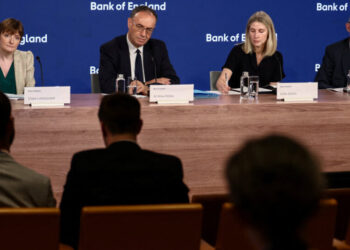
The Federal Reserve raised interest rates on Wednesday, which will drive up the cost of borrowing at a time many voters are already paying high rates for mortgages, auto loans and credit card debts. Mr. Trump has said not to expect gas price relief before the midterms, with the nation’s strategic petroleum reserves at a 44-year low.
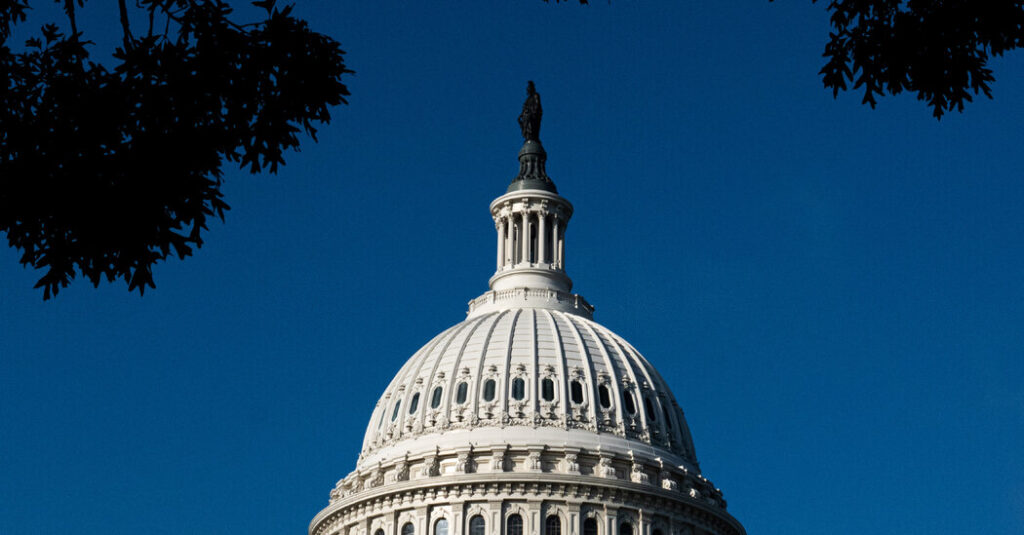
“Gas prices are too high right now, diesel prices are too high,” Speaker Mike Johnson acknowledged on Tuesday at the Capitol. “There is a very simple reason for it. It is tied to the Strait of Hormuz.”
A national poll released this week by The New York Times and Siena University found that Democrats entered the fall with an advantage of nearly nine percentage points over Republicans on the congressional ballot — an edge similar to 2018, the last time there was a so-called blue wave.
“Republicans are panicking and are on the brink of losing the House, with the Senate not far behind,” Representative Hakeem Jeffries of New York, the minority leader, said in an interview.
But with so many House and Senate races considered tossups by both parties, the fight for control of Congress remains fluid. Republicans have a big cash advantage that they are using for attack ads against Democrats from South Florida to Alaska. And Democrats are defending Senate seats in Michigan and New Hampshire in races that appear closer than party leaders had hoped.
Republican super PACs, led by Mr. Trump’s network, have booked more than $140 million in advertising since Labor Day.
“Our bet is that voters weren’t paying attention until after Labor Day — and now is when we’re turning everything on,” Representative Richard Hudson of North Carolina, the chairman of House Republicans’ campaign arm, said in an interview. “We’ve got a money advantage, which I’ve never known in my lifetime.”
Will the Lights Go Out in Georgia?
The first big state that could fall off the map for Republicans is Georgia.
Senator Jon Ossoff, the Democrat up for re-election, began the midterms holding his party’s most endangered seat. But races for Democratic-held seats in Michigan and even New Hampshire now appear more competitive for Republicans, according to strategists in both parties. To win control of the Senate, Democrats must flip at least four seats, including two in states Mr. Trump won by double digits, while holding all of theirs.
As of Wednesday, Georgia was the only one of the top nine Senate battleground states where Republicans did not have more money in advertising reserved than Democrats, according to data from the media tracking service AdImpact.
Some Republicans have quietly begun to discuss the pros and cons of redirecting resources away from the state, where Representative Mike Collins, the party’s nominee, has trailed Mr. Ossoff in the polls.
At a donor meeting last week in Dallas held by Senate Republican strategists, one presentation slide noted four of the party’s “quality” Senate recruits: Representative Ashley Hinson in Iowa, Michael Whatley in North Carolina, former Representative Mike Rogers in Michigan and former Senator John E. Sununu in New Hampshire, according to an attendee who took a picture of the slide.
Mr. Collins was present in the room but conspicuously absent from the slide.
“We have received continued investment from Republicans,” said Meyer Siegfried, a Collins spokesman. “Any claims to the contrary are not based in reality.”
The planned advertising blitz tied to Mr. Trump’s super PAC has so far included only $2.2 million earmarked for Georgia — a fraction of the combined $29 million for Michigan and New Hampshire.
One reason for Republicans to keep spending in Georgia would be to ensure that Democrats, who have less cash, cannot divert money to other states.
Signs of Republican Anxiety
Republicans are racing to erect defenses against a potential blue wave.
In deep-red Nebraska, which has not been seen as a top Senate battleground this year, a new super PAC, Cornhusker Majority, reserved $3.7 million ads on Tuesday. It immediately began attacking the independent candidate Dan Osborn, who is backed by Democrats.
In Kansas, Mr. Vance’s visit came just as Senator Roger Marshall, a Republican, began airing an ad attacking his Democratic challenger, Adam Hamilton, the senior pastor at the largest United Methodist congregation in the country. Another Republican-aligned super PAC linked to the artificial intelligence industry also began airing pro-Marshall ads.
“The fact that they sent the vice president, I thought, was a really great sign,” Mr. Hamilton said in an interview. “I just had to go, ‘Wow, cool.’ They realize this thing is in play.”
Notably, Mr. Trump’s operation has been using newly created super PACs instead of his main one, MAGA Inc., to book ads in states other than Texas. One result of that move: The damaged MAGA brand will not appear in the disclaimers of the ads.
The rising price of diesel is hitting farm states especially hard, and Republicans like Mr. Marshall are rushing to show that they are trying to do something about it. This week, he wrote a public letter to the agriculture secretary urging the Trump administration to provide relief for farmers.
Mr. Hudson, the House Republican campaign chief, said in the interview that the war with Iran was “not helpful,” but that the party’s main problem was that voters who backed Mr. Trump were not aware of what the Republican-led Congress had accomplished.
“A lot of voters don’t know the policies we passed,” he said.
There are signs some Republicans are looking to distance themselves from Mr. Trump. On Tuesday, Representatives Zach Nunn and Mariannette Miller-Meeks, both Iowa Republicans, voted with Democrats to direct the president to end the war with Iran. Their votes came as Ms. Hinson boasted in a new television ad about how she had “worked with Democrats” in Congress.
Mr. Vance is scheduled to speak at a rally on Friday for Iowa Republicans — but Ms. Hinson said she would not attend.
Democrats Go on Offense in Red Areas
Democrats are bullish about competing in House districts and red states the party has not come close to winning for years.
The party’s campaign arm claims to be contesting 58 Republican-held seats, including several Mr. Trump won by as much as 20 points two years ago.
The landscape Republicans are defending reaches deep into territory Mr. Trump won easily. A super PAC run by the Trump operation has bought $637,000 worth of advertising in Kentucky’s Sixth District, which the president carried by 15 points in 2024.
Zach Dembo, the Democratic candidate there, said Mr. Trump’s tariff policies had hurt farmers and the bourbon industry.
Republicans, he argued, “clearly recognize that we’re connecting and the ground is shifting.”
The district backed Mr. Trump overwhelmingly but also voted for Gov. Andy Beshear, a two-term Democrat whose own super PAC is airing ads there.
Seats like the one Mr. Dembo is contesting are unlikely to determine the majority. But if some of them flip, they could deliver Democrats a larger governing majority in 2027 and give the party a better chance of maintaining control after the next election in 2028.
In another deep-red seat, Eileen Laubacher, a Navy veteran, is mounting a competitive challenge to Representative Lauren Boebert in a largely rural Colorado district that Mr. Trump had won by 18 points.
Ms. Laubacher said she had heard from many people who were angry about the high costs of fuel and supplies.
“Their lives are becoming more difficult and more expensive, and that is not what they were hoping for and not what they voted for,” she said.
J.B. Poersch, the president of the main super PAC for Democratic Senate candidates, Senate Majority PAC, said his party was on the verge of winning as long as it did not get swamped by Republican ads.
“This is a map that’s springing in opportunity,” he said before adding a plea and a warning: “More financial resources are necessary.”
Bayliss Wagner and Theodore Schleifer contributed reporting.
The post Republicans Reel on the Midterm Map as Deep-Red Areas Come Into Play appeared first on New York Times.