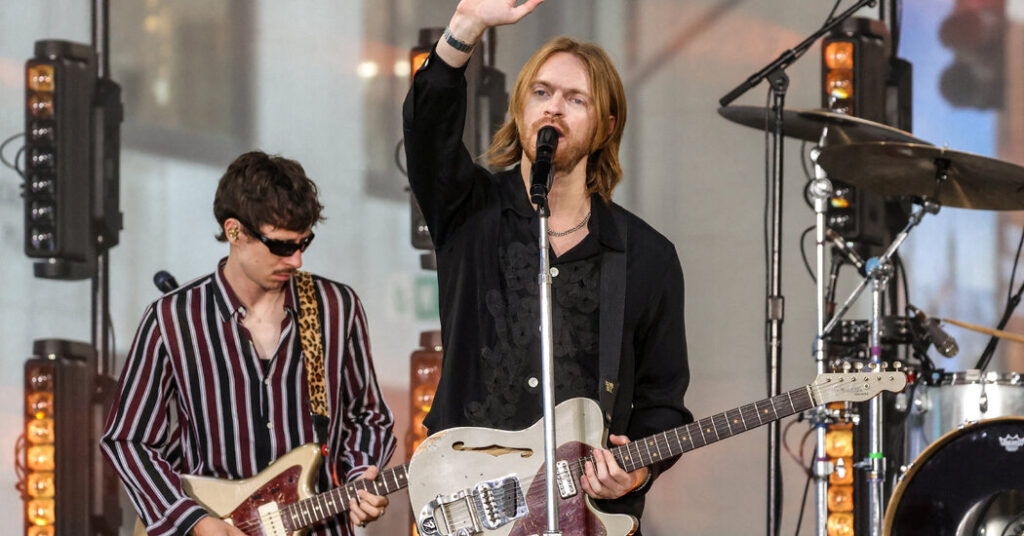
Finneas and an array of other musicians associated with Ed Sheeran’s stadium tour have withdrawn from the engagement, a day after the rapper Macklemore was removed over his statements opposing the war in Gaza.
Finneas, along with the singer-songwriters Aaron Rowe and Lukas Graham and the traditional Irish group Beoga, all announced their withdrawals on social media on Tuesday. Each cited the need for free speech and voiced support for Palestinians.
“Artists must not be silenced when they speak up for the oppressed,” wrote Finneas, the Grammy- and Oscar-winning musician and producer who is the brother and collaborator of Billie Eilish. He added, “I stand with Palestine and its people.”
The departures add to mounting pressure on Sheeran, a streaming giant and a top touring draw. Since Macklemore’s removal was announced, Sheeran has been widely criticized for allowing it — a decision that Sheeran said was made by the tour’s promoter and the owners of the stadiums where the concerts have been booked.
Rowe and Graham have been recent opening acts on Sheeran’s tour, and Finneas, whose full name is Finneas O’Connell, was set to join a number of dates in South America in November and December. Beoga has frequently played with Sheeran, including on his current tour.
The controversy began on Sept. 4 and 5, when Macklemore — the Seattle rapper of 2010s hits like “Thrift Shop” and “Same Love” — performed at Sheeran’s concert at MetLife Stadium in East Rutherford N.J.
Macklemore played his protest song “Hind’s Hall,” which accuses Israel of “genocide” in the war that began after the Hamas-led attack against Israel on Oct. 7, 2023, and the song’s video shows scenes of destruction in Gaza and of protests in New York.
“I wanted to stand up on here on stages and stadiums across America,” Macklemore said onstage, “and say two words that are very near and dear to my heart: Free Palestine.”
Organizations like the Anti-Defamation League, and many commenters online, quickly criticized the performance, and the Israeli-American Council circulated a petition calling on Sheeran to drop Macklemore from the tour.
“I don’t take the decision lightly,” Rowe, a young musician from Dublin, wrote on social media. “Ed has been a friend to me and has changed my life. I could never thank him enough for this,” he added.
“But as Irish people,” Rowe said, “we know all too well about genocide, forced famine and violent occupation. I cannot stand by and allow billionaires to use their position of power to silence the rightful voices of those who speak up against Israeli genocide and who highlight the savage murder of children.”
Graham said in his own statement on social media: “Money doesn’t give you the right to own the conversation. Nobody’s bank balance should decide who gets to speak or which suffering we’re allowed to acknowledge.” He added emojis of watermelons, a signal of support for the Palestinian cause.
In another statement, Beoga said its decision was a reaction to “the silencing of Macklemore by Zionist lobbies.”
Macklemore, in an online statement on Monday, said Sheeran had told him that the venues hosting the tour had demanded his removal.
Robert Kraft, whose company owns the New England Patriots and Gillette Stadium outside Boston, acknowledged in a statement on Monday that he decided Macklemore could not play at Gillette, saying he would not “provide a platform for hate speech,” and pointing to a “broader history of antisemitic rhetoric and imagery” by Macklemore “that we believe has been deeply offensive and hurtful to the Jewish community.”
Kraft did not elaborate on that accusation in his statement. But many commenters on social media have pointed to a “Jewish caricature” stage costume in 2014 with a hooked nose and beard; Macklemore apologized at the time and said he “would never intentionally put down anybody for the fabric that makes them who they are.”
The next scheduled stop on Sheeran’s tour is Saturday at Lincoln Financial Field in Philadelphia.
The post How Ed Sheeran’s Tour Turned Into a Clash Over Palestinians and Antisemitism appeared first on New York Times.