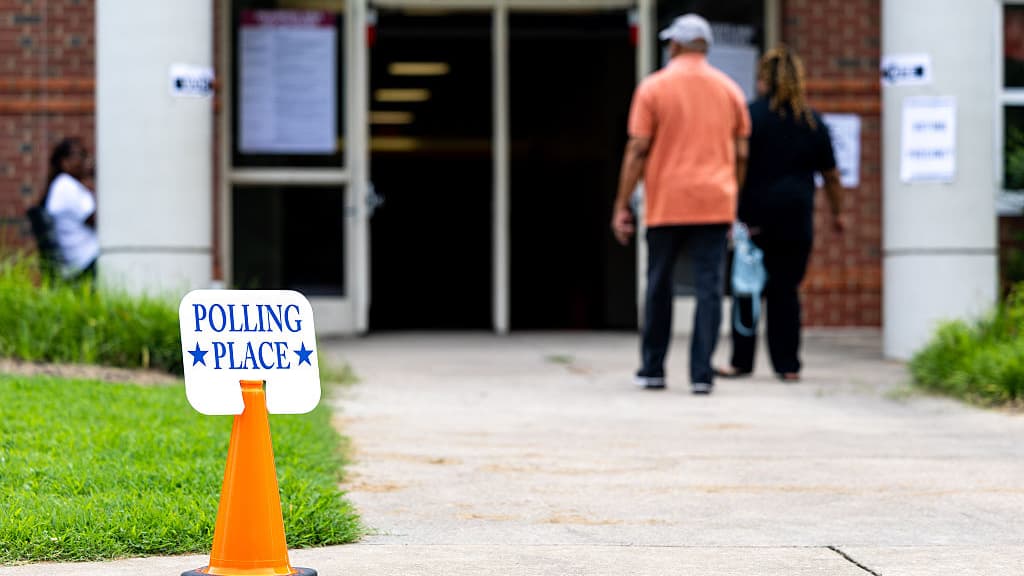
With the midterm elections less than two months away, Democrats are training thousands of volunteers on how to respond to any potential incidents of voter intimidation at the polls in November.
The New Battlefield Project—an initiative that is being coordinated by the Association of State Democratic Committees (ASDC), which operates under the Democratic National Committee (DNC)—involves training at least 10,000 volunteers so that they’ll be equipped to counter interference or intimidation at polling locations across the country if such situations arise, says Jane Kleeb, the chair of the Nebraska Democratic party and president of the ASDC.
The on-the-ground team—dubbed the “Democracy Protectors”—will be wearing blue to distinguish themselves, and will be trained in de-escalating conflicts and documenting any potential “bad actors and bad behavior.” Information about such incidents would then be passed along to the state party and the DNC to take action where necessary. Kleeb says the volunteers will also be helpful resources to voters—for instance, they can help direct people to the right polling locations. The trainings, Kleeb adds, are based on constitutional observer trainings that the Minnesota Democratic Party coordinated amid Immigration and Customs Enforcement (ICE) raids in the state.
In addition to the Democracy Protectors, the New Battlefield Project includes teams that are focused on encouraging citizens to register to vote and to vote early, as well as on dispelling any misinformation or disinformation spreading online ahead of Election Day.
The DNC musters an election protection program every year, and states sometimes train volunteers to perform similar tasks. But this year’s effort is larger in its scope and is being coordinated nationwide.
Kleeb says Democrats were spurred to launch the initiative because of speculation and concerns they were hearing from voters, candidates, and elected officials that President Donald Trump could send federal agents to polling places.
“About six months ago, state parties really started to put in place a program that we thought would address the threat of Donald Trump and what we think his allies are doing this cycle,” Kleeb says. “We heard Trump and Steve Bannon talking about how they could potentially be sending the National Guard, the military, or ICE agents outside of polling locations.”
“We take them very seriously,” she continues.
Trump Administration floats sending federal agents to the polls
The Justice Department announced last month that its Civil Rights Division would be “monitoring polling sites in Florida and Wyoming for the states’ primary elections to ensure transparency, ballot security, and compliance with federal law.”
On Tuesday, FBI Director Kash Patel also indicated that he was not opposed to the idea of dispatching federal agents to voting locations.
Separately, Trump has deployed the National Guard to cities across the country, including Los Angeles and Washington, D.C., with the stated goal of helping combat crime, though the data indicates that crime rates in many of those cities have been falling for years. When asked in May if he would send members of the National Guard or ICE officers to the polls, Trump replied, “I’d do anything necessary to make sure we have honest elections.”
The troops’ presence, as well as comments from the President and his allies, has raised concerns from some Democrats that the military could be sent to voting locations. Members of the military are prohibited under federal law from being sent to “any place where a general or special election is held,” however. And in August, the chairman of the Joint Chiefs of Staff told Democratic Sen. Elissa Slotkin in a letter that the “Joint Force has no plans to send Federal military personnel or Federalized members of the National Guard to polling places during the 2026 elections. Likewise, the Joint Force has no plans to use such personnel to seize ballots, voting machines, or other election-related material.”
Homeland Security Secretary Markwayne Mullin said earlier this month that ICE—which has also ramped up enforcement in cities around the U.S. since Trump returned to office—“isn’t there to patrol the polling places.” But he added that “We’re there to enforce specific threats,” a comment that exacerbated fears among Democrats, advocates, and voters that ICE agents may show up at the polls in November.
When asked about the possibility of ICE agents being stationed at the polls during the midterms, then-White House Press Secretary Karoline Leavitt said earlier this year that that was “not something [she has] ever heard the President consider.”
“I can’t guarantee that an ICE agent won’t be around a polling location in November,” Leavitt said in February. “I mean, that’s frankly a very silly hypothetical question. But what I can tell you is I haven’t heard the President discuss any formal plans to put ICE outside of polling locations. It’s a disingenuous question.”
Kleeb says that Democrats wanted to be prepared just in case.
“Maybe nothing will happen,” Kleeb says. “Maybe they don’t send anybody anywhere. Maybe that’s going to be true. But as the Democratic party … we do not want to wake up the next day after Election Day, saying to ourselves, ‘Damn it! They said that they were going to do this, and we didn’t believe them,’ or ‘We thought that it was just them thumping their chest.’ We’re taking them seriously.”
When asked by TIME about the New Battlefield Project, White House spokeswoman Lauren Bis said in a statement that “the only ‘fears’ Americans have about our elections are being fueled by extreme liberal Democrats who refuse to support commonsense legislation that ensures Americans, and Americans only, decide our elections and other basic election security measures like Voter ID.”
Bis’ comment appeared to be referring to the SAVE America Act, the restrictive voter ID bill that the President has forcefully championed during his second term that has been met with vocal backlash from Democrats and voting rights advocates. The measure passed the House, but Senate Republicans have said they don’t have the votes required for it to pass the upper chamber.
‘An air of menace’: Experts express concerns over Trump Administration’s actions
Experts have expressed concerns about potential election interference in the November midterms, in light of recent actions taken by the Trump Administration.
“The Trump Administration has been progressively trying to regulate and interfere in elections in ways which are not constitutional,” alleged Pippa Norris, a lecturer in comparative politics at the Harvard Kennedy School and founding director of the Electoral Integrity Project. “Most of his actions haven’t actually succeeded, but they have sown confusion, and therefore there’s been problems because they can undermine public trust in the system.”
She cites, for instance, recent reports that the Trump Administration has directed federal agents to comb through voter rolls, which are overseen by the states, in a quest to find non-citizens. Research overwhelmingly shows that voter fraud is extremely rare.
Richard Briffault, a professor at the Columbia Law School, says that Trump “has been consistently complaining about fraud and misconduct at the polls, always without evidence.” Trump has repeatedly falsely claimed that the 2020 election was “stolen” from him.
Briffault adds that the Trump Administration has dispatched federal officials—such as those from the Justice Department, the National Guard, and ICE—to various places, which could be sparking concerns among local elections officials and voters about potential conflicts at the polls. He also points to the Trump Administration’s effort to impose new restrictions on mail-in ballots—a move that was blocked by the U.S. Supreme Court on Monday, which the President railed against on social media this week.
“It is not surprising that many people are nervous that [Trump] might do something to try and disrupt the election if he feels it’s going against him,” Briffault says. “We don’t know what he’s going to do.”
“There’s kind of an air of menace that the Administration has generated,” he continues. “Whether they do anything, we won’t know until Election Day or the lead-up to it and after.”
Norris says that the practice of sending people to polling places to counter intimidation is often used in other countries during contentious elections. But she cast doubt that the New Battlefield Project was “the most effective thing which the DNC can do,” expressing concern that there isn’t enough time before the November midterms to effectively train volunteers in recognizing and responding to potential issues and that that could raise the possibility of “disputes” or conflicts at polling places, particularly if Republican organizations also dispatch volunteers to those locations.
Training for the volunteers started about three weeks ago, according to Kleeb. She adds that Democrats are taking the concern of potential conflict “very seriously;” a critical part of the training, she says, is teaching volunteers how to de-escalate tense situations while making it “very clear” that they should not engage if any violence erupts.
Briffault says it’s not clear yet if the initiative will be effective at countering potential intimidation, but that it could foster “a level of comfort” for voters at the polls. He notes, though, that there are so many polling places across the U.S. that it’s not possible for the New Battlefield Project to have a presence at all of them.
“I do think it’s important for people to know that there will be other people there looking out to make sure the election goes smoothly and without disruption,” he says.
Kleeb says that the volunteers won’t be at every polling place in the country, but each state party will decide the locations that have the most need for them. In Nebraska, for instance, Democrats think the second congressional district is “the most flippable congressional seat” in the state, so the party plans to station volunteers in high-traffic precincts in that area. In some states, the party may look to dispatch volunteers to polling places in areas with high immigrant populations or with many young people who may be voting for the first time, she adds.
“Our elections are safe and secure,” Kleeb says. “The Democracy Protectors Program is put in place to ensure that voters have a friendly face outside the polling location to make sure that their vote is counted.”
The post How Democrats Are Mobilizing to Counter Potential Election Interference Amid Trump Concerns appeared first on TIME.