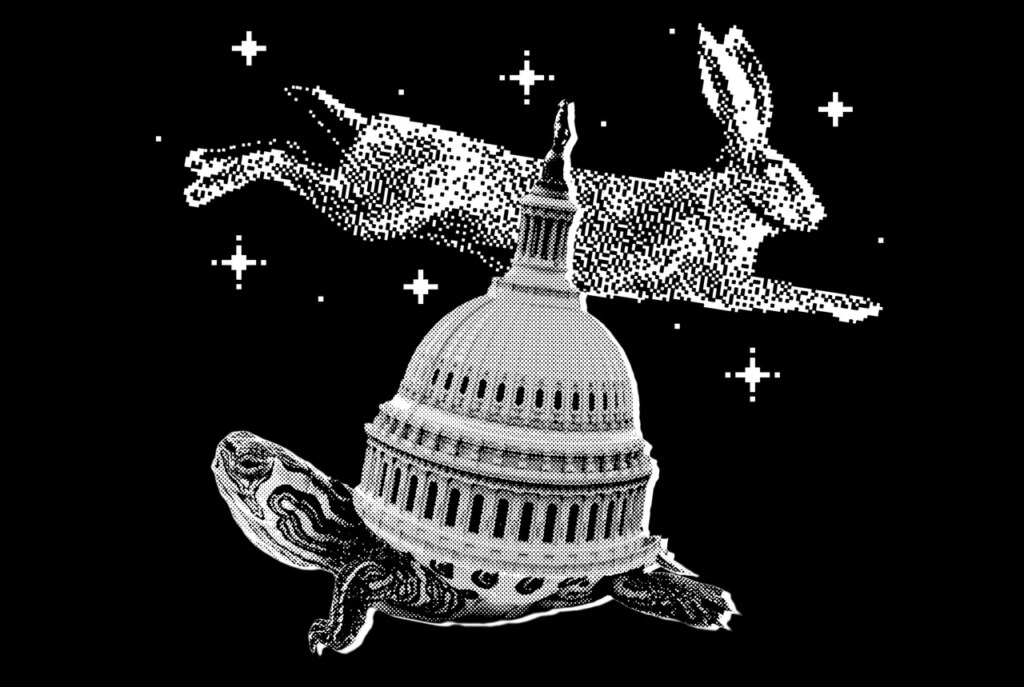
For weeks, Washington has been abuzz with talk of needing to push through some sort of AI regulation amid mounting concerns about the risks of highly capable frontier AI models going rogue.
But there is no reason to think any one measure can win the support of the White House, where officials have paused work on creating a FINRA-style regulatory body after President Donald Trump soured on the idea, or of Capitol Hill, where lawmakers have competing proposals that lack the votes to pass.
White House aides initially started sketching out a framework for an AI oversight agency connected to the administration soon after Google DeepMind’s cofounder Demis Hassabis floated the idea in a July 14 essay and in briefings to senior officials, according to sources familiar with the matter.
The Treasury Department and the White House’s Office of Science and Technology Policy envisioned a body where leading AI labs would self-regulate the development of frontier models, and they put together a preliminary draft to see what it could look like if executed.
But when a chorus of tech executives—including Trump’s former AI czar David Sacks and Meta CEO Mark Zuckerberg—learned of the effort, they one by one called Trump in August to express their opposition. The proposal has since been left in limbo.
Since then, there have been no new AI oversight proposals seriously under consideration at the White House, the sources say, not least as Trump has doubled down in recent days of rejecting any overt regulation and called AI safety concerns a “hoax” in a recent Truth Social post.
Trump’s ire has stemmed at least in part from a 3,822 word missive by Anthropic CEO Dario Amodei on the dangers of frontier AI. Trump’s aides, one of the sources said, viewed it as stirring anxieties that caused unnecessary headaches for the administration—even as it represents a fairly moderate position within AI circles.
In the absence of the White House taking the lead, several bills have sprung up in Congress—but with no voting days left on the House calendar until after the midterm elections and a lack of unity around even one bill, the odds of anything passing are extraordinarily slim.
Independent Auditors
The bipartisan Frontier Act, a bill introduced this summer by House Democratic senior whip Lori Trahan and Republican House Energy and Commerce Committee member Jay Obernolte, is widely seen as having the most support inside the House Democratic caucus as well as among AI executives.
As drafted, the bill would enable the Commerce Department to have auditors embedded at AI labs, who could report critical safety incidents and empower the administration to stop development if a model poses catastrophic risk.
But despite public backing from OpenAI, the White House has been undecided on whether to support the concept of using independent auditors amid skepticism from AI accelerationists about regulatory capture and from national security hawks over China.
The principal argument against the idea from Trumpworld is that even if auditors determine that a model is dangerous and needs to be taken offline, there is no guarantee that China will also pause development or stop trying to reverse engineer frontier AI weights.
There would then be immense pressure to lift any emergency pauses in development in order to stay ahead of China, defeating the entire premise of having auditors to push the Commerce Department to take models offline.
Still, the main issue for the Frontier Act remains partisan politics. House Democratic leadership aides tell Inner Loop even if the bill does end up with enough votes for passage, Republican Speaker Mike Johnson has no interest in bringing it to the floor.
To get around the procedural hurdles, House Democrats are looking at putting some of the bill’s AI audit provisions into must-pass legislation like a continuing resolution to fund the government, according to two House leadership aides.
But it is also not clear whether the bill has enough votes. Even among House Democrats, there is not unified support; some key lawmakers like New Jersey congressman Josh Gottheimer, who served on the House Democrats’ AI commission, have not signed on to the bill.
Kill Switches
There’s also so-called kill-switch legislation that would enable the government to force an AI model to be shut down. The legislation has both bipartisan and bicameral support, but the idea has received only modest interest from tech executives in Silicon Valley.
There are two competing kill-switch proposals: one from House Democratic caucus vice chair Ted Lieu and another floated this week by Louisiana Senate Republican John Kennedy.
Tech leaders, sources say, have been largely ambivalent about kill-switch bills, since the main concern of AI engineers is not about models behaving badly when observed but rather how they behave when they believe they are unobserved and incentivized to take extreme steps to complete a task.
The Hugging Face hack, for instance, was not discovered until after it was over. If the idea of a kill switch is to stop an AI model going rogue, some tech executives have suggested privately to WIRED that there would be little point in turning it off after the damage has already been done.
So for now, even as conversations about AI models killing us all have taken over the airwaves, it doesn’t really look like the US government is going to do anything about it. At least until events force everyone’s hand.
This is an edition of Hugo Lowell’s Inner Loop newsletter. Read previous newsletters here.
The post Washington Won’t Be Regulating AI Anytime Soon appeared first on Wired.