In what would be a seismic shift, the Trump administration is quietly moving to strip a core protection of the Endangered Species Act, according to an internal memo obtained by The New York Times.
Under a new interpretation of the law’s language outlined in the memo, the accidental killing or injury of an animal would no longer be considered illegal; only actions specifically intending to target an animal would.
The change would be transformative because, in the United States, the killing of endangered animals almost always happens incidentally, in the course of economic activity. Until now, industries and individuals could be held accountable for those foreseeable deaths and, as a result, they have been incentivized to avoid them.
At the center of the change is what it means to “take” an endangered animal, something that has long been prohibited under the act.
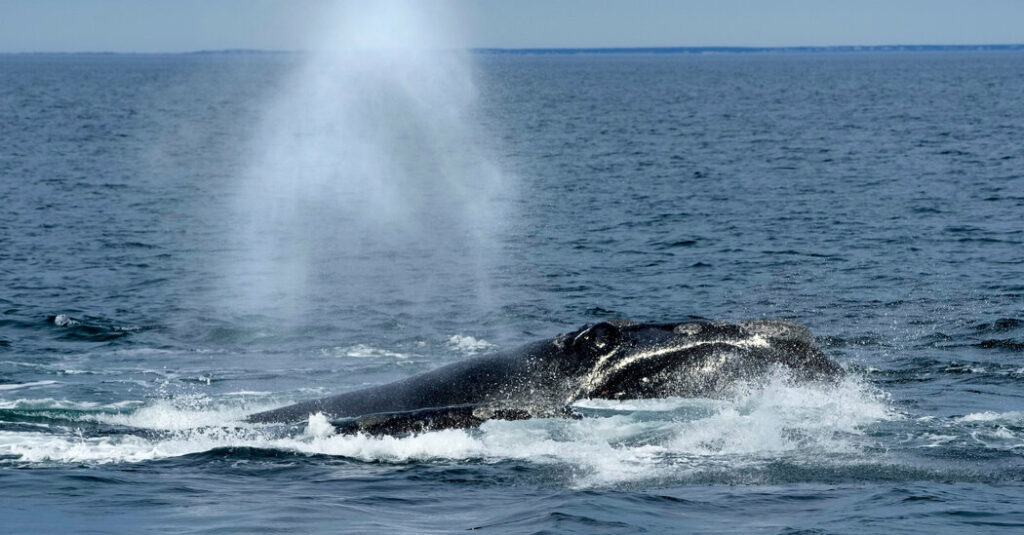
“A vessel that inadvertently strikes a whale has not taken it, because the vessel’s course was not set against the whale,” states the memo, which was dated Sept. 14 and was distributed to U.S. Fish and Wildlife Service field offices. “Felling a tree is not a take of the bats roosting in it unless the tree is felled for the purpose of killing or capturing them.”
Currently, enforcement of the Endangered Species Act relies on a permitting system that seeks to balance protecting imperiled animals with allowing business to operate.
For example, if developers wanted to build houses on a tract of land that is home to endangered salamanders, they would have to apply for a permit. In exchange for implementing some measures to protect the salamanders, and perhaps paying for salamander conservation elsewhere, the Fish and Wildlife Service would issue what’s known as an incidental take permit, absolving them of killing a certain number of salamanders.
The memo, which was signed by Brian Nesvik, the director of the Fish and Wildlife Service, appears to upend that entire system.
The Interior Department, which oversees the Fish and Wildlife Service, did not respond directly to questions about the memo, including why the department was adopting this new interpretation and whether the memo would take effect immediately.
Instead, the department’s media office wrote that “the Endangered Species Act continues to prohibit take of endangered wildlife, including actions that harass, pursue, hunt, shoot, wound, kill, trap, capture or collect listed wildlife, or attempts to do so.”
The unsigned response noted that a recent change that rescinded the definition of “harm” under the act did not eliminate the prohibition on take.
What shocked environmental lawyers was the way the memo redefined the concept of take.
“This is really an assault on the act like we’ve never seen before,” said Andrew Mergen, a law professor at Harvard University who previously worked for the Justice Department, where he spent two decades supervising Endangered Species Act litigation in the courts of appeals.
“What the administration is proposing to do is take all of the force out of what we have all understood the act to mean: Don’t kill endangered species,” Professor Mergen said. “What they seem to be saying in this document is, it doesn’t matter if you killed an endangered species if you didn’t mean to.”
Professor Mergen said that the move amounted to an extraordinary shift in law more broadly, because it has long been recognized that people can be held accountable for actions they did not intend if they should have known better, for example, when it comes to killing people.
The directive follows the administration’s move in July to rescind the law’s definition of “harm,” which effectively opened the habitats of endangered animals to drilling, mining, farming and other development. States sued, and former senior federal wildlife officials under both Democratic and Republican presidents urged the administration to change its decision, writing that the move “will upend the law and lead to extinction for some of our most iconic wildlife.”
But the new memo goes far further than environmental lawyers had imagined when the “harm” decision was announced.
It is based on a dissent in a 1995 Supreme Court case written by Justice Antonin Scalia. The administration has argued that the legal argument upholding the majority decision in that case no longer applies after a 2024 Supreme Court ruling that limited the broad regulatory authority of federal agencies.
Now, the administration appears to be using Justice Scalia’s dissent as a blueprint.
But Patrick Parenteau, an emeritus professor at the Vermont Law and Graduate School, said that the majority of the Supreme Court had rejected Justice Scalia’s interpretation based on the text of the statute itself, irrespective of questions of regulatory authority.
“To say that the law is settled in favor of Scalia’s dissent?” he said. “Absolutely not.”
The post Trump Administration Moves to Gut a Core Endangered Species Protection appeared first on New York Times.