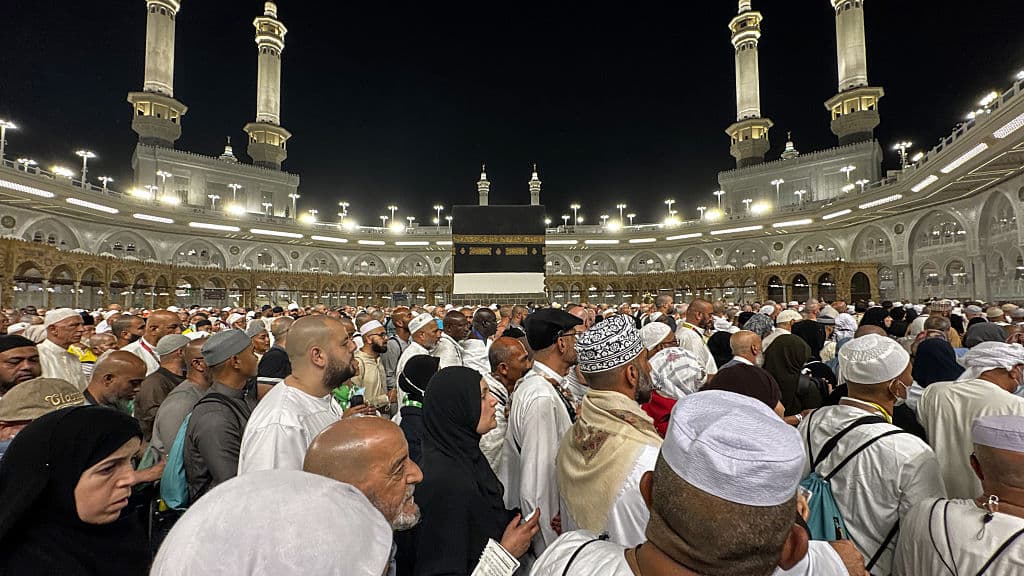
Saudi Arabia on Wednesday accused the Iran-backed Houthis of an attempted attack on Mecca, the holiest city in Islam and a site of pilgrimage for Muslims worldwide.
Colonel Turki Al-Malki, spokesperson for the Saudi-led coalition forces in Yemen, said that the Houthis launched a drone toward Mecca on Tuesday evening, but it was shot down by the Saudi Air Defense Forces before entering the city’s restricted airspace.
“The security of the Two Holy Mosques and the pilgrims is a red line,” said Al-Malki, who warned that the Saudi-led coalition “will not hesitate to take the necessary and deterrent measures” against the Houthis.
Riyadh referenced a previous similar incident from July 2017, in which it accused the Houthis of targeting Mecca. The Houthis acknowledged launching a missile from Yemen, but said that it was aiming for the King Fahd air base in Taif.
The Yemeni militia group has denied the allegation, accusing Riyadh of spreading “false accusations” on Wednesday.
“There is no threat from Yemen to the holy sites. Our operations target its oil facilities and military bases, and are far from the holy sites,” said Houthi military spokesperson Yahya Saree via Telegram.
The allegation comes amid a widening regional crisis. Houthi advances along Yemen’s Red Sea coast are threatening shipping and energy supplies—already disrupted by the conflict in Iran— while drawing growing concern from the U.S. and other Saudi Arabia allies.
The religious stakes: Why Mecca is a ‘red line’
The past month’s escalation is only the latest development amid the wider civil war between the Houthis and the Saudi-backed Yemen government, which has been ongoing since 2014. But a confirmed attack on Mecca would undoubtedly be a turning point.
Pakistani Prime Minister Shehbaz Sharif, whose country signed a joint defense agreement with Saudi Arabia and Turkey last month, called on all parties to exercise restraint. He warned that the conflict was on the “brink of further escalation” and that “dialogue and diplomacy remain the only sustainable path to peace.”
At the same time, he condemned the alleged attack.
“There are no words sufficient to express the depth of pain and sorrow we feel toward this unforgivable and shameful deed,” he said Wednesday.
Fawaz Gerges, a professor in international relations at the London School of Economics, questions what the Houthis would have to gain from such an attack. Over 1.7 million Muslims this year performed Hajj, their pilgrimage to Mecca, according to the Saudi government.
“For the Houthis, as a religiously dominant organization, this would be catastrophic for them—to target Mecca,” he tells TIME. “It’s a lose-lose for them.”
Gerges does, however, offer another explanation: “The Houthis are using drones and homemade missiles, so there is a real possibility that the Houthi drone basically misfired.”
In light of Riyadh’s allegation, Gerges assesses that “[Saudi Arabia] is trying to say that the Houthis are not just waging a political and geo-economic war against them, they are trying to target the most sacred religious site in Islam, and that resonates deeply.”
“Both sides are now engaged not only in military hostilities, but also for the hearts and minds of Arabs and Muslims,” he adds.
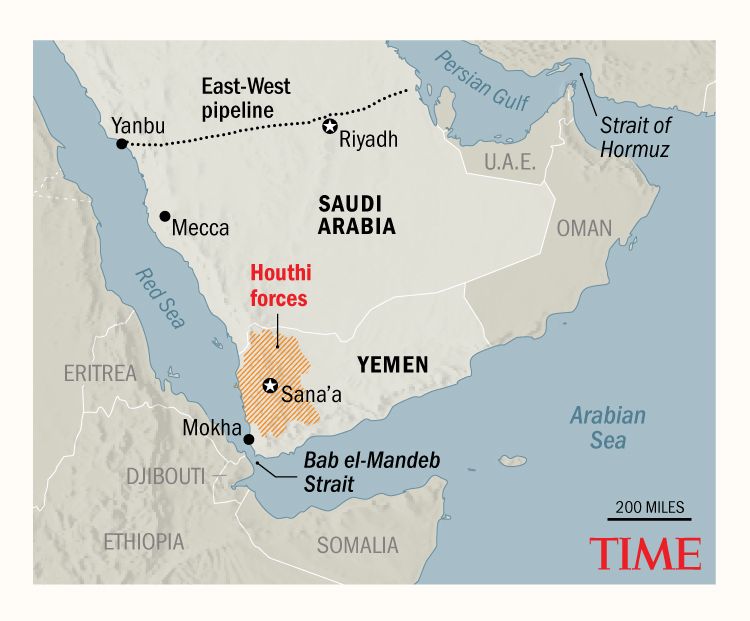
Houthi advances deepen the Red Sea oil crisis
The Houthis claimed that Saudi aircraft had carried out more than 450 airstrikes this week. The group also claimed, without providing evidence, that it had shot down a Saudi-led coalition F-15 over Yemen.
Houthi strikes, meanwhile, have been largely concentrated along the Yemeni border in the south. They have also made advances in the Red Sea, seizing key sites like Perim Island and the port of Mokha. The captures strengthen their control over the Bab el-Mandeb Strait—a pivotal shipping lane that could affect global trade and oil prices at a time when they are already under strain.
Shipping through the Strait of Hormuz, a critical oil transit lane, remains largely restricted amid continued strikes between the U.S. and Iran. Most recently, the UK Maritime Trade Operationssaid a vessel was struck by an unknown projectile on Monday.
Amid these regional developments, the price of Brent crude, the global standard for oil, climbed above $100 per barrel earlier this week. The price fell about 3% on Wednesday but remained above $105 a barrel. Experts warn that more strikes between the Saudis and Houthis will only drive up prices further.
“Pressure on global energy is already there, and I think it’s just going to get worse,” Farea Al-Muslimi, a research fellow at Chatham House’s Middle East and North Africa program, tells TIME.
Continued fighting this week “is going to start making the West bleed more efficiently over the next few weeks,” he says. “With winter, there will be a lot of need for energy and for heating.”
Pressure grows in Congress to end the Iran war
Amid precarious energy developments in the Middle East, sentiments about ending the Iran conflict seem to be shifting in the U.S. House of Representatives.
In what was its third vote on the matter this summer, three Republican Representatives changed their votes to align with Democrats in favor of a War Powers Resolution to end U.S. military action against Tehran. With a total of seven Republicans voting in favor, the resolution was approved with 220 votes, beating 204 against.
Rep. Mariannette Miller-Meeks, Rep. Zach Nunn of Iowa, and Rep. Nancy Mace of South Carolina switched their votes in this latest round of considerations. Nunn said that Iran “must be held accountable” but that “with the negotiating window closed, sustained combat operations now require congressional authorization.”
Nunn added: “I will not support another open-ended war. We can defend Americans, pressure Iran, and pursue peace while ensuring Congress fulfills its constitutional responsibility.”
It is likely the last time the House will bring the matter to a vote ahead of midterm elections this November. But the vote is largely a symbolic gesture, as Trump would likely veto the resolution once it reached his desk.
He did, however, hint Monday at the possibility of a return to negotiations with Iran, after last week saying the conflict will likely persist until “immediately after the [midterm] election.”
As pressure builds in Washington to end the war with Iran, the Houthi escalation in Yemen is creating a new regional flashpoint for the U.S.
U.S. warns government personnel away from the Yemeni border
In response to growing security risks, the U.S. Embassy in Riyadh prohibited American officials in Saudi Arabia from traveling near the Yemeni border as of Wednesday.
U.S. government employees are not permitted to travel within 20 miles of the border with Yemen, and they require special authorization from the embassy to travel to the regions of Jizan, Asir, and Najran in southern Saudi Arabia.
The embassy also published a travel advisory Tuesday, urging Americans to reconsider travel to Saudi Arabia, citing armed conflict, Iranian missile and drone attacks, and renewed threats from the Houthis. Tehran has targeted multiple Gulf states housing U.S. military bases through the conflict, and has threatened U.S. energy assets in the region.
“Armed groups in Yemen have attacked Saudi border towns and other sites in Saudi Arabia with armed drones, missiles, and rockets. People near the border with Yemen are at increased risk. Do not travel to this area for any reason,” the embassy said in its advisory.
TIME has reached out to the White House and State Department regarding the recent developments.
Asked Monday if the Trump Administration was concerned about the recent Houthi advance and capture of Perim Island, Vice President J.D. Vance told reporters: “Concerned, certainly.”
“We’ve been in constant contact with the Emiratis, the Saudis, and others affected in the region. It’s something that the United States Administration is very much on top of,” he continued.
The Vice President added that there has also been direct communication with the Houthis. “We’re going to keep on monitoring it and making sure that America’s best interests are represented,” he said.
President Donald Trump claimed over the weekend that he had spoken with the Iran-backed militia. “They would much prefer not having us involved, and they’re letting most ships go through. There’s just one country that they’re not too happy with, and we’ll get that straightened out,” he told reporters during a visit to Ireland.
Following a threat from the Houthis to blockade the Bab el-Mandeb Strait in July, the U.S. President said, “If something like that happens, we take care of it.”
On Monday, a Houthi spokesperson said that the Strait “is free for navigation for all countries except for Saudi Arabia.”
Could the conflict widen?
Tuesday’s alleged drone attack toward Mecca has prompted international concern over regional escalation.
In light of the joint defense agreement signed between Saudi Arabia, Turkey, and Pakistan, Al-Muslimi says that Ankara and Islamabad have greater political latitude to support Riyadh following the contested incident.
“Defending Mecca is going to create legitimacy domestically in their countries if they engage with the Saudis in a war against the Houthis,” says Al-Muslimi.
But Gerges suggests that support from Turkey and Pakistan would be largely ineffective, and therefore unlikely.
“The problem is how could Pakistan and Turkey really provide support since the armies are not integrated,” he says. “The key challenge facing Saudi Arabia is ground forces.”
Gerges notes that Riyadh’s aerial capabilities alone are not enough to inflict necessary damage on the Houthis.
Therefore, diplomacy could be the most viable option.
Gerges says that “the Houthis have proved to be very resilient, very dynamic, very resourceful, very nimble,” throughout the conflict, maintaining significant control in Yemen.
“Taking on the Houthis again in an all-out war, I doubt very much whether there is a viable military option,” he says.
Oman and Qatar have previously positioned themselves as mediators in the conflict, and they could be integral to any talks moving forward.
The post Saudi Arabia Calls Mecca a ‘Red Line’ After Alleged Houthi Drone Attack appeared first on TIME.