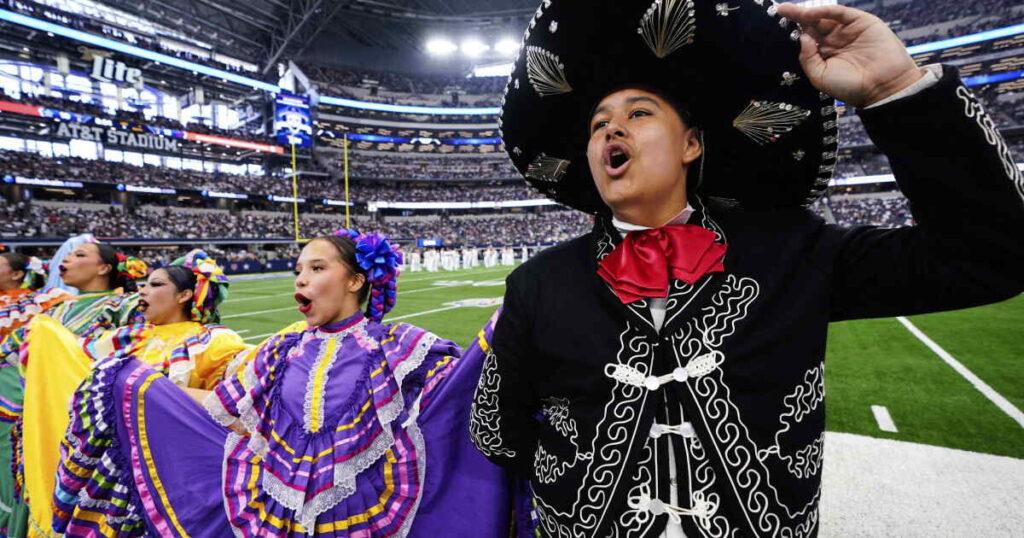
Since its inception, National Hispanic Heritage Month has been problematic, and never more so than now.
It began as Hispanic Heritage Week in 1968 under President Lyndon Johnson, and then in 1988 President Reagan turned this commemoration of heritage and culture into a full month. The expansion mirrored the growing political, social and economic importance of Hispanic Americans. We number roughly 68 million, or about one-fifth of the U.S. population.
The issues around Hispanic Heritage Month begin with the name itself, which uses a catch-all phrase even though, as the Pew Research Center noted in 2024, “No single pan-ethnic term has been fully embraced by U.S. adults with roots in Latin America or Spain.”
Some people object to the term “Hispanic” — which originally meant “related to Spain” — as it focuses on the dominant power in Latin America’s colonial past. Although more people in our communities prefer “Hispanic” (52%) to “Latino” (29%), these labels are usually not how we describe ourselves.
In my experience, people rarely say, “I’m Hispanic.” That’s just a box we check on college applications and employment forms. Most of us identify by referencing our family’s country of origin; if asked, I tell people I am Mexican American.
It’s common to hear both immigrants and U.S.-born Hispanics say that they are Cuban or Dominican if their ancestors came from those places. Puerto Ricans often call themselves by that term regardless of whether they were born or raised on the island. These signifiers have further variations too, such as Tejano (Tex-Mex), Nuyorican (New York City Puerto Rican) or Chicano (a political identification among some Mexican Americans).
With such distinct identities in our communities, the construct of “Hispanic Heritage Month” was perhaps doomed to not catch on.
It had another potentially fatal flaw from the beginning. Running from Sept. 15 to Oct. 15 so it encompasses national holidays of Costa Rica, El Salvador, Guatemala, Honduras, Nicaragua, Mexico, Chile and Belize, Hispanic Heritage Month is not an easily remembered calendar month, like Black History Month (February) or Women’s History Month (March).
While its odd timing was an inclusive idea, it’s also confusing. And its spot on the calendar is close to the start of the school year, the 9/11 anniversary, peak hurricane season in the Caribbean and the Jewish high holy days, meaning it’s easily overshadowed.
Ironically, over the years the people most critical of Hispanic Heritage Month have been Hispanics. The 30 days earmarked by the federal government to celebrate our communities have generated a great deal of ambivalence, as the commemoration became more of a marketing opportunity for brands rather than an organic expression of cultural pride.
In 2025, President Trump put out a proclamation for National Hispanic Heritage Month, recognizing “the extraordinary contributions of Hispanic American citizens past and present.”
Yet those words ring hollow, as Hispanic Heritage Month seems to be hanging on by a thread. Corporations and academic institutions have backed away from ethno-centric events, in response to the administration’s attacks on diversity initiatives. Some large media outlets have likewise retreated from elevating Hispanic voices and stories. The very idea of highlighting Hispanic culture seems out of touch when so many Hispanics are feeling under assault in our daily lives.
This year, Hispanic Heritage Month events will probably be muted. Many Hispanics are wary of large public gatherings, because the fear of encounters with ICE is real (this was why, in part, Bad Bunny eschewed any concert dates on the U.S. mainland during his smash 2025 tour). U.S. citizens of Hispanic descent have been detained, deported and killed by immigration agents. Some U.S.-citizen Hispanics have taken to carrying their passports or other documents with them and avoiding speaking Spanish in public, as last year the Supreme Court recognized doing so as cause for suspicion and detention.
Right now, many Hispanics are just not in the mood for celebrating. Our communities are in survival mode.
The only counterbalance to this grim situation is context. While times are extremely challenging right now, that’s unfortunately nothing new; the history of Hispanics in the U.S. is largely defined by struggle and resilience. And maybe our communities have outgrown the need for institutional validation.
With or without Hispanic Heritage Month, Hispanics still have joy in our families and in our communities. We know that our ancestors were here long before the pilgrims, and that we have a rich tradition of military service. We take pride in the American experience, because it is our experience. These feelings are deep and enduring. These are feelings that no presidential proclamation can give us — and that no administration can take away.
Raul A. Reyes is an immigration attorney and television commentator in New York City. X: @RaulAReyes; Instagram: @raulareyes1
The post Hispanic Heritage Month was a worthy but doomed idea appeared first on Los Angeles Times.