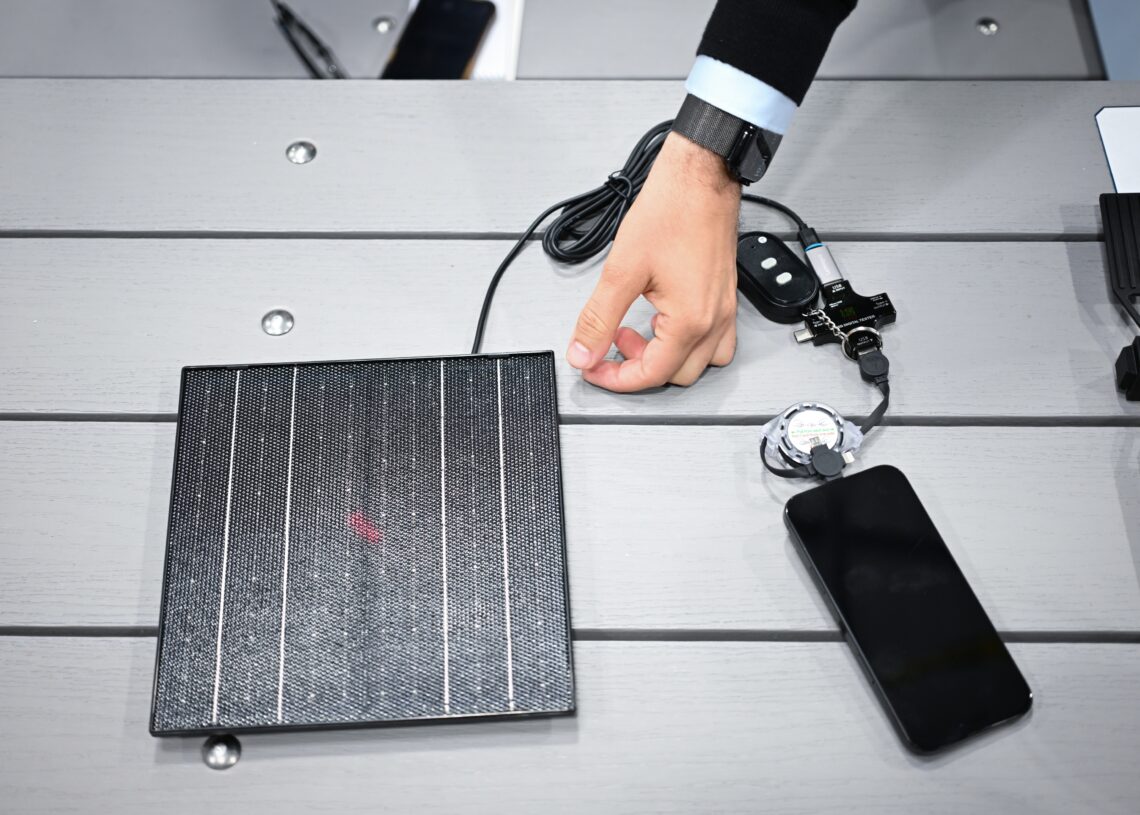
In a laboratory amid Northern Virgina’s sprawling data centers, a group of scientists is looking very far outside the box for a solution to overwhelmed power grids.
They want to harness the sun’s rays and shoot a kilometer-wide laser — they prefer the term “power beam” — down from satellites in space to solar panels on Earth. The idea is to overcome solar power’s biggest weakness: that it stops working when there is no sunlight.
If all goes according to plan — a big if, as this is a vision innovators and investors have been chasing for decades — those beams could turn the energy industry on its head. They would enable off-the-shelf solar panels to generate electricity even at night and could more than triple the amount of energy produced by a conventional solar farm.
As the scientists in Ashburn, Virginia, tinker with photovoltaic films, infrared rays and heat-resistant metals, a large wall-mounted digital clock counts down toward January 2028. That’s the deadline their four-year-old start-up, Overview Energy, has imposed for beaming its first batch of power from space.
“We really believe that we are able to provide utility-scale power with this technology,” said co-CEO Darko Filipi. He estimated that his company could supply a quarter of the new energy the United States will need over the next decade with no new construction on land.
Not everyone is convinced that the answer is in the stars. Space solar energy has long been dismissed as too impractical, too dangerous and too expensive.
“The technology may work,” said Amory Lovins, a Stanford physicist and co-founder of the energy think tank RMI. “But I have serious doubts the economics do.” He said other technologies can produce abundant, even round-the-clock clean power for much cheaper.
The outlook for the renegade space solar industry, though, has changed markedly in recent months. Like fusion power plants, tiny nuclear reactors and other sci-fi worthy ideas that were largely written off years ago, this one has come roaring back as tech companies and investors grasp for solutions to a power crunch that threatens to stymie the growth of artificial intelligence and chill the U.S. economy.
Meta has signed a contract to secure the first gigawatt of capacity Overview helps generate for its data centers. Big solar manufacturers are scurrying to design new products that could be used by a growing constellation of firms looking to make energy in space with an array of technologies. The U.S. Department of Energy is invested in helping space solar start-ups and university labs speed up development.
The science underpinning Overview’s business plan dates back to NASA’s study of power beaming in the 1970s as a possible solution to that era’s energy crisis.
The system would be built around thousands of satellites orbiting thousands of miles above Earth, collecting energy from uninterrupted sunlight and sending it down as invisible, near-infrared light.
Solar farms would be equipped with beacons that could guide a beam their way. A beam could be pointed toward any such beacon at any given time. And Overview would be able to constantly move power to areas most in need, as determined by its tech company and utility company clients.
Overview’s executives maintain that the beams would not be concentrated enough to be dangerous to humans on the ground.
“If you can stand in the sun, you can stand under this,” said Abdullah Al-Shakarchi, the company’s other CEO. “There is no chance this could be used as a weapon. We have military folks come though and sometimes they ask, ‘Can this be used as a weapon?’ The answer is always no.”
The executives say that by the mid-2030s, they could generate electricity at prices lower than the gas plants currently used to keep the power grid stable in times of high demand.
It’s a heady projection — and one that draws some industry skepticism in the face of daunting engineering challenges and huge potential costs to make the technology operational.
Building the satellites, each the size of roughly two football fields, and catapulting them into orbit would be a massive undertaking.
“It is one thing to do some experiments with this technology,” said Henry Hertzfeld, a research professor of space policy at George Washington University. “It is another to send lots of these things into space. There are real questions about whether the launch capability will be there.”
Company officials acknowledge that it will be expensive to generate the first megawatts of power that would come from the planned 2028 demonstration. But Overview is betting that launch costs would plummet over the next decade, as companies such as Space X and its competitors vow they can accommodate an explosion of space-bound energy infrastructure. Space X itself is building factories to produce solar panels for use in orbit.
Others in the space industry are not so confident about launch prices going down. They note that demand for satellite launches from all manner of industries is expected to soar.
Hertzfeld said he is also unconvinced that all safety questions have been answered. “Even if it is not meant to be used as a weapon, it could still interfere with communications or flight navigation or other things,” he said.
Meta is willing to bet the obstacles can be overcome. If the technology were to be a success, it could cure some of the company’s biggest headaches.
Silicon Valley firms are struggling to lock down the power they need to fuel data centers. Their plans for developing more capacity are meeting intensifying resistance in communities across the country, as the environmental impact and the costs associated with the AI buildout trigger a fierce backlash. The idea that the energy equivalent it takes to power entire large cities could be generated without building anything new on Earth is enticing.
“Space solar has the potential to deliver uninterrupted energy to the grid by building on existing solar infrastructure — this means no new land, no fuel, and solar at night,” Nat Sahlstrom, Meta’s vice president of energy and sustainability, said in an emailed statement.
Some potential customers may prefer to wait to see if it all works out. For them, Al-Shakarchi has a marketing line ready.
“In our early years, we are only going to be able to provide this energy to a limited number of customers,” he said. “If you are not in our queue today, then it will be a long time before you are able to see this energy. That’s an advantage that you are ceding to the companies you are competing with.”
Overview is not the only option. It is among several space solar start-ups jockeying to show they can use space technology to produce clean energy at competitive prices. The methods of harnessing sun power vary widely. Some envision using it to power data centers floating in space.
“The markets see space as the next growth area,” said Danielle Merfeld, global chief technology officer at Qcells, one of the largest solar panel manufacturers in the U.S. “Our investors are definitely expecting space will be the next frontier for solar.” The company has entered a partnership with the Georgia Institute of Technology to advance space-based solar power research, and it has launched a new space solar research and development team in Atlanta.
“There are still a lot of challenges for space solar, but we are also now seeing the pathway for solving them,” said Ali Hajimiri, co-director of the space-based Solar Power Project at Caltech. He has been working for 13 years on satellite systems that would beam microwaves down to Earth.
Microwaves can cut through clouds and precipitation in ways that Overview’s infrared lasers cannot. But there’s a catch: they can’t generate power through conventional solar panels already on the ground. Existing solar farms would need to be retrofitted entirely, adding to the project’s potential cost.
Hajimiri argues it can all be done economically, resulting in abundant electricity at prices competitive with energy from conventional technologies.
The open question is whether existing technologies anchored to the Earth will be quicker than any space-based invention to solve the economic and environmental challenges unleashed by a worldwide surge in energy demand.
The cost of storing solar and wind energy in giant, industrial-scale batteries continues to plunge, Lovins said. At the same time, the solar industry is working with communities on designs that are more efficient, less land intensive and built to integrate with agricultural operations rather than displace farmland.
Lovins suspects advancements in the batteries that turn solar energy from an unpredictable, intermittent technology into one that can boast the reliability of coal or nuclear power could make space solar obsolete for creating energy on Earth before it even makes it into the mainstream.
Like so many other advancements in energy, though, space solar is driven not just by cost and climate concerns. There is also the China factor. Beijing is rapidly scaling up its extraterrestrial solar industry, raising concern that this will become yet another crucial sector that was innovated here and then ceded to our rival.
Such concerns are top of mind for the Trump administration, which a couple of weeks ago announced it would invest $12 million to accelerate product development at universities and space-solar firms.
President Donald Trump has branded solar power part of the “scam of the century” (along with wind power), but as China races ahead with technologies that harness the sun’s power from space, the Department of Energy has declared the promise of “near constant power” from space-based solar a development that could “further the Trump Administration’s space superiority agenda.”
The post This far-out idea could enable solar panels to work at night appeared first on Washington Post.