The last few days have brought two very different Russia-related headlines from the free world that raise a serious question about the coherence, logic and indeed wisdom of Western policy toward Moscow.
In late August, the government of Canada announced that it is lifting travel and financial sanctions off Anatoly Chubais, a longtime confidant of Kremlin dictator Vladimir Putin. Having helped strengthen Putin’s hold on power in the early years, Chubais continued to work for him for decades, either as head of state-controlled corporations or as his personal adviser, before quietly slipping out of Russia after the start of its full-scale invasion of Ukraine in 2022. The Canadian Foreign Ministry cited unspecified “reasonable grounds” for Chubais’s delisting. It is difficult to fathom what these could be: Since leaving Russia, Chubais has not uttered a single word against Putin’s dictatorship or against his war in Ukraine.
The second headline came from the French city of Strasbourg, the seat of the European Court of Human Rights, where judges decided to summarily dismiss hundreds of applications from Russian citizens whose rights had been violated by Putin’s regime. During Russia’s membership in the Council of Europe from 1996 to 2022, the Strasbourg court served as the final court of appeal for thousands of Russians who were unable to find justice at home. When Russia was expelled from the Council over its invasion of Ukraine in 2022, the court expressly stated that Russian authorities remained legally bound by all judgments in relation to human rights abuses that took place before the expulsion.
Now, with the stroke of a pen, European judges dismissed 879 pending applications against the Russian state that represented more than 1,500 people and organizations, some of whom had been waiting for justice for decades.
The reasoning was purely procedural: the court stated that “the individualised examination of those applications would require the deployment of significant further judicial resources,” and that the applications in question “do not appear to raise issues of marked importance.” This last explanation is truly perplexing, as the applicants whose complaints the court has refused to hear include opposition politicians Alexei Navalny (who was killed in 2024) and Lev Shlosberg (who was recently sentenced to 11 years in prison for opposing the war in Ukraine); the family of journalist Timur Kuashev (who was murdered by an FSB poison squad); and victims of the Kremlin’s heavy-handed “counterterrorism operations” in the North Caucasus.
The court’s decision — a plain denial of justice to Russian victims of state-sponsored abuse — drew simultaneous condemnation from pro-democracy Russians and from politicians in Western Europe. Grigory Vaypan and Nataliya Sekretareva, two of Russia’s leading human rights lawyers, called it “a gift both to the Kremlin and to other states that violate human rights” and predicted that it “will go down in history as one of the most shameful decisions the ECHR has adopted in its entire existence.” Meanwhile, Pieter Omtzigt, a longtime Dutch lawmaker and former rapporteur of the Council’s Parliamentary Assembly, grimly noted that “the country with the worst human rights record gets rewarded for overloading the court.”
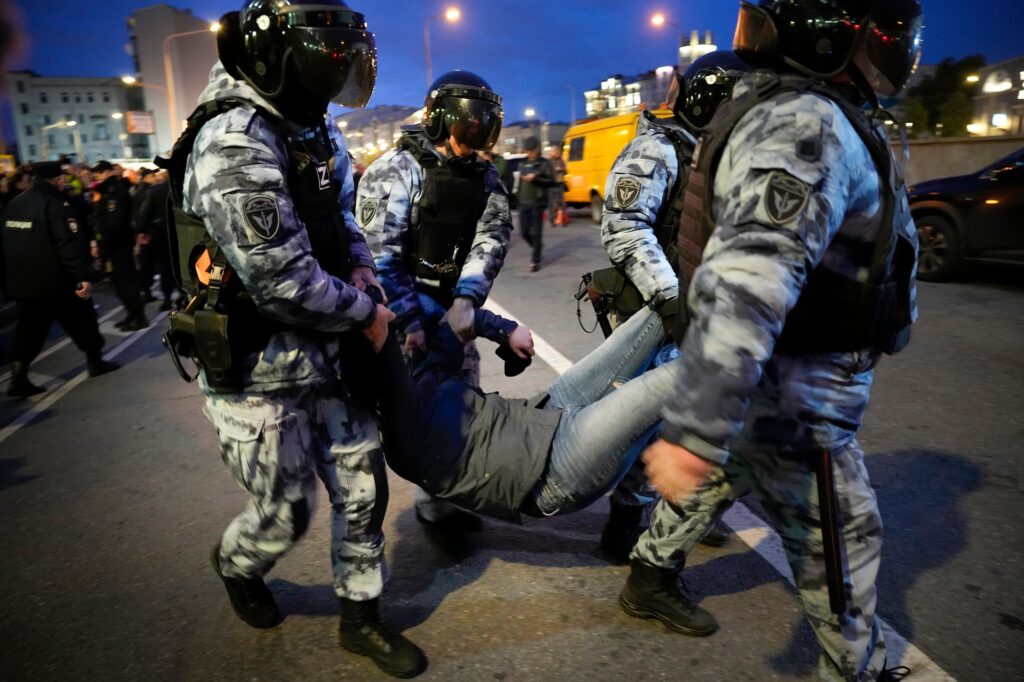
The contrasting news from Ottawa and Strasbourg was the latest reminder of how misaligned Western policies toward Russia have often been since the start of the Ukraine war. While senior Kremlin officials continue to be welcomed in the United States and in Europe, and while leading Kremlin propagandists continue to freely travel in the democratic world, several E.U. and NATO countries imposed blanket bans on entry by most Russian citizens, regardless of their own actions or views — bans that often target Russians who oppose dictatorship and war.
It is strange to have to explain in the 21st century that there is no such thing as “collective guilt” and that blanket discrimination of a group of people is always wrong, whether it is by the color of their skin or by the color of their passport. Apart from violating international law (Article 14 of the European Convention on Human Rights prohibits discrimination by national origin), blanket bans help the Kremlin’s domestic propaganda by seemingly confirming its longtime narrative of the West as being “Russophobic” — that is, hating any and all Russians — rather than being anti-Putin.
In the early 2010s, when Russian opposition leader Boris Nemtsov successfully campaigned for the passage of the U.S. Magnitsky Act — a law imposing travel and financial sanctions on human rights abusers and corrupt actors in Putin’s government — he emphasized its smart and targeted nature. “Don’t touch the country, punish the villains,” he would tell his interlocutors at one Capitol Hill meeting after another. The Magnitsky Act did exactly that. It is very much possible for sophisticated democratic governments in the modern world to be able to make this distinction.
Policymakers should focus on expanding and strengthening Western sanctions against the Kremlin — from targeting Putin’s “shadow fleet” that helps bankroll his war in Ukraine through illegal oil sales to closing the loopholes that help his acolytes evade restrictions. (They certainly should not open new ones, as Canada just did.) At the same time, Western democracies should continue engagement and dialogue with Russian society, a large part of which is increasingly — and evidently — turning against the regime and the war.
In years past, the free world has been able to make the distinction between regime and society when it came to dealing with authoritarian countries. Invariably, this distinction played an important and positive role when those countries underwent political change. It would be both prudent and farsighted for the West to do the same in relation to Russia.
The post The West’s Russia policy has lost the plot appeared first on Washington Post.