It’s only September, and America just barely averted the first constitutional crisis of this year’s midterm elections.
Hang with me here because this gets a bit complicated. Last September, the Missouri Legislature passed a redistricting bill called H.B. 1. This bill was part of the wave of mid-decade census redistricting initiated after President Trump essentially ordered the state of Texas in July to redistrict to create more Republican-majority congressional districts and diminish Democratic voting power in the state.
Texas dutifully complied, and this set off a lopsided redistricting arms race between red states and blue states that has resulted in Republicans thus far potentially gaining 10 additional Republican districts, a number that — in a close election — could easily decide control of the House.
To illustrate how important 10 seats could be, the House majority for both Republicans and Democrats hasn’t exceeded 10 members after an election since the 2018 midterms.
Missouri, a bright red state, has eight representatives in Congress, two Democrats and six Republicans. The Legislature altered the maps to eliminate one of the Democratic seats, hoping to create an even more lopsided outcome — leaving the roughly 40 percent of Missourians who vote Democratic with, in essence, only one Democratic representative.
The Missouri Constitution, however, contains a provision that says that the people of the state “reserve power to approve or reject by referendum any act of the general assembly, except as hereinafter provided.”
On Dec. 9, 2025, a coalition of Missourians who sought to overturn H.B. 1 submitted a referendum petition that contained more than 300,000 signatures — more than enough to put it on the November ballot.
As the Missouri Supreme Court has explained, by law, once the petition was submitted, the Missouri secretary of state, Denny Hoskins, had until Aug. 4, 2026 at 5 p.m. to accept or reject the petition, but his power to reject the petition was sharply limited by Missouri law.
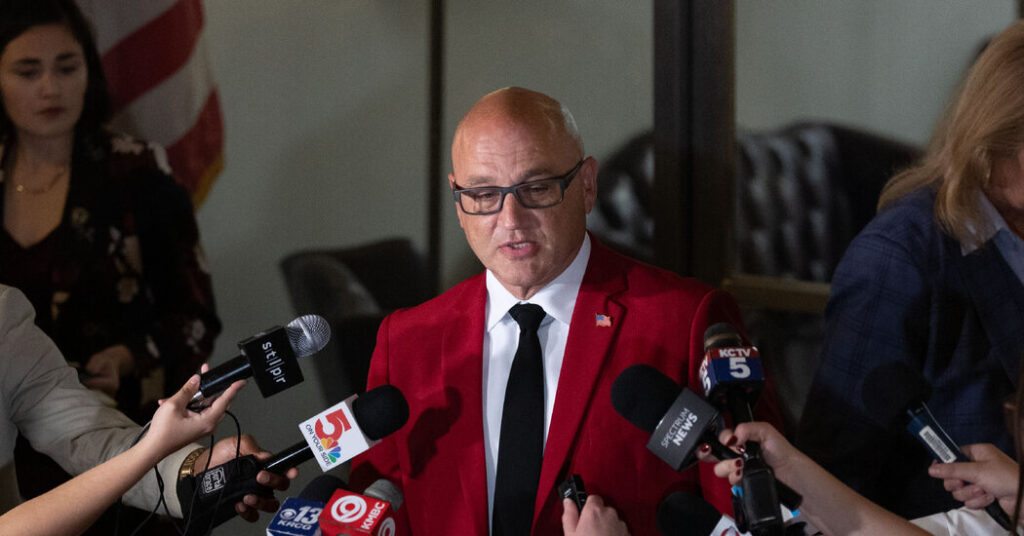
Hoskins, it will surprise no one, is a Republican. Before now, his main moment in the media spotlight came when he was sued for defamation after he publicly, but falsely identified a man named Denton Loudermill Jr. as an illegal immigrant and a suspect in a deadly shooting at the Kansas City Chiefs’ Super Bowl celebration in 2024.
Complicating the picture further, the state’s primary elections were set for Aug. 4. Given this reality, a responsible secretary of state would accept or reject the petition well before August, so that the matter could be fully litigated before the primaries.
But no, the state plunged forward with the primaries anyway, and on Aug. 4 at about 4 p.m. — one hour before the deadline — the secretary of state also rejected the petition, arguing that the Missouri Constitution does not permit a referendum on redistricting plans.
In other words, the primaries were conducted under the new maps when the Republican secretary of state was in possession of a referendum petition challenging those maps. He rejected that petition under his own, novel legal theory that he knew would be challenged in court.
If you think that’s brazen, just wait.
On Sept. 3, the Missouri Supreme Court issued a unanimous opinion holding that voters do have the right to overturn redistricting legislation by referendum, that the petition was sufficient to put the referendum on the November ballot, and — as a result — “H.B. 1 is not the law and has never been the law.”
Missouri appealed the ruling to the U.S. Supreme Court, but in a one-sentence order issued on Sept. 8, Justice Brett Kavanaugh refused to stay the Missouri ruling. This outcome was predictable. The Missouri Supreme Court has the final say over matters of Missouri law, not the U. S. Supreme Court.
So the matter was over, right? The Missouri Republican Party lost. The old maps were in force, and the referendum was on the November ballot instead.
Not so fast — two things happened in rapid succession. Minutes after Justice Kavanaugh rendered his decision, Judge Stephen Clark, a Trump-appointed Federal District Court judge in Missouri, issued a temporary restraining order in a separate federal case ordering Missouri to use the new maps.
How could the judge do this after the Missouri Supreme Court ruled? Because the case in Federal District Court raised federal claims. The judge ordered that the new maps be used in part because those were the maps used in the primary, and restoring the old maps “would disenfranchise primary-election voters and undermine the nominations of candidates chosen in the primaries, leading to ‘certain’ and ‘great’ harm.”
But wait. Wasn’t the primary conducted in bad faith? The secretary of state had the referendum petition sitting on his desk for months and pushed ahead with the primary anyway. No matter. The Federal District Court ordered the use of the new maps anyway.
That same day (Sept. 8 was quite hectic), the secretary of state wrote an email directing that the new maps should still be used in November, directly defying the Missouri Supreme Court. The court was not amused and immediately scheduled a hearing for Sept. 10 to determine whether to hold Hoskins in contempt of court.
Then things got really wild.
On Wednesday afternoon, Sept. 9, the U.S. Court of Appeals for the Eighth Circuit refused to stay the Federal District Court’s order, and the case was immediately appealed to the U.S. Supreme Court.
On the morning of Sept. 10, just before the scheduled contempt hearing, the Supreme Court weighed in again. In a short, unsigned order with no noted dissents, it stayed the Federal District Court’s ruling, which meant that the Missouri Supreme Court was back in charge. The old maps were back in force.
The new maps would only apply to the next election — if they survived the November referendum.
That should have largely ended the matter. But, incredibly, it did not. At the contempt hearing, Hoskins bobbed and weaved. Rather than provide any clear answers to the court, his attorney said, options were being “carefully evaluated.” Before the court adjourned, Chief Justice W. Brent Powell of the Missouri Supreme Court directed Hoskins to “not venture far from Jefferson City,” the capital of Missouri.
Finally, Hoskins blinked. “Following the United States Supreme Court’s stay, the only governing court order in effect is from the Missouri Supreme Court,” he said in a statement. “In accordance with that order, my Office is directing local election authorities to use the 2022 congressional map.”
The Missouri Supreme Court then issued a written order holding Hoskins in contempt of court — saying he’d engaged in “contumacious conduct” (strong words in legalese that mean willfully disobedient or rebellious) — but that he’d “purged” himself of his contempt through his belated compliance.
A fraudulent election was averted, for now.
I wanted to walk through this situation in detail because it’s indicative of exactly how MAGA attempts to fix elections. It uses the complexity of the law (and public ignorance of the law) to obscure the utter brazenness of its defiance.
This conduct is more than a little reminiscent of the campaign to overturn the 2020 election results. That time around, the Trump team tried to exploit legal complexity and public ignorance to create a cloud of confusion around what were — in reality — crystal clear election results. And that cloud of confusion ultimately triggered outright legal defiance, culminating in the violence of Jan. 6.
Missouri Republicans crossed the line, right before they jumped back. Hoskins engaged in gross legal gamesmanship by rejecting the referendum petition on specious grounds the very day of the primary election. He then tried to use that legal gamesmanship to justify using the new maps.
MAGA might blame the Missouri Supreme Court for disenfranchising voters by throwing out the maps used in the primaries, but the court didn’t disenfranchise primary voters, Hoskins did.
Legal gamesmanship is one thing. Outright defiance is another. It raised the nightmare scenario. What do we do when a state government defies a court, and the court has no independent means of enforcing its decision?
And consider this: All of that gamesmanship and all of that defiance was over one House district, and it occurred weeks before the election, without any overt pressure from Trump to break the law.
In other words, prepare yourself.
Whenever I write about potential MAGA efforts to steal the 2026 midterms, I’m assured that those efforts will fail. That the law is against MAGA. That the voters (at this point) seem to be against MAGA. I agree that the law and the voters stand against MAGA, but they did in 2020 as well. As you may recall, that was the year we were one Mike Pence yes away from the gravest constitutional crisis since the South Carolina secession convention of December 1860 effectively launched the Civil War.
The corrupt machinations of the Missouri case reveal that MAGA’s perfidy is limited only by its creativity. And while we keep dodging MAGA’s legal bullets, I fear that it is only a matter of time before one hits.
The Times is committed to publishing a diversity of letters to the editor. We’d like to hear what you think about this or any of our articles. Here are some tips. And here’s our email: [email protected].
Follow the New York Times Opinion section on Facebook, Instagram, TikTok, Bluesky, WhatsApp and Threads.
The post The Fix Was Almost In appeared first on New York Times.