Years ago, I worked for a nonprofit focused on supporting the spouses and children of members of the U.S. military. The people I worked with and the people we served would sometimes stumble onto a topic that’s not supposed to be discussed, the third rail of American militarism: empathy for the families of civilians abroad who’ve been killed in wars led or supported by U.S. armed forces. These people and their lost loved ones are not combatants who bravely chose to risk their lives for their nation. They do not have the support that U.S. military families have. And yet they suddenly find themselves facing the kinds of broad challenges our organization was designed to address for American servicemembers and their loved ones.
While it’s common to gloss over, even celebrate, enemy combatants’ deaths, it’s much harder for most of us to dismiss civilian deaths, to believe they’re either warranted or otherwise acceptable. But this isn’t a given — and there is reason to think the once verboten topic has come to weigh on more people’s minds.
In 2019, when asked in a YouGov/Washington Post poll, a full 36% of respondents in the U.S. indicated that America should use airstrikes even if innocent civilians might be killed. Notably, this poll was taken before Israel’s onslaught in Palestine on the heels of Hamas’ 2023 incursion. Since then, social media and news coverage have given billions of people a clearer idea of the nature and scale of war, while also invoking once-uncommon language around intentionality.
In a 2025 poll by the Economist/YouGov, 43% of respondents said they believed Israel is “committing genocide against Palestinian civilians.”
If more people are more willing to confront the realities of civilian death tolls, then we should also be discussing: What role are governments playing in the increasingly routine killing of civilians? And what moral obligations do we have to the grieving families left behind?
Condolence payments, or ex gratia (Latin for “out of grace”), are an example — and a very rare one — of how governments have historically used money to convey sympathy and exercise good faith in the aftermath of civilian killings. As such, they’re a potentially potent form of soft power that could be wielded by military superpowers such as the United States in a period of warfare that has been marked by a sharp uptick in civilian deaths in global conflicts. I’ve been studying why superpowers haven’t been making these payments.
The psychological trauma from losing a civilian loved one to war is often immense, even debilitating, not only because of the frequently casual nature of the killing but because of the seeming preventability of war’s metastasis into civilian spaces. The trauma entails not only the loss of connection to the deceased, but also the loss of vital financial and material resources, and order.
The strategic, albeit subtle, calculation of a condolence payment is that it will cool the aggrieved’s animosity and erode the potential desires for retaliation, perhaps even earning the aggressor favor — or at least neutrality — in their fight.
The U.S. government has had a formal condolence payment system dating back to at least the Korean War, where roughly two million North and South Korean civilians are estimated to have been killed. During the Vietnam War, approximately 1.4 million civilians were killed, many deliberately. Neither war, though, yielded significant or broad civilian recompense from America.
Many of America’s allies — and enemies — have stepped up, but not without a hint of irony.
In 2016, Israel paid $20 million to the families of 10 Turkish activists whom the Israeli navy had killed during a raid of a Gaza-bound aid flotilla six years earlier. But its ongoing assault in Gaza has not elicited wide-scale condolence payments.
According to the Gaza Health Ministry, more than 67,000 Palestinians, the overwhelming majority of them civilians, were killed in the destruction between Hamas’ Oct. 7, 2023, attack on Israel and the ceasefire agreement that went into place on Oct. 5, 2025. The onslaught has led to unprecedented levels of global animus toward the Israeli government, particularly in America, where attitudes had long been favorable across the political spectrum. An additional 1,160 Palestinians have reportedly been killed by Israeli forces since the ceasefire.
There are no indications that Israel has directly compensated any slain civilians’ families.
In contrast, in 2003, Libya reached a belated but large settlement with families of the victims of the 1988 Lockerbie bombing, which killed 270 civilians, most Americans, awarding each victim’s family $10 million. And in 2020, Iran’s cabinet approved a plan to pay $150,000 to the heirs of 176 people killed on Ukraine International Airlines Flight 752, which was mistakenly downed over Tehran a year earlier by the Islamic Revolutionary Guard Corps.
The families of civilians killed by the U.S. military are compensated quite infrequently and with inconsistent expressions of sincerity. In 2007, the American Civil Liberties Union reported that the U.S. military had initiated a series of $2,500 payments, a then-common cap, to the family members of Iraqis they killed. In one instance, U.S. officials authorized a $2,500 payment, equivalent to about $80,000 in an American household, to an Iraqi family for the military’s role in the death of the family’s daughter, who was killed by American gunfire while playing in her front yard. In 2015, the Intercept reported on the case of an Afghan boy whose family was paid $1,916 by the U.S. after he drowned in an anti-tank ditch.
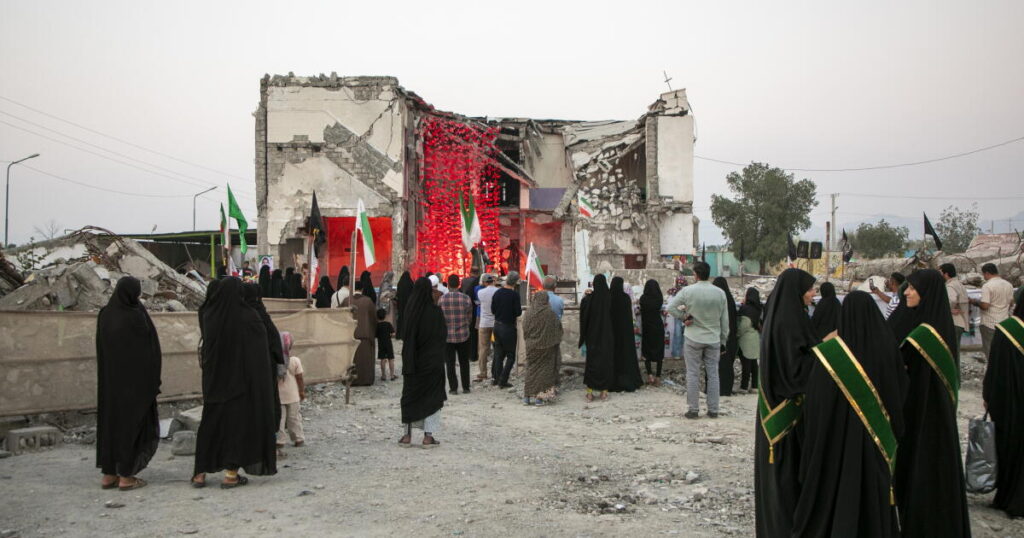
The incipient stage of this year’s U.S.- and Israel-led assault on Iran saw an airstrike that devastated Shajareh Tayyebeh Primary School in Minab, Iran, killing more than 150 people, mostly schoolgirls, with the U.S. as the likely culprit (though it has largely denied responsibility). In the proceeding weeks, Amnesty International and a glut of other human rights enterprises called for America’s financial and moral atonement. None has been forthcoming. And the incident has no doubt helped the hardline Iranian regime insulate itself from internal criticism, shifting attention away from the dynamics that precipitated the coordinated bombing of Iran and toward the stunning loss of civilian lives caused by the American military.
Even when used, condolence payments aren’t, quite deliberately, considered a direct admission of guilt or responsibility, let alone an acknowledgment of criminality, which is frequently what grieving families want to see.
Some people with whom I discuss these payments support the idea but are concerned that a morally and financially untenable dynamic would then emerge: the actuarialization of civilian life. If condolence payments were a norm, military budgets might allocate in advance the estimated financial coverage required for the civilian deaths “needing” to accrue in battle. I agree that acknowledging the reality of civilian casualties should not cross over into accepting such collateral damage as inevitable or acceptable.
While the gravity of civilian losses in wars can’t be, or at least shouldn’t be, rigidly measured in dollars and cents, the effects of condolence payments can be substantial. Multiple studies, including one examining trends in insurgency violence during the Iraq war, have found that in communities where condolence payments were offered, insurgent violence was significantly lower. This indicates the money is at least partly achieving one of its intended purposes in stymieing retributive actions.
America can and should go further financially, as other countries have, in illustrating our understanding of the vast toll of war. The moral case is simple. The practical case is clear as well. And perhaps a predictable and steep price on any possible civilian casualties would present a financial deterrent to the increasingly haphazard and dire ways we conduct modern war.
Jerel Ezell is a sociologist and assistant professor at the University of Chicago Medical Center.
The post Why the U.S. should pay families of civilians killed by the military appeared first on Los Angeles Times.