Iranian officials will meet on Monday in Oman with representatives of some of the Gulf Arab states that it has repeatedly attacked during its war with the United States and Israel, as the regional conflict has widened in recent days.
Yemen has emerged as the latest front in the fighting, with the Iranian-backed Houthi militants there seizing the strategic port of Mokha and the island of Perim in the Bab el-Mandeb Strait in the Red Sea last week. They have also attacked Saudi energy sites and sought to blockade Saudi shipping, exacerbating a global oil and gas crisis prompted by the U.S.-Israeli war with Iran.
Saudi Arabia was forced to shut its East-West Pipeline on Friday after it was targeted by drones from Iraq. That pipeline has been a critical lifeline for the country’s oil exports after Iran effectively blockaded the Strait of Hormuz in the Persian Gulf. No one took responsibility for the drone attack, but Iraq has long harbored well-armed militias backed by Iran.
The meeting in Oman will take place as talks with the United States to reopen the Strait of Hormuz have stalled. Iran has continued to fire on ships passing through the strait, squeezing the Gulf Arab states and roiling global oil markets. Last week, the price of Brent crude, the international benchmark, briefly exceeded $110 a barrel, its highest level for months, before dropping to about $104 on Sunday.
Esmaeil Baghaei, the Iranian Foreign Ministry spokesman, said last week that the meeting would be held in Oman, which has often served as a mediator between the United States and Iran. Participating countries would discuss efforts by Iran and Oman to reopen the Strait of Hormuz, he added.
Even if an agreement is reached, however, Iranian officials have demanded concessions from the United States before ending their blockade, including lifting sanctions on Iran and releasing frozen U.S. assets. The Trump administration is unlikely to take those steps without Iranian moving to curb its nuclear program.
It was unclear which Arab states would attend the meeting. Mr. Baghaei said officials from Iraq and other Arab states along the Persian Gulf would be involved.
Iran has repeatedly attacked some of those countries since the war began, saying it was targeting the U.S. soldiers and military assets they hosted.
Bahrain, which has repeatedly been targeted by Iranian missiles and drones during the war, said in a statement on Saturday that it would not participate in any talks with Iran.
“The kingdom has been subjected to attacks targeting its infrastructure and civilian assets,” the Bahraini Foreign Ministry said in a statement, adding that any such dialogue would have to be based on “disregarding facts.”
Other countries that have been targeted, however, have signaled that they are open to dialogue. Crown Prince Khaled bin Mohamed Al Nahyan, the Emirati heir apparent, met with President Masoud Pezeshkian of Iran on the sidelines of the BRICS summit in India on Saturday — the first public meeting between the countries since the beginning of the war.
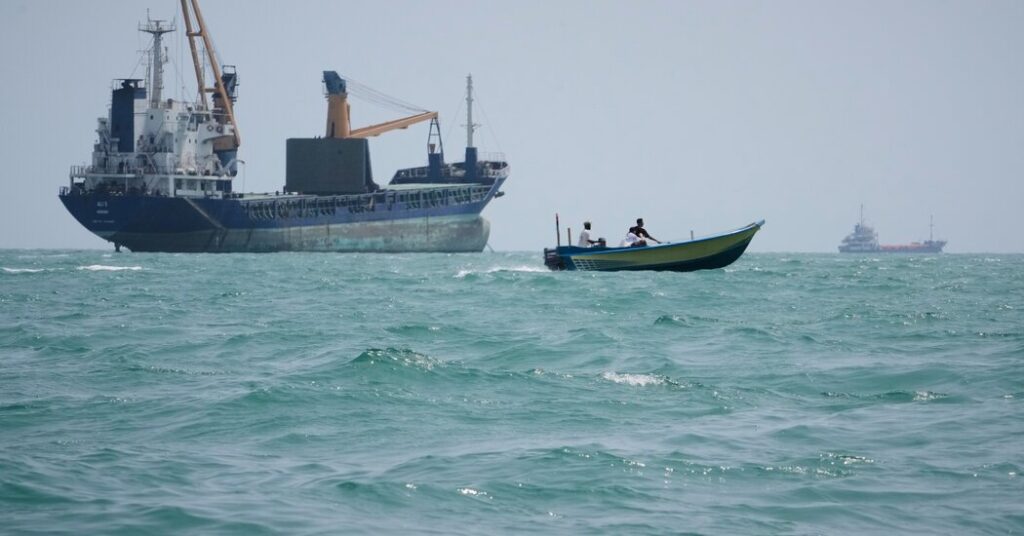
Ship operators still face severe risks in the region. On Sunday, a vessel was struck by a projectile while traveling through the Strait of Hormuz, causing a fire to break out, according to United Kingdom Maritime Trade Operations, a monitoring group run by the British Navy. It was unclear who had fired on the ship.
The post Iran Will Meet With Gulf Arab States as Mideast Conflict Widens appeared first on New York Times.