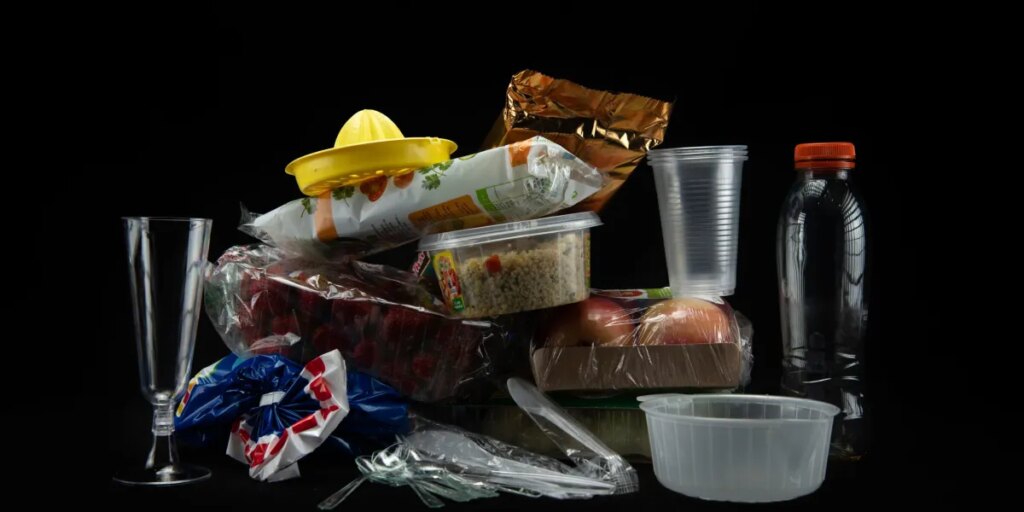
It looks like the American consumer has more to worry about than food recalls and cyclospora—a new study found that even the packaging the food comes in may pose some health concerns.
Out of over 15,000 food contact chemicals (FCCs), 1,222 or 8% can pose serious health risks, according to a recent study published in the peer-reviewed journal Environmental Science & Technology. Some of these FCCs, which in general are “substances that come into contact with food, such as through food packaging, processing, storage or other handling,” per the FDA, were found to be hazardous to human health.
Researchers from the nonprofit Food Packaging Forum Foundation, which conducted the study, found at least 2,160 chemicals regularly contact food and “migrate into foodstuffs.” Using guidelines from the UN’s Globally Harmonized System of Classification and Labeling of Chemicals (GHS), researchers found some of the chemicals related to food packaging and other materials were “carcinogenic, mutagenic, toxic to reproduction, harmful to specific organs after repeated exposure, [and] endocrine disrupting.”
That’s not the only concerning part. The researchers found that 13,211 of the 15,159 known food-contact chemicals lacked harmonized hazard data. That means the scientists could not determine from the available data whether those chemicals met the study’s criteria for being hazardous.
“There’s a lot of ways of establishing whether something is hazardous or not, and some methods are based very much just on computer models, looking at the structure, predicting something. And others are based on in vitro tests,” Dr. Helene Wiesinger, scientific communication officer at the nonprofit and one of the researchers on the study, told Fortune. “And in some sense, the data that we used?’ So this is the data we used, and the problem we ran into at that point was that there were huge data lags.”
A “regrettable substitution”
Those “data lags” have proved to be an ongoing issue throughout the food safety process. She said that it creates a problem regulators have faced across the chemicals industry—removing a known hazardous substance doesn’t necessarily solve the problem if it’s replaced with a structurally similar chemical that has also never been adequately tested.
A large majority of the chemicals that contact food regularly are under-researched and lack the necessary information to estimate their risks, Wiesinger said. She said researchers refer to this as “regrettable substitution,” where a governing body may unknowingly expose consumers to other dangerous chemicals by removing a known one.
“So take bisphenol A, and we say we don’t want to use bisphenol A anymore, so we use bisphenol S instead, because it’s functionally similar,” Wiesinger said, referring to two chemicals used in plastics and thermal receipts. “It has, in a sense, similar ways it can be used in the industry—so it’s an easy substitute. But it didn’t have enough data,” she said, to “the point where the replacement was searched for, and then bisphenol S was used, and then later, it turned out to be similarly problematic as bisphenol A.”
Bisphenol A is a common chemical found primarily in water bottles and other various products—and according to the National Institute of Environmental Health Sciences, roughly 93% of people over the age of six have detectable levels of the chemical. Bisphenol S is a common replacement for Bisephenol A—but it has been found to cause negative hormonal effects “comparable to or worse” than its predecessor, based on a study from the National Library of Medicine.
The study attempted to address that problem by looking beyond the individual chemicals. Wiesinger grouped the 15,159 FCCs according to chemical structures and identified specific “priority groups,” or clusters of chemicals structurally similar to ones already known to be hazardous. Among those groups were ortho-phthalates and known “forever chemicals” like PFASs. According to the FDA’s recall website, there have been no open recalls regarding food packaging.
About 70% of the over 4,000 chemicals fell into the priority groups, essentially meaning a hazardous chemical could potentially fly under the radar not because scientists have established that it is safe, but because scientists don’t have enough information to determine if it’s dangerous.
But Wiesinger warned that even if the conclusions of the study may be concerning for food consumers, the findings are most effective in the hands of policymakers. She said it would be “a bit of a policy failure” if a hazardous material can simply be replaced with another that hasn’t been adequately tested, and that comes with testing materials worldwide.
“Our data base is global,” Wiesinger said. “There is a lot of trade from all places to all places that we have data for.”
The post It’s not just food: The plastic packaging your food comes in may carry cancer-linked chemicals, and most go untested appeared first on Fortune.