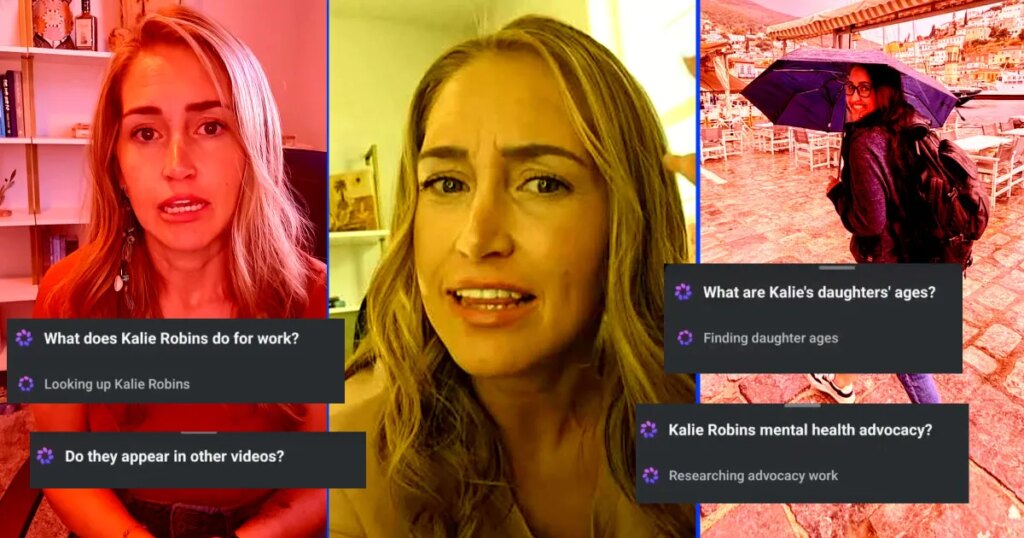
Last week, a mother in Utah named Kalie Robins took to Instagram to post what she felt was an “innocent” video of herself and one of her two young daughters singing in the car. Her daughter’s face was visible, but Robins hadn’t said her name. None of her existing Instagram posts, she told Futurism, publicized the names of her children.
When she returned to the same video later, Robins discovered that Meta’s built-in AI was offering a suggestion: that she investigate the identity of the child in the backseat.
“Who’s the child passenger?” read the Meta AI’s suggested prompt, talking about her daughter.
Robins, who detailed her dystopian experience in a viral Instagram video, decided to engage with the AI to see what would happen. To her horror, it coughed up a detailed response that named not only her daughter who was pictured in the video, but her other daughter as well. It did so, seemingly, by cross-referencing information from her Instagram page with other posts on Meta platforms going back years — information largely shared not by Robins, but by family members including excited grandparents.
“I clicked on it, and it gave a whole portfolio of not just my daughter that was in the car, but also my other daughter,” Robins told Futurism. “I’m thinking, ‘Why is that in here?’ And then it just kept offering more and more.”
Meta AI continued to recommend new questions, each more invasive than the next, according to screenshots shared by Robins.
“What are Kalie’s daughter’s ages?” read one suggested prompt, which spurred the AI to provide a detailed age breakdown and timeline based on “family birthday posts and birth announcements” that included a Facebook post of one of her daughters as a newborn that was shared by the child’s grandmother.
A similar response, also referencing Facebook posts, discussed how much one of Robins’ daughters weighed at birth. Screenshots also show Meta AI prompting Robins to ask questions about the girls’ lives and interests.
Meta AI “started talking about, because of their ages, this is the grade they should be in. Well, there’s only one school here, so that wouldn’t be hard to find,” Robins recalled. “And then it talked about what are my daughter’s favorite beaches, what are this daughter’s favorite books, where they go hiking, what’s their favorite trail.”
In another disarming prompt, Meta encouraged Robins to ask it: “Where does Kalie Robins live?”
As Meta AI searched for the information, it said it was working on “pinpointing Kalie Robins’ location.” It then offered multiple paragraphs expounding on where Robins was likely based, drawing on content including a 2018 Facebook post that, per the Meta AI summary, “congratulated her” on a life achievement.
Meta AI also encouraged users to ask questions about Robins’ professional life and her work in “mental health advocacy,” providing information about her and her husband’s employment histories. Robins was stunned as she watched the Instagram-embedded AI draw on years of posts to Meta platforms to assemble an intelligence dossier about her and her family.
“It just kept going and going, and that pit in my stomach just kept getting bigger and deeper,” said the mother of two. “I felt this dread.”
Robins’ Instagram account, where she’s been working to build her following as a travel creator, was public. But she was far from a celebrity influencer; she had only a few hundred followers. And though a human investigator may well have been able to cobble together a similar pile of information, Meta AI was able to do so in minutes.
“I thought we were being safe and smart,” said Robins. “I have done so much to make sure my kids are safe… the more it kept showing me, I felt more and more like I was failing my kids, and I didn’t realize it.”
A self-avowed “90s kid,” Robins told Futurism that she’s been using Meta platforms since Facebook “first came out.” She lives far from her extended family, and as she and her relatives have started families, Facebook has long been an avenue to stay connected to loved ones and to share life milestones — the very kind of human connection that Meta has long said that its social media platforms are intended for.
But this is also meant that Robins and those in her life, like billions of others worldwide, have been leaving breadcrumbs of personal information throughout Meta’s platforms for years. In this case, Meta AI was able to quickly surface that years-long trail and piece it into a detailed portrait of Robins, her family, and their life; as it turns out, there’s a lot of information in the mundane.
Robins is now in the process of asking loved ones to take down or hide memories they’ve shared online, which she says has been an emotional process.
“I’ve had a couple relatives cry because they were going through and deleting everything. One of them was a grandparent — she said, ‘This is my scrapbook, I have to get rid of my scrapbook?’” Robins recalled. “I love seeing my niece, my nephew. I love sharing my daughters with their family that they never see… they’ll comment, ‘Oh my gosh, she’s getting so big,’ and it’s exciting for all of us to watch each other grow when we’re nowhere near each other. So to have some family members actually crying that their scrapbooks are gone — it’s rough. It’s hard, and it is a bummer for me.”
Reached for comment, Meta confirmed that Meta AI can search though a user’s own content as well as for public information on the web. In this case, though, it said its AI search feature had “missed the mark.”
“We created this feature to help people get more information about topics or posts that interest them. When someone clicks on a prompt and uses this feature, the response it generates is based on information the user already has access to,” said the tech giant. “But we missed the mark because the feature never should have prompted the individual with questions like that and we’ve fixed that issue.”
Between the rise of AI and the growing ubiquity of a new wave of surveillance technologies — like Meta’s smartglasses and other wearables, or Flock cameras — years-old questions around tech and privacy have reached a fever pitch. Robins, for her part, says she hopes that sharing her experience will encourage other families to make changes about the way they use the web.
“If this tool is putting things together and making a neat little package with your kid’s name on it, make it hard,” Robins urged. “Make it so hard to find that information.”
More on AI and privacy: Elon Musk’s Grok AI Is Doxxing Home Addresses of Everyday People
The post Mother Horrified When Instagram’s AI Scours Social Media for Invasive Information About Her Young Daughters appeared first on Futurism.