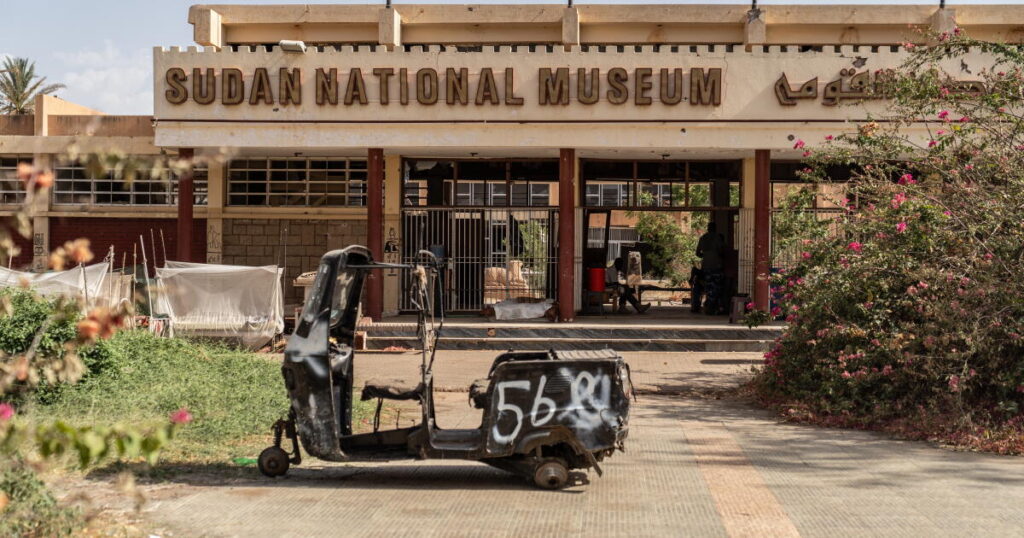
KHARTOUM, Sudan — The ancient statues of the deities Heket and Beset, too heavy to move, were used for target practice. The 4,000-year-old skeletal remains from the bio-archaeology lab? Scattered or scorched. The gold vault lays ransacked, the storage rooms firebombed.
Walk through the grounds of the Sudan National Museum and the reminders of the civil war’s devastating impact on this country’s cultural history seem everywhere.
“It was systematic. They entered the depots and stole everything they could,” said Umaima Abdul-Rahman Al-Sanusi, one of the museum’s curators, as her eyes scanned a shattered display case. She was referring to the Rapid Support Forces, or RSF, a paramilitary group that controlled the capital — and the museum with it — from April 2023 until government forces dislodged them in March of last year.
When Al-Sanusi first saw the level of destruction in the museum — where she’s been employed around 15 years — she cried. Even now, more than a year after she and her colleagues returned to the museum, her voice was tight with not-quite-resigned frustration.
“These artifacts and sites, they’re part of us,” she said, her fingers giving a reassuring touch to a statue of the Nubian god Apademak — a lone survivor standing in a courtyard strewn with shattered stone shards and the occasional bullet casing — as she walked past.
“You lose them, you lose your identity.”
Sudan’s civil war, a conflict credibly described as the world’s worst humanitarian crisis, has seen violence matched only by the belligerents’ rapacity in pillaging the country’s riches.
Like gold, oil, gum arabicand other resources, Sudan’s archaeological treasures, a legacy of the successive kingdoms that flourished and died in the Nile Valley over millennia, have been commandeered to power a war machine that has killed hundreds of thousands and displaced some 14 million people.
At least 76 heritage sites and 20 museums have been ransacked by the RSF and run-of-the-mill thieves, officials say, carting off an archaeological haul worth more than $150 million. One museum was turned into a barracks.
The National Museum alone lost almost two-thirds of its inventory, comprising nearly 100,000 artifacts that covered Sudan’s prehistoric age through its Nubian era, the Kingdom of Kush, the Christian era and its Islamic period.
Some items were smashed and shattered when the museum’s grounds became a run-and-gun battlefield.
The museum was undergoing renovations before the war, so most of the collections were packed in the main warehouse. The RSF stole the artifacts in the same boxes where they were stored, said Jamal Zaid Al-Abideen, a veteran official at the National Corp. for Antiquities and Museums.
“They didn’t even need to break into the strongroom,” Al-Abideen said bitterly, looking at a heavy metal door secured with multiple bolts. Behind it was the vault that once contained almost 2,000 objects of 24-carat gold, gem-ornamented Nabatean funerary figures and ancient jewelry from the Kingdom of Kush. All gone.
“They had the time to go through the museum director’s desk and find the key. They could loot it all at their leisure.”
Al-Abideen, who was the first civilian to enter the museum after the Sudanese army clawed back Khartoum, walked to a room where staff had gathered all the ordnance found when bomb experts came and sanitized the museum of explosive materials. Lined on the floor was box after box of ballpoint-pen-sized .50-caliber rounds; beside them lay a mound of bullet casings and a half-destroyed drone.
Al-Sanusi joined, and with Al-Abideen continued their macabre tour of the museum’s grounds. They headed to the backyard, where a dozen containers lay in the sun, one for each of the international archaeological missions that had been working in Sudan before the war’s start.
“Everything was packed here for when the research missions were supposed to come back,” Al-Sanusi said, as Al-Abideen heaved a jammed container door open. Inside was a maw of fire-roasted boxes, shards of pottery spilling across the floor, a skull and a scorched femur.
“Now all of it — excavation equipment, notes, samples — it’s all burned. And we don’t even have records for them,” Al-Sanusi said.
“The metal pieces were burned because they thought they could melt them down and find gold in them,” Al-Abideen added.
The ravaging of the museum reflects the destruction seen across Khartoum. The neighborhood where the museum is located — once a well-appointed Nile-side quarter of luxury hotels, architecturally adventurous towers and botanical gardens — became a prime target for the RSF.
The group evolved from the government-supported Janjaweed militias of the 2000s to become the army’s most powerful ally before turning on it in 2023. In Khartoum it went street to street, ransacking what it could, and destroying what it couldn’t. (The RSF denies that its fighters engage in looting.)
Even now, with fighting centered away from Khartoum, the scars persist: Almost no structure, be it the multistory gold souq, the national cinema or the four museums in the capital, stands unscathed. Those buildings not gutted by fire sport a rash of bullet holes or appear gap-toothed where an artillery shell punched through a wall. The mirrored high-rises have no intact windows.
The civil war erupted in April 2023, when the RSF launched attacks across the country aimed at dislodging its rival, the Sudanese military. Before, the two forces had been allies, working together to crush rebellions in Darfur, but also pro-democracy movements that sprung up after the ouster of Sudanese dictator Omar Al-Bashir in 2019.
Since then, the conflict has taken on an ethnic as well as an international dimension, embroiling Sudan’s neighbors but also the UAE, Saudi Arabia, Turkey, Russia, Ukraine and Iran. The U.S. has sanctioned the RSF for war crimes and genocide; rights groups accuse it of sexual violence, torture and forced disappearances. The Sudanese army too has been accused of war crimes.
The stolen antiquities follow other types of bounty the RSF has ransacked. The pieces are spirited across the border to Egypt, Libya, South Sudan and especially Chad, officials say. But they rarely stop there, said Ahmed Junaid, the Sudan representative for UNESCO, which is supporting national authorities in tracking down lost antiquities.
“We know that some objects went to Europe, Middle East and even Gulf countries,” Junaid said, and from there an unknown number of antiquities entered the regional and international market.
A big challenge for the staff in Khartoum is that there hasn’t been a full accounting of the national museum’s vast holdings from even before the war.
By the museum’s front steps, in the shadow of the main building, Qassem Hassan Nasser leaned in close with a camera and snapped a high-resolution photo of a wooden artifact. Inside, other staff members worked to incorporate paper records into a database. It was all part of a gargantuan effort to stitch together a comprehensive inventory.
There have been some modest successes in tracking down looted antiquities. In January, Sudanese authorities showed off a haul of some 570 items taken from the national museum, including scarab-shaped amulets, along with ancient vases and figurines. They were recovered in Port Sudan, probably before they were to be transported outside the country.
Sudan is hardly the first war-ravaged Middle Eastern nation to have its heritage stolen and sold, said Amr Al-Azm, a Syrian archaeologist and co-director of the Antiquities Trafficking and Heritage Anthropology Research Project.
“In Iraq, Syria, in Lebanon, in Sudan, in Yemen; wherever you have antiquities, it’s a revenue stream,” he said. Much of it can be subsistence looting, with people selling antiquities because their livelihoods have been disrupted by war.
“Then you come to the organized side of things: In all these places, you have a network of criminals and smugglers, and when you get armed, non-state actors, they tap into it. Then they institutionalize the process.”
The money from selling the antiquities is yet another input enriching the RSF’s financial empire, which experts count as one of the world’s largest non-state economies. The funds have enabled it to purchase fighters’ loyalties, as well as advanced materiel, such as drones.
Many looted items appear on Facebook and channels for the encrypted messaging app Telegram, which are based outside the country, Junaid said.
“The scale and the systematic nature of the looting demonstrates this is no longer an isolated or opportunistic case,” he said, “but rather a broader illicit trade taking Sudan’s cultural identity and historical legacy.”
The post How Sudan’s civil war is erasing thousands of years of cultural memory appeared first on Los Angeles Times.