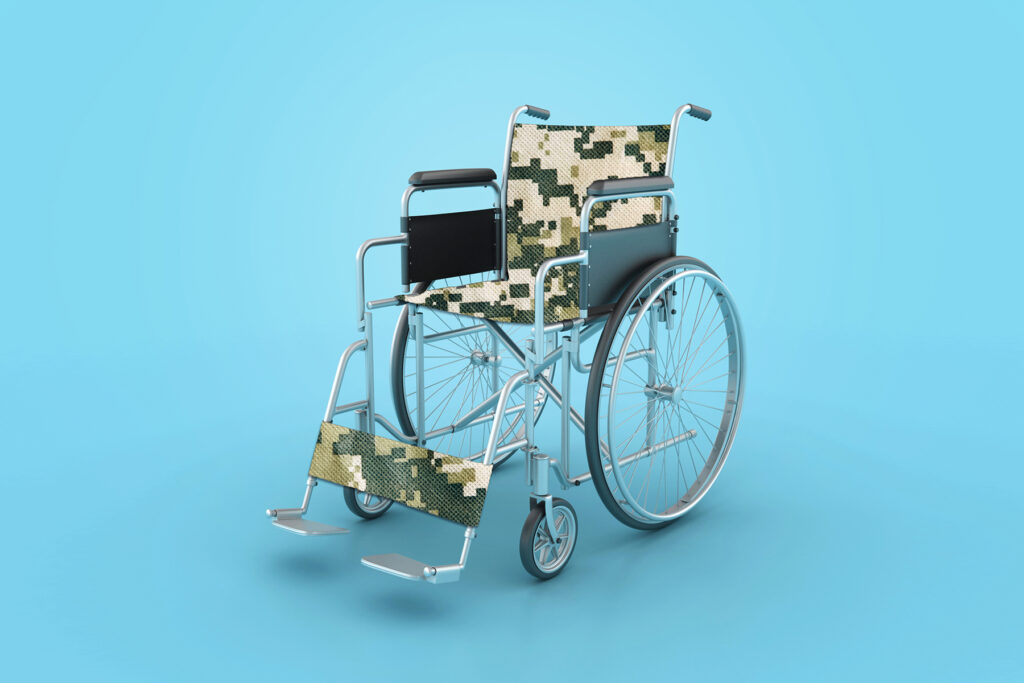
Kristin Duquette is a master’s student at Harvard Kennedy School and the former U.S. team captain for Paralympic swimming.
Resting my hands on the arms of my wheelchair, I sat with a cap and goggles behind the starting blocks of a pool at a swim meet in Connecticut. As my feet brushed the wet tile of the deck, a nondisabled swimmer asked me, “Are you lost? The bleachers are up there.”
At that time, I held several American swimming records — and I was waiting for my race to begin. I shook my head and said: “No, I’m right where I belong.”
Too often, disabled Americans like me are dismissed before entering the room or, in my case, the pool. I have muscular dystrophy — and I have represented the United States in sports and later in federal civil service. I am disabled, but I am not incapable of serving my country.
Yet disabled Americans still do not have the opportunity to fully choose how we would like to serve our country, including in the military. The military rejects applicants who do not fit strict medical requirements, whether they are too visually impaired or paraplegic. But even if a disabled person exceeds entry standards such as fitness tests, he or she will be rejected. Current policy goes to the extreme of barring anyone with a knee replacement, psoriasis or a history of dislocated joints.
Hannah Cvancara, a civilian nurse whose leg was amputated as a child, surpassed the physical fitness and entry exams for military service. She has been rejected several times from serving as a nurse in the military — even as a bill bearing her name, which would prohibit such exclusion, is making its way through Congress.
It is time for U.S. military leaders to seriously consider the strategic benefits of expanding military personnel standards to include certain disabled Americans who are barred from serving the country.
Thanks to technological advances, modern warfare increasingly relies on cyber and remote operations, demanding that soldiers have mental resilience and technical skills as much as physical prowess. The Israel Defense Forces provides a working model for the United States. In Unit 9900, soldiers on the autism spectrum use their cognitive strengths to analyze satellite and aerial imagery. This model has grown to include intelligence, cyber and artificial intelligence roles once considered off-limits to disabled service members.
Although the U.S. does not require mandatory service the way that Israel does, it has many of the same national security needs. In modern warfare, where physical combat is less and less essential, there is no need for the armed services to assume disability is always a military liability. After all, a double amputee or paralyzed soldier can execute military operations as a drone pilot or cyber-operations specialist. Physical strength and speed alone will never outperform Iran’s advanced computing.
Historically, the U.S. military has included disabled Americans it currently deems unfit to serve. From the Revolutionary War to the limited service programs of World Wars I and II, soldiers who might be rejected today for disability contributed to essential missions when manpower and expertise were in short supply. Five-star generals answered to a disabled commander in chief, Franklin D. Roosevelt, to defeat Nazi Germany. Shortly after World War II, the chief of the Army’s Classification and Personnel Actions Branch published a notice announcing the enlistment of 5,000 disabled combat veterans who fulfilled job requirements: “It would be possible for a man with only one eye, one leg, or even no legs, to be enlisted.”
The U.S. faces a moment of need against foreign adversaries, compounded by long-standing enlistment difficulties at home. Although the services have met or surpassed recruitment goals for 2026, the long-term struggle to recruit and retain service members remains a vulnerability to combat stamina and capabilities. With this in mind, the country cannot afford to overlook willing and capable talent.
History has shown that, when given the opportunity, disabled Americans contribute to military success and answer the call to service. Barring talent from service ultimately weakens the military, especially as conflict becomes increasingly dependent on remote and digital technologies. The armed services must create pathways for recruiting and harnessing the talents of disabled people who want to serve. After all, countries such as Ukraine are deploying the same strategies right now.
Warfare will always have physical aspects. But the United States will fall behind if it defines military readiness exclusively by the number of bodies on the battlefield. Looking toward the next 250 years of the American experiment, I hope disabled Americans can don uniforms and proudly say: “We’re right where we belong.”
The post Warfare can now be cyber and remote. Why can’t disabled Americans serve? appeared first on Washington Post.