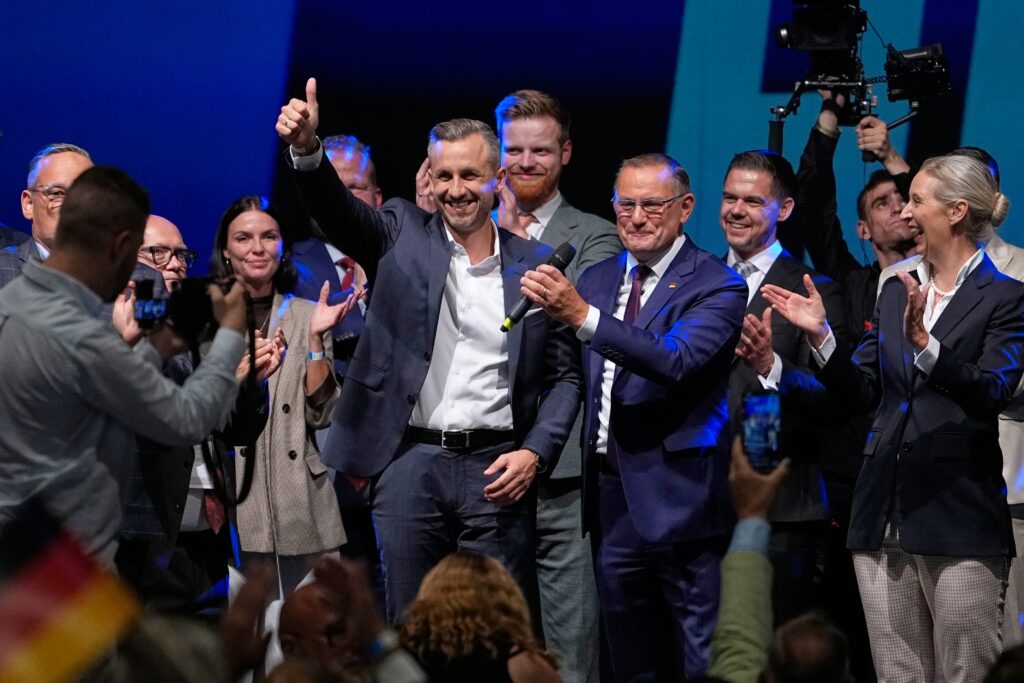
BERLIN — Safely inside the cordon of chain-link fences covered in campaign posters outside the Alternative for Germany’s Berlin headquarters, a crowd of supporters had gathered with beer and bratwurst to await — and celebrate — the results of the biggest election night in the nationalist, anti-immigrant party’s history.
The angry chants of protesters beyond the fences were drowned out by TV news coverage of projections from the eastern state of Saxony-Anhalt, where the party, known as the AfD, instantly posted a huge, insurmountable lead with more than 40 percent of the vote.
“We have achieved exactly what we wanted. We have made history,” Ulrich Siegmund, a 35-year-old former salesman turned social media star who led the AfD’s campaign, declared in a victory speech at the party’s headquarters in Magdeburg, the state capital. The result, he added, would “shake all of Germany.”
And not just Germany. In Berlin, Brussels and capitals across Europe and the Western world, the meteoric rise and first-place finish of the AfD, a party labeled “extremist” by German intelligence, sent tremors through establishment political circles — suggesting that politics once derided as far-right had moved decisively into the mainstream of the electorate in a state of more 2 million people.
The AfD on Sunday fell short of winning the outright majority in the Saxony-Anhalt parliament, which would have brought an extremist party to power in Germany for the first time since World War II. But the political trend AfD represents is evident not just in the former East Germany but also France, where Marine Le Pen, a mainstay of nationalist, anti-immigrant politics, is polling at the top of a crowded field in next year’s presidential election.
As the results in Germany rolled in Sunday night, President Donald Trump, whose MAGA movement has built strong ties to the AfD, made clear that he was watching, posting an image on Truth Social that showed the AfD far ahead of other parties, including Chancellor Friedrich Merz’s Christian Democratic Union (CDU), which finished a distant second with just 17.1 percent.
A lot of credit for the AfD’s strong performance is directed at Siegmund.
“We have a very young main candidate who is very enthusiastic, and the people love him a little bit — like JFK’s image, the young JFK or Charlie Kirk,” said Christian Buchholz, an AfD politician who previously served in Berlin’s House of Representatives. “He makes for really fantastic publicity for us, and so we expect a boost, support and good pictures, and of course a lot of votes.”
Even without an absolute majority, the AfD in theory could still end up controlling the state government should cracks emerge in a pledge by other parties not to join a coalition with the AfD, which for years has been accused of xenophobia, antisemitism and Islamophobia.
In and of itself, the possibility of the AfD seizing power marks a seismic shift in Germany. Since the last state election, in 2021, the AfD more than doubled its support — an outcome attributed to Siegmund and other party leaders, who largely bypassed traditional media and embraced social media platforms like TikTok to speak directly to voters.
Historical grievances and long-standing economic challenges in the former East Germany helped the AfD gain traction among voters who feel alienated by traditional politicians. This included deep fatigue with Merz’s CDU, which has led the state government since 2002.
Across the Atlantic, some politicians on the right also celebrated the AfD’s success.
Republicans in Congress, including Sen. Mike Lee (Utah) and Rep. Anna Paulina Luna (Florida), congratulatedthe AfD for its win. They also discouraged the German government from banning the party or its leaders.
“Germany’s chancellor is treating a major opposition party as something to be walled off from democratic competition,” Lee posted. “Is he really that blind to the German stereotype he’s feeding?”
Trump’s MAGA movement has widely embraced the AfD. AfD members of the Bundestag — Germany’s federal parliament — visited the United States to meet with Republicans last year and also attended a New York gala for young Republicans. State Department officials have also met with party members.
One factor that has complicated the growing alliance, however, has been the U.S.-led war against Iran, which is deeply unpopular among Germans.
While campaigning in the state election, Siegmund largely refrained from discussing U.S. connections. But some AfD members in Berlin said they believe that the state-level win could lead to stronger U.S. ties.
“As our party gets stronger,” said Ronald Glaeser, a Bundestag member and spokesman for AfD for Berlin, “every foreign government will turn to AfD since we are an important factor in German politics.”
Eric Langenbacher, the director of the Society, Culture & Politics Program at the American German Institute, said he anticipates Trump’s allies “will feel vindicated” by Sunday’s outcome.
And though Langenbacher cautioned against reading too much into Sunday’s outcome, he said it could serve as a barometer of AfD’s national appeal.
“We shouldn’t overinterpret any of these results. But this, unlike many other elections, is something that can be interpreted because it’s going to matter if the AFD does really well,” Langenbacher said. “It’s going to matter for the momentum of the national party.”
Siegmund quickly boosted the AfD’s public image.
While the party had long leaned on anger-laden slogans like “enough is enough,” Siegmund projected an approachable, social-media friendly persona, and ran on a more upbeat campaign slogan: Alles ist möglich — Everything is possible.
He was born in 1990, just a few weeks after German reunification, when the formerly communist East was reunited with the capitalist West, and grew up in Tangermünde, a small, picturesque town in Saxony-Anhalt, against the backdrop of the region’s struggles.
Many East Germans remain disgruntled over lasting economic gaps compared with the West and a deep-rooted sense that they are second-class citizens.
Siegmund became a millennial face for the party, decades younger than the average member of CDU, which was his first political affiliation. He joined the party, then led by Angela Merkel, in the early 2010s, before later switching to the AfD.
He rose to prominence during the covid-19 pandemic, using social media to rally against lockdowns and mask mandates, which he called “crazy,” quickly gathering a loyal supporter base. He then carried that image into his campaign, posting endless TikTok clips of himself riding motorcycles with supporters across the state, footage later edited into sleek, cinematic campaign trailers, and turning campaign events into celebrity-like meet-and-greets, handing out hugs, signing autographs and posing for selfies with supporters who lined up for hours.
What happens next in Saxony-Anhalt remains uncertain.
Siegmund has ruled out a minority government. But AfD leaders have signaled openness to coalition negotiations and suggested that other parties might accept an AfD minority government.
State governments in Germany have broad powers over domestic security, education and culture. And the AfD has said it wants to drastically overhaul Saxony-Anhalt’s policies related to education and immigration.
Its platform includes allowing home schooling, and Siegmund has described “a deportation offensive” — to remove irregular migrants — as one of his top priorities. A frequent antagonist of mainstream news media, Siegmund has also said wants to withdraw the state from a regional public broadcaster.
If other parties ultimately decide to work with the AfD in Saxony-Anhalt, it would represent a break in the so-called “firewall” that establishment political forces have used to keep extremist parties out of power since the end of World War II. That also could have major implications for Germany, which is scheduled to hold its next federal elections in 2029.
A national vote could happen sooner if Merz’s coalition collapses. Whenever a vote occurs, AfD leaders say it will present another decisive moment for the party, allowing it to demonstrate rising strength across the entire country.
The post A German politician with a MAGA touch lifts his nationalist party to victory appeared first on Washington Post.