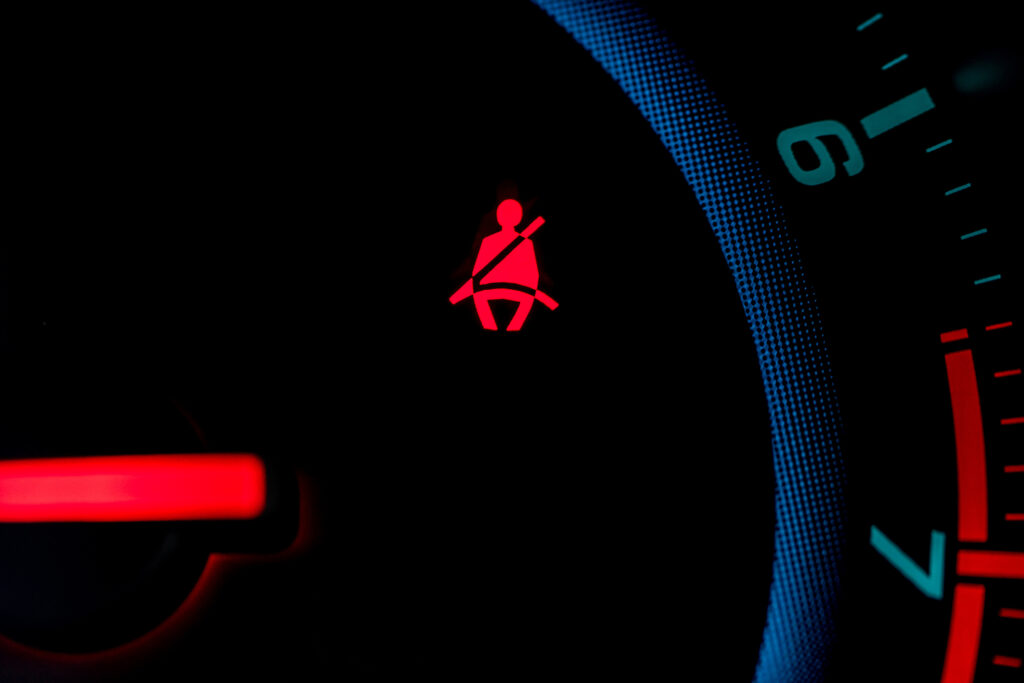
David Kidd is an expert in something that some people hate and others tend to just tolerate: Seat-belt warning systems — the “ding ding ding” chimes and flashing dashboard lights that serve as reminders to buckle up.
He’s spent years testing different systems in cars and trucks as part of his work at the Insurance Institute for Highway Safety. So he knows very well that the incessant chimes can be annoying.
They’re “an irritant,” he admits. But he prefers a different term.
“We use the word ‘motivating,’” Kidd said.
The lowly seat belt is still considered the best way to avoid serious injury or death in a crash. Forget air bags, anti-lock braking systems or any other new-fangled safety technology. Unbelted occupants are roughly twice as likely to be killed in a car crash.
Buckling up works.
So does nagging. Kidd’s research found that belt warnings came in a variety of tones and volumes, but if they are “heard and persistent,” people respond.
The seat-belt chime is such a recognizable refrain that when pop star Olivia Rodrigo needed an iconic car sound to open her hit song “Drivers License” a few years ago, she reportedly used a recording of the seat-belt beep in her mom’s car.
The “buckle up” reminders were set to become even more widespread this month, when new federal safety regulations were supposed to require more persistent chimes not just for the driver’s seat but for the front passenger seat, as well. But automakers objected, saying they couldn’t be ready in time. Regulators backed down. So the new rules have been delayed for another two years — 2028 at the earliest — when some rear-seat warnings would be required, too.
The National Highway Traffic Safety Administration said in a statement that it found the automakers’ worries “have merit.”
Others were not convinced.
“It was a bit of mystery to us why this has taken so long already. And now it’s going to take even longer,” said Peter Kurdock, general counsel for Advocates for Highway and Auto Safety, which began pushing for the new rules in 2007.
“It’s disappointing,” he said.
The technology is not cutting-edge. Europe has required seat-belt alarms in new vehicles since 2021. Some automakers, such as Volvo and Subaru, already have voluntarily installed them in vehicles sold in the U.S.
But the fight over the warning chimes feeds into Americans’ long-running love-hate relationship with seat belts.
Seat belts are still seen by some as a question of choice and freedom.
State laws and education campaigns have helped soften some of those attitudes. Today, 49 states require adults in the front to buckle up. The lone holdout is New Hampshire, which lives up to its license plate motto of “Live Free or Die.” Just 34 states plus D.C. require adults to wear seat belts in rear seats. (Children are covered by different restraining-device requirements.)
Still, researchers know some people remain militant in their opposition. They’re the ones buying $6 devices and printing 3D tools to fool the alarm. They sit on top of buckled seat-belt straps. They watch online videos claiming to reveal the hidden tricks to deactivate the warning chimes.
“Those that don’t like seat belts are really hardcore against buckling up,” Kurdock said.
These holdouts are why U.S. seat-belt usage rates have largely flat-lined in the last decade, according to NHTSA observational studies. The unbuckled make up a minority of all vehicle occupants, but they die at a much higher rate in crashes: Roughly half of all vehicle fatalities involve unbuckled occupants.
At one point, federal officials tried a much tougher tactic than just chimes.
In 1974, the federal government required many cars to have ignition interlock devices that prevented a car from even starting until the front occupants were buckled up. Motorists hated it. It blew up in NHTSA’s face.
“That got a lot of blowback that reached Congress,” Kidd said.
The idea was quickly pulled, and Congress banned NHTSA from requiring interlocks. Lawmakers then went further and limited seat-belt warning chimes to a fleeting eight seconds.
Some advocates say this is why NHTSA has seemed reluctant ever since to even tinker with seat-belt warnings.
In 2007, Public Citizen and Advocates for Highway and Auto Safety petitioned NHTSA to change the belt-reminder rules and add them for rear seats.
Little happened for years.
In 2012, Congress passed a bill that abolished the eight-second chime limit and required federal officials to create new warning rules for seating positions besides the driver’s seat. It was a start, but a very slow one.
“The chime is very important,” said Shaun Kildare, research director for the Advocates for Highway and Auto Safety.
While NHTSA worked on a plan, the lack of government action created an opening for the Insurance Institute for Highway Safety, which rates vehicles on a series of safety metrics. It began rating cars and trucks on the quality of their seat-belt reminders with the 2021 model year.
IIHS wants seat-belt chimes to last at least 90 seconds and be easy to hear, among other criteria. The chimes should annoy drivers enough to get them to buckle up — but not so much that they complain.
“It was: Get them to wear a seat belt, but at the same time not email their congressperson to demand a change,” Kidd said.
Compliance has been voluntary, but some automakers have jumped at the chance to make a good showing. IIHS saw rapid adoption, even without federal regulations, Kidd said.
At first, less than 20 percent of vehicles scored IIHS’s top “good” ranking for seat-belt reminders. Five years later, 71 percent of vehicles qualified.
“You’ve had a complete change in the seat belt reminders in the new vehicles,” he said.
In 2025 — 13 years after Congress asked for a plan — NHTSA finally unveiled its blueprint for overhauling the nation’s seat-belt warning system.
The new rules will require a chime lasting at least 30 seconds for either an unbuckled driver or front passenger when the vehicle starts up, and if they are still unbuckled when the vehicle reaches slightly faster than 6 mph, a second chime will play endlessly until the seat belt is secured.
That’s the rule that was supposed to hit new vehicles on Sept. 1. A rule requiring a 30-second chime if someone unbuckled a seat belt in the rear seats was set to start in September 2027.
But in April, NHTSA acquiesced to arguments from the Alliance for Automotive Innovation, an industry trade group, that the changes “require significant hardware and software changes” and would need more testing.
Now, regulations for both front- and rear-seat warnings are being pushed back to September 2028.
Despite the delay, automakers still “support efforts to increase seat belt use and for decades have voluntarily and proactively installed seat belt reminder systems across the vehicle fleet,” Audrey LaForest, communications director for the Alliance, said in a statement last week.
Kurdock, whose group first petitioned for this change nearly 20 years ago, was in disbelief.
“This is not a new technology. Seat-belt reminders have been in cars for a very long time,” he said.
Kidd said he was frustrated with what he saw as an unnecessary delay. He has estimated that nearly 1,600 lives could be saved annually if all vehicles had more noticeable and persistent seat-belt warnings leading to more people buckling up.
“The disappointing piece is we’ve known what to do for a long time,” he said, “but we just haven’t done it.”
The post Ding! Ding! Ding! The long, strange fight over your car’s seat-belt chime. appeared first on Washington Post.