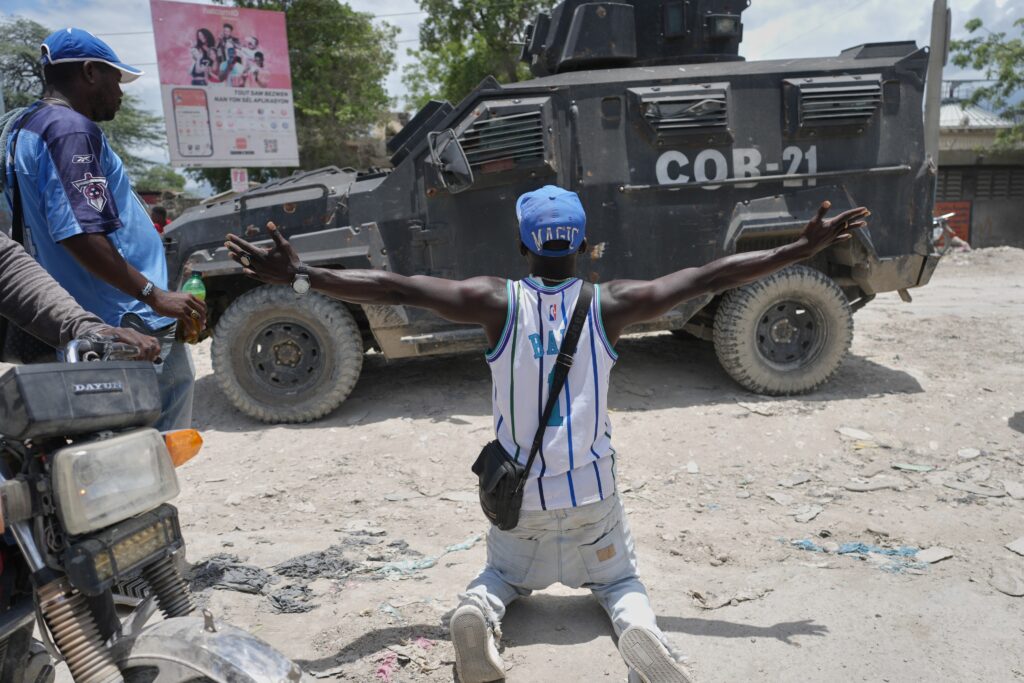
PORT-AU-PRINCE, Haiti — Like many in Haiti’s Artibonite region, the 26-year-old woman once viewed the Coalition as protectors.
A powerful group of murky origins, one of many of this country’s “self-defense brigades,” the Coalition emerged three years ago to fight back against the criminals who were preying on communities such as hers. As a U.S.-backed, U.N.-authorized force attempts to restore security here, some of the brigades have enjoyed support from Haiti’s interim leaders.
But in January, the woman says, four Coalition members, two of them armed, pulled up on two motorcycles and took her to an abandoned hotel in Terre Noire. There, according to the woman and human rights advocates familiar with her case, she was surrounded by men wielding AK-47-style rifles. A Coalition leader known as Woody, she says, ordered them to sexually assault her.
In the months since, the woman says, she has identified her attackers to police, endured threats and watched videos of the assault circulate online. They continue to operate freely.
She now sees little distinction between the brigadiers and the criminals they claim to be fighting. “Both do the same things,” she told The Washington Post. “Soon, people won’t be able to tolerate them anymore. The brigades have become gangs themselves.” (The Post does not identify victims of sexual assault without their consent.)
As the United States and its allies try to root out Haiti’s gangs, the Coalition and other vigilante groups are presenting a unique challenge. Some brigadiers wear uniforms, receive funding from the Justice Ministry and enjoy support from the Haitian National Police. Some are accused of robbery, extortion, trafficking drugs and weapons, abduction, sexual assault and murder.
The State Department described the U.S. role in Haiti as “helping to shape conditions conducive to safe elections” by supporting the international force and the Haitian National Police.
“The Haitian government is actively building its formal security forces, including another 7,000 military and police forces,” said a State Department official, who spoke on the condition of anonymity under rules set by the administration. “The Haitian government intends these institutions to come online during the GSF’s mission to allow them to secure their own nation.”
“For more details on how they choose to build their national security,” the spokesperson referred The Post to the Haitian government.
Neither the office of Haitian Prime Minister Alix Didier Fils-Aimé, the Justice Ministry nor the Haitian National Police responded to requests for comment.
“Self-defense groups and spontaneous mobs remained a driver of violence and human rights abuses,” U.N. Secretary General António Guterres reported to the U.N. Security Council in July. In Artibonite and Ouest departments from mid-April to mid-July, Guterres said, at least 87 people “were brutally killed by members of the local population or self-defense groups — including being beaten to death with sticks, machetes or stones and, in some cases, having their bodies subsequently set on fire.”
The brigades, a recurring feature of the Haitian security landscape, have proliferated in response to the rise of heavily armed gangs since the 2021 assassination of President Jovenel Moïse. The gangs, armed with weapons largely smuggled from the United States, control 90 percent of Port-au-Prince, the United Nations estimates, and are spreading through the countryside. Masked criminals who outgun the underequipped Haitian National Police have shut down airports and seaports, closed major roads, and disrupted the transport of fuel and food.
At least 1,408 people were killed in gang-related violence in April, May and June, the U.N. Integrated Office in Haiti reported, and at least 326 were subjected to sexual violence. More than 1.4 million people have been forced from their homes, according to the International Organization for Migration. In one massacre alone last month, authorities say, at least 47 people were killed and 52 were kidnapped in Kenscoff, a contested farming town southeast of the capital.
More than five years after Moïse was killed, the presidency remains vacant; the National Assembly has been empty since the last senators’ terms expired in 2023.
That year, President Joe Biden’s administration led the creation of the U.N.-authorized Multinational Security Support mission to support the Haitian police improve security so the country could hold its first national elections since 2016. President Donald Trump’s administration guided its upgrade last year to a Gang Suppression Force, with double the authorized strength and more aggressive rules of engagement.
The force has been staffed primarily by Kenyans first and now Chadians. The U.S. has provided planning, logistics and funding, support totaling more than $970 million.
Results have been limited. Since the force deployed in 2024, the gangs have expanded their territory, and killings and kidnappings have increased. Officials have scheduled a first round of presidential and legislative elections for December. As of Friday, more than 500,000 voters had registered, Jacques Desrosiers, president of Haiti’s Provisional Electoral Council, told The Washington Post.
A spokesman for the Gang Suppression Force described the self-defense brigades as a response to the government’s “limited capacity to provide adequate security in certain areas.” By improving security and strengthening state institutions, spokesman Igor Rugwiza said, the force is working to create conditions in which such groups “are no longer necessary.”
“Restoring the State’s monopoly on the legitimate use of force remains a core objective of the mission,” he said.
But no one expects the brigades to disband on their own. “Conflict always reconfigures the power dynamics,” said Jessica Hsu, a Haiti-based researcher. “If there are no alternatives that feel aligned, legitimate and/or enable them to feel appreciated, resumption of life in these communities will be nearly impossible.”
Haiti’s National Commission for Disarmament, Dismantlement and Reintegration is discussing the brigadiers’ future with police and military leaders, commission official Ilionor Louis said. Those who are not implicated in killings, fraud or other criminal offenses could be eligible for integration into legitimate forces, he said. Those suspected of crimes should face justice.
Several of the armed gangs that now menace Haiti were themselves once neighborhood self-defense groups. The relationship between gangs and vigilantes remains fluid.
Gangs operating in Sarthe and Terre Noire, for example, received support from brigades amid escalating clashes in the Plaine du Cul-de-Sac north of Port-au-Prince, Guterres told the Security Council.
The Croix-Fer brigade near Belladère, on Haiti’s border with the Dominican Republic, is suspected of involvement in drug trafficking, according to U.N. official familiar with security conditions. The group, whose name is French for “Iron Cross,” exerts considerable influence over weapons- and narcotics-trafficking routes in the area, said the official, who spoke on the condition of anonymity because he was not authorized to discuss the subject publicly.
Security officials have linked a brigade operating in the Port-au-Prince neighborhood of Solino to kidnapping, the official said.
In prolonged security crises, he said, the pattern is familiar: “When communities turn to vigilantes because the state cannot protect them, those groups often become another source of abuse.”
As conditions have worsened, political scientist Robert Muggah said, the brigades and gangs have joined an arms race.
“There continues to be very high demand for firearms among gangs, self-defense groups, private security companies, the Brigade for the Security of Protected Areas and ordinary civilians,” said Muggah, co-founder of the Rio de Janeiro-based Igarapé Institute.
“The growth of all these armed constituencies is mutually reinforcing,” he said. “As gangs acquire military-style rifles, community defenders seek greater firepower, which in turn intensifies gang demand and increases the likelihood that police weapons, commercial imports and trafficked ammunition will be diverted.”
Some Haitians rely on the brigades for protection, Guterres acknowledged. But their growing role in providing security and exercising social control while generating revenue through “extortion, racketeering and protection arrangements,” he warned, was blurring the distinctions among self-defense groups, local governments and gangs, contributing to “insecurity, impunity and the erosion of public authority.”
The disarmament commission is studying the challenge through two units. Louis, a sociologist, heads a unit focusing on prevention and reintegration. The other focuses on disarmament, dismantlement and demobilization.
The commission, founded in 2019 and relaunched in recent months, faces significant constraints, Louis said. It lacks a permanent headquarters and struggles with shortages of staff, equipment and office furniture. Still, it maintains a hotline for gang members interested in abandoning crime, is seeking facilities to receive them and has established 11 educational camps for young people.
Before any long-term solution can be implemented, Louis said, authorities must first conduct a comprehensive assessment of the brigades now operating in Haiti.
As many as four such groups operate in Artibonite, activists there say. The Organization of Cooperating Haitian Women of Verrettes receives up to 10 complaints of rape each month, according to Juanita Exantus, one of its leaders. In several cases, she said, the alleged rapists are brigadiers.
“The brigadiers have turned themselves into vigilante enforcers,” Exantus said. “They beat residents. The level of violence in the commune has also increased because of them.”
From January through July, the Platform of Women Organized for the Development of Artibonite assisted 29 rape survivors who alleged they were assaulted by brigadiers and other self-defense groups, coordinator Louisette Vertilus said. Most of the victims were minors, she said.
She described the case of a 17-year-old student in L’Estère. In February, brigadiers allegedly demanded that the girl’s parents bring her to them. When they refused, Vertilus said, an armed man went to their home and took her away. Four brigadiers raped her, the girl reported.
“We are exhausted,” Vertilus said. “The region has no future with these brigadiers. They should be disarmed and brought before the courts.”
The post They formed to fight Haiti’s gangs. Now they’re an obstacle to peace. appeared first on Washington Post.