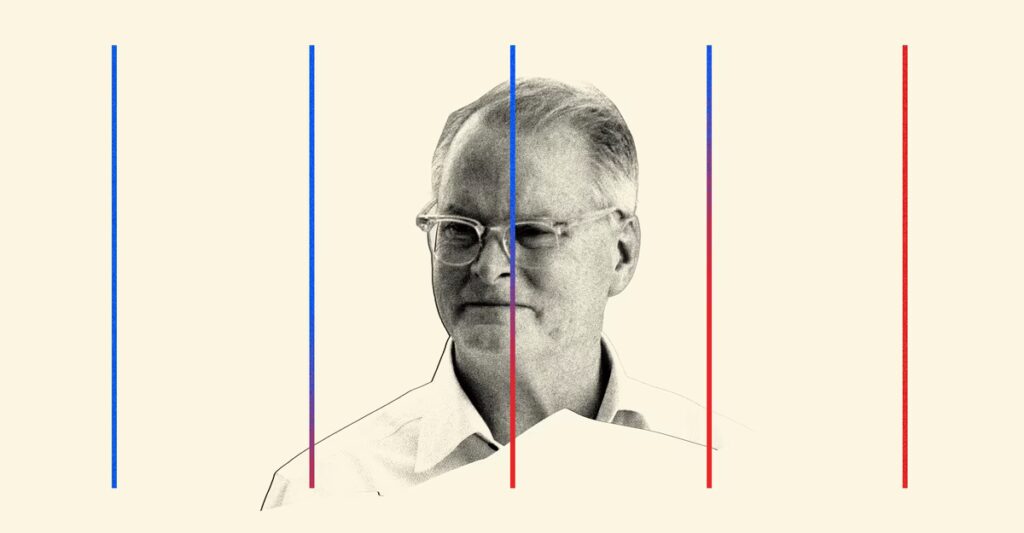
One simple rule shapes Kansas politics: Republicans win statewide. In U.S. Senate races, the GOP has prevailed without interruption for more than 90 years. But the rule has a corollary, which accounts for the occasional Democratic governor. A Republican thought to be too extreme, too ideological, or too big for their britches can be beaten by a centrist Democrat when the wind blows just right.
And so, on the same August Tuesday that saw Michigan Democrats choose Abdul El-Sayed, Kansas Republicans realized their safe seat might not be so safe. Kansas Democrats had picked a man who extols moderation as a matter of faith—literally. Adam Hamilton, the founding pastor of America’s largest mainline Protestant congregation, will challenge the first-term incumbent Senator Roger Marshall in November. In the handful of months since he announced his candidacy, Hamilton has defeated 10 garden-variety Democrats in the primary while setting new records for Kansas fundraising, pulling in $1 million in his first week and nearly $3.7 million in his first quarter.
Political analysts continue to rate Hamilton a long shot; admittedly, they have nine decades of justification. But Marshall ticks every box that can mean trouble for otherwise-invulnerable Kansas Republicans. Full of himself even by senatorial standards (one Republican Senate colleague described him to me as a “know-it-all”), Marshall is leery of public forums where he might hear from protesters and tends to speak before thinking—a hazard of his appetite for cable-TV appearances. In nearly six years as a constituent of the senator, I have traveled from one end of Kansas to the other, and I have concluded that passionate supporters of Roger Marshall are the electoral equivalent of jackalopes: If they exist, I have never found one.
Should Hamilton break the Senate’s longest GOP win streak, he would score more than an enormous off-year upset; his influence on 2028—a free-for-all to define post–Donald Trump politics—could be even larger. Because Hamilton seeks to vindicate the belief, beleaguered in today’s culture, that moderation is a good thing, not just as an electoral strategy, but as an approach to life.
[Elizabeth Bruenig: Texans will decide if Jesus was a lefty]
In Texas, James Talarico’s Christianity seems, at times, to dovetail with uncanny precision with the agenda of secular progressivism. Hamilton’s rhetoric suggests that his Democratic revival tent would be roomier, but at the same time he has so far faced relatively little pressure to translate his disposition into details. He is motivated by “compassion, a belief in safety nets for vulnerable people,” he told me, and also by “fiscal responsibility, limited government, and strong defense.”
Such inoffensive straddling may be out of step with today’s politics. “People are really pissing mad, really, really pissing mad,” El-Sayed explained to Michelle Goldberg of The New York Times. A roiling left has risen to match Trump’s raging right. To win, Hamilton must not only persuade independents and Republicans to vote for him—he must also motivate angry progressives in this time of throat-cutting.
If El-Sayed and others like him are the furious faces of the Democratic future, perhaps Hamilton is a DINO. When I asked him if Democrats should seek to impeach Trump a third time, he ventured his belief that “the impeachments in the first term did not accomplish anything”—a claim that dismisses the expression of righteous anger as a political imperative in itself. Hamilton likes to talk about the good that he could accomplish in partnership with the well-liked Senator Jerry Moran, the senior Republican from Kansas. But maybe that’s not what the people, who truly are pissing mad, really want.
Emporia is the seat of Lyon County, which in 2024 gave 56 percent of its votes to Donald Trump and 41 percent to Kamala Harris. Yet Hamilton was not in hostile territory when he visited one late-August morning. Gravel City Roasters is a combination coffee shop and art gallery located directly across Emporia’s main drag from the county Democratic headquarters. There is a Pride flag on the wall with Refugees welcome superimposed on its rainbow stripes. The chai, served in mismatched mugs, is excellent.
But the comfort zone is narrow here for a 21st-century Democrat. The little city with its college campus is surrounded by farmland that has historically bred beasts, grains, and discontent. In its heyday—the era of William McKinley and Theodore Roosevelt—Emporia was home to the journalist William Allen White, whose Gazette newspaper was a sort of proto-Substack. Readers around the world vibed to his grumbling, which often had to do with the eternal sense of Kansas as undervalued and overlooked. “Go east and you hear them laugh at Kansas; go west and they sneer at her; go south and they cuss her; go north and they have forgotten her,” White wrote in his career-launching screed, dated 1896 and titled “What’s the Matter With Kansas?”
Thirteen decades later, an Emporia pharmacist, John Schmidt, picked up the theme, telling me at the coffee shop of the town’s beef processing plant (closed), its Michelin rubber-track factory (downsized), its maker of plastic ice scrapers (victim of a bankrupt holding company), and the nearby drugstore (battered by low reimbursements). The area’s future, too, feels festooned with pink slips.
A few dozen people awaited Hamilton, who arrived in a blue blazer and an open-collared white shirt. He immediately went to work shaking hands and nodding thoughtfully. After watching Hamilton campaign half a dozen or so times, the best description I can manage is “pastoral.” Fair enough, I suppose, for a 62-year-old pastor. Hamilton has a soft voice, and his gaze is gentle, intent, and framed by horn-rimmed glasses. His head moves constantly in tiny yeses and no’s, like a seismograph needle registering each quick conversation.
After working his way to the rear of the shop—pausing to autograph a woman’s copy of his book on the Holy Spirit—Hamilton used a wireless microphone to tell a joke about hypocritical politicians pretending to know the Lord’s Prayer. “I am a Democrat who actually knows the Lord’s Prayer,” he said. “When it says, ‘give us this day our daily bread,’ it’s reminding us to make sure that people have enough to eat.”
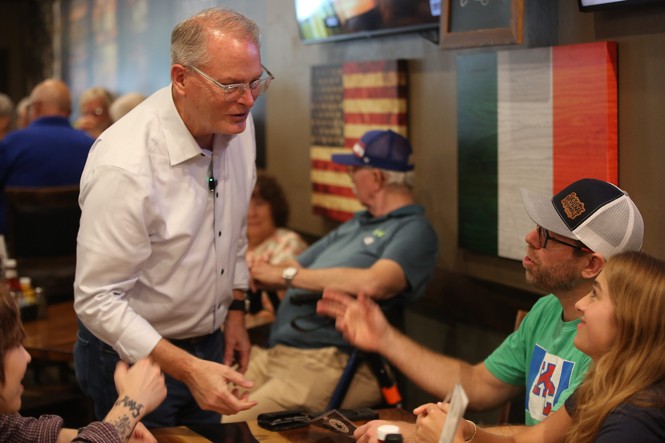
A sturdy little stump speech rolled out from there, befitting a man who has been crafting sermons since Seinfeld was new. He said he is a fifth-generation Kansan who married his sweetheart a week after high-school graduation and wants to give his granddaughter “a better country.” He said he built a church from nothing to 24,000 members. He said he prayed a year and a half ago that Trump would govern “with wisdom, grace, and compassion,” but found himself watching something quite different. Somebody’s got to do something became Maybe I should do something.
Rather than take on Trump directly, however, he aimed the balance of his fire at Marshall, who, Hamilton noted, “has voted for nearly everything the president has done.” Hamilton said he is against tariffs because they hurt farmers, against the Iran war because it drives up fuel prices, against Medicaid reductions because they threaten rural hospitals, and against cuts to food aid because more than 14,000 Kansas children need that support. “Since when did it become woke to care about your neighbor?” he asked rhetorically, aware that his audience was already seeing attack ads trying to tie him to left-wing ideas, and that Republican Senator Ted Cruz of Texas used an X post to denounce one of Hamilton’s sermons as “heretical.”
Don Duncan was part of that audience, having driven to town from nearby Chase County to have a look at the candidate. In the primary, a local Democrat, Christy Davis, drew 113 votes in Chase County, leaving Hamilton with eight; on the Republican side, Marshall got 479. Duncan, a self-described “Democrat who leans independent,” told me he did not think things are as bleak for Hamilton as that would suggest.
“It’s just a matter of people getting to know him,” said the retired school administrator and coach. “We need someone to get us back together.”
Could that be Marshall? I asked. “I can’t say we ever talk about him,” Duncan answered.
About 100 miles north and east, amid the big houses and busy shops of Kansas City’s southern suburbs, stands Hamilton’s monument to open minds, the “church for thinking people” that he founded in 1990. The main sanctuary of Leawood’s United Methodist Church of the Resurrection is visible from all directions, an elliptical edifice clad in glass and stainless steel, vaguely reminiscent of Disney’s Space Mountain. Rising 100 feet above a 77-acre campus of auxiliary buildings and parking lots, it features the largest fused-stained-glass window in the world, a work roughly the size of a basketball court. Nine satellite churches in greater Kansas City—four in Kansas; five in Missouri—carry the COR brand to sites around the area and beyond.
If the words megachurch pastor conjure images of hellfire oratory and $400 haircuts, Hamilton comes as a surprise, as mild as Jake from State Farm. Yet his success stands in contrast to the decline of mainstream Christianity in his lifetime.
Born in 1964 and raised by divorced parents in Prairie Village, one of those same southern suburbs, Hamilton came of age in a time of Protestant crisis. Perplexed by the social upheaval of the 1960s, Hamilton’s United Methodist denomination lost more than 10 percent of its membership in the 1970s and a further 5 percent in the 1980s. What energy there was in American Christianity came from conservative movements energized by opposition to abortion, homosexuality, scientific modernism, and a grab bag of philosophical attitudes derided by evangelicals as “secular humanism.”
Even as a teen, Hamilton found this alienating. Drawn to church for its social possibilities—“I didn’t believe in God, but I believed in girls,” he likes to say—the God he eventually embraced was one who delighted in discovery and gloried in progress. God gave us a brain for a reason, he thought, taking to heart the biblical admonition to worship with all of one’s “heart and soul and mind.”
In college at Oral Roberts University in Tulsa, Oklahoma, Hamilton “grew more and more interested in the parts of the Gospel that evangelical churches were leaving behind,” he told me during a July interview at a barbecue joint across the state line in Kansas City, Missouri. “I began focusing on scriptures dealing with social justice, ‘rolling down like waters,’ as Amos has it; the caring for widows and orphans; the story of the Good Samaritan. And I noticed that our churches were great at helping the people who came to church, but not so much with the people who were outside.”
Trained as a pastor at Southern Methodist University in Dallas, Hamilton returned with his young family to Kansas City in the late Reagan years. He soon persuaded his regional bishop to let him start a new congregation for people turned off by what Christianity had become. Though United Methodism suffered a further 29 percent drop in membership from 1990 to 2020, Hamilton’s congregation grew from fewer than a dozen people meeting in a funeral-home chapel to the largest mainline Protestant congregation in America.
He credits an idea known to theologians as the via media, the “middle way,” which has roots in ancient philosophy and scholastic Christianity, but had its flowering in Elizabethan England. At its core the idea involves a belief that truth is not to be found on the extremes and that compromise in pursuit of worthy aims is a virtue. Society as Hamilton envisions it is a sort of Newton’s cradle, the toy that is composed of a line of metal balls suspended by threads. When the ball on one end is lifted and released, it swings into contact with the pack, where its energy is conducted to the ball on the other extreme, which swings away in reaction. Energy might come from extremism, but stability lies with the center.
[Peter Wehner: American Christians face a choice]
COR is that stable center, Hamilton maintains, “roughly equal parts Democrat, Republican, and independent,” where inevitable conflicts among freethinking people can be respected and accommodated in pursuit of shared missions. “I am wired to see both sides,” he told me, “which is not the same as saying that all issues are 50–50. I believe cutting Medicaid and closing rural hospitals is just wrong. Making it harder for public schools to serve special-needs students is wrong, and I am willing to talk with anyone to explain why I think so. But I don’t expect everyone to agree with me all the time.”
Hamilton hasn’t shied from hard issues as a pastor. When a faction of American Methodists joined forces with culturally conservative congregations in Africa to try to pass anti-LGBTQ ordinances for the denomination, he led the opposition. Criticizing what he saw as a misguided focus on a few biblical verses over a larger Gospel of inclusion and acceptance, Hamilton ultimately concluded that a schism was inevitable, and he was instrumental in negotiating the many details of separation.
The thing to notice about that story, as Hamilton tries to turn from pastor to lawmaker, is that the via media was the road not taken by Hamilton and the Methodists when the chips were down. There was no middle ground, and now there are two denominations where there used to be one.
Hamilton would likely run into an even more challenging divide in Washington, where the two factions cannot go their separate ways. Can moderation really be an agenda? In the biblical story of King Solomon, when confronted with a seemingly unresolvable impasse, the wise solution was not to split the baby, but for one combatant to surrender for the greater good. That’s not the Washington way.
Electoral politics is, in some ways, just second-grade math: addition and subtraction. Candidates seek to add votes in Column A while subtracting votes from Column B. All of the money, overt or dark; all of the advertisements; all of the pandering and polarizing; all of the door-knocking, the text messages, the awkward TikToks, the yard signs, the stilted visits by candidates to factories, diners, fairgrounds, living rooms, nursing homes, colleges—it’s all about addition and subtraction.
For Hamilton, the problem pencils out at around 80,000 votes. Any combination of addition and subtraction that hits this target, whether raising the Democratic vote share or reducing Marshall’s compared with his 2020 victory, will get the job done. That’s a big number in a state the size of Kansas, where about 1.3 million people voted in 2024, but so is the number of people who cram the pews of Hamilton’s sanctuaries each Christmas and Easter: around 100,000 per holiday.
As shown by the August 4 results, his stronghold is in Johnson County, home to his church and to about a quarter of the state’s voters. Once a bastion of chamber-of-commerce Republicanism, the county turned purple during its explosive growth in the Baby Boom years and has, in the Trump era, become a relatively safe base for Democratic Representative Sharice Davids.
Driving up turnout in Johnson County and other metro centers—working-class Wyandotte County (Kansas City, Kansas), liberal Douglas County (Lawrence, home to the University of Kansas), booming Sedgwick County (Wichita, still the state’s largest city)—will be the keys to Hamilton’s addition problem.
As for subtraction, meet Marshall. A retired ob-gyn who calls himself “Doc”—a nickname that hasn’t caught on with Kansas voters—he has distinguished himself as one of Trump’s most obsequious acolytes, though not always the most on-message. Marshall’s ready-fire-aim approach to public speaking has left his candidacy riddled with self-inflicted wounds. Asked whether he’s okay with Iran having ballistic missiles (the program Trump was promising to destroy), Marshall said, “I would prefer they didn’t. But I don’t think that’s the key issue here. I think that they have to be able to defend themselves.” Of rising gas prices triggered by the war: “Freedom is not free. Americans are going to have to make some sacrifices.” When Kansans died on a plane that collided with an Army helicopter over Washington, Marshall blithely blamed their deaths on DEI, a theory unsupported by crash investigators.
Having sold his house in central Kansas shortly after being elected to the Senate, Marshall is dogged by allegations that his status as a Kansas resident is largely fictitious. He lists as his residence a roughly 1,200-square-foot cabin on a family ranch property, but for several years his congressionally paid travel plans included frequent stops at his “vacation” home in Florida, which he says has been uninhabitable since suffering severe hurricane damage in 2024. Marshall’s campaign did not respond to my requests to discuss the race for this article, but in a recent social-media post he wrote, “Over the last six years, I’ve averaged 185 days per year in D.C. doing the work you sent me to do, 130 days per year in Kansas with over 300 stops per year across the state, about 35 days of official travel, and 20 holiday/personal days.”
When he does visit Kansas, Marshall has avoided open meetings with the public ever since a crowd in a rural community jeered him in March 2025 during Elon Musk’s DOGE fiasco. “The town halls just became non-productive and dangerous,” Marshall told a newspaper in Hays, Kansas.
The odor of weakness around the incumbent helped inspire the GOP-dominated legislature this year to spitball easing Marshall out of office in favor of an appointed successor whose term they would extend through 2028. Voilà! No election needed. The scheme died amid criticism that the Constitution doesn’t allow states to change the length of a Senate term, no matter how lame their senator might be.
With no choice but to defend Marshall, the GOP is probing for Hamilton’s vulnerabilities. A Massachusetts-based super PAC spent a reported $600,000 on a TV ad that pieces together phrases from sermons to portray Hamilton as “mega-woke.” “Black Lives Matter,” Hamilton says in the ad, “marching for righteousness.” In another moment, marked with an ellipsis on-screen, he says, “By virtue of being white … I have to repent.” The Kansas City Star dug up the June 2020 sermon from which the clip is taken and found Hamilton saying “I have certain benefits by virtue of being educated, white, and male, right?” adding, almost a minute later, “Before I can do anything to help anyone else, I have to have a conversion. I have to repent.”
Ted Cruz’s X post avowing that Hamilton held “heretical” views relied on a sermon in which Hamilton says that non-Christians might enter heaven. Marshall thanked Cruz in his own post and added, “Wait until you hear about the ‘hundreds of mistakes in the Bible’ my opponent claims to have found.” In response, the Hamilton campaign shared a quote from Joshua Leu, a pastor of a church in Great Bend, Kansas, where Marshall once served on the board. HuffPost had asked Leu about Hamilton. “I would say that he’s a middle-of-the-road pastor who is willing to listen to all sides, and then based on his understanding of the gospel, try to make the best decision,” Leu said.
Attacking Hamilton as a fellow traveler of the progressive left, a democratic socialist in gossamer disguise, might work in Kansas. But there are reasons why even Kansans who reject that portrait as grossly inaccurate might still say no to his candidacy. The party of Lincoln still has deep resonance in a state where people were battling years before Fort Sumter. Bob Dole’s success at amassing power in Washington and using it to funnel money to the state taught lessons in the value of seniority that are still remembered. Western Kansas is not only overwhelmingly Republican, but it is also suspicious of what it regards as the citified East, where Hamilton is from. And not even all of his Johnson County congregation’s members are Hamilton supporters, by the candidate’s own assessment. As the church has grown, some members have griped that Hamilton has become less accessible—an issue that his Senate campaign is likely to exacerbate, to say nothing of actually serving in the Senate. He’s taken a leave from sermonizing for now, but would stay on as senior pastor and preach at least a dozen times a year if elected.
A Kansas Democrat starts out in such a deep hole in a Senate race that Hamilton considered running as an independent, but the recent example of the failed independent Greg Orman (who lost a race for Senate in 2014 and governor in 2018) convinced the pastor and his advisers that only a Democrat could unseat Marshall. When voters ask, as they frequently do, how Hamilton would deal with pressure from party leaders, he told me his answer is: “I won’t work for Chuck Schumer; I’ll work for the people of Kansas.”
But other candidates in the region—Dan Osborn in Nebraska, Brian Bengs in South Dakota—have chosen the middlest of ways by running as independents. Perhaps Hamilton’s decision to step off the via media by allying himself with one of our nation’s two political parties is a concession to the reality of politics. Before Hamilton can be as nettlesome for Schumer as, say, West Virginia’s Joe Manchin was during the administration of Joe Biden, he first must win in November. Well-intentioned concessions, however, are the beginning of another, much more famous, road.
With money continuing to pour in from more than 16,000 donors, Hamilton can answer the attacks. And he has another shield in his armory. A prolific author of books on scripture, prayer, and Seeing Gray in a World of Black and White, Hamilton has created texts and instructional videos that are staples at Bible studies and Sunday-school classes in at least 500 Kansas churches, he told me. This makes him something of a known commodity in rural communities that might otherwise be leery of a big-city candidate.
As he calculates, 500 churches averaging 50 people each represents a small army of 25,000 people at least partly inoculated against anti-Hamilton attack ads. He doesn’t expect to win them all in counties where Democrats sometimes number in single digits, and he doesn’t need to. Maybe a handful in each precinct, in the secrecy of the voting booth, stung by the price of tractor fuel and fertilizer, will mark his name, or simply skip Marshall’s.
Hamilton is not a dynamic political performer; he doesn’t suck the oxygen from the room. The son of a service-station manager, a husband and father by the end of his teens, Hamilton instead relies on approachability, on his feeling for life as ordinary people live it: sometimes messy; sometimes painful. He seems to genuinely believe that what people have in common matters more than their differences. You can build a church on that. But can you build a campaign?
[Molly Worthen: What the fastest-growing Christian group reveals about America]
Jim Hightower, the former Texas agriculture commissioner turned liberal pundit, used to say, “There is nothing in the middle of the road but yellow stripes and dead armadillos.” But Kansas has—or had—something of a tradition of moderate Republican senators in the not-so-distant past. Nancy Kassebaum, the daughter of former Governor Alf Landon, the Republican Party’s 1936 presidential nominee (even Kansas went for Franklin D. Roosevelt that year), died last month. She served three terms in the Senate, from 1978 to 1997. She was a Republican who worked on health care, voted to ban assault weapons, and opposed, for nearly all of her career, a constitutional amendment to balance the budget. “We should be wary of the seemingly simple solution,” she said. Hamilton might anger partisans on the left and right—in his pews and beyond—by adhering to the middle way. He will need to make compromises in order to win, or, should he win, in order to govern. Politics inevitably sullies religion. But Jesus, in the Gospel of Matthew, also recommends the narrow road instead of the wide and easy one.
As a student of the via media, Hamilton surely knows what came for Queen Elizabeth’s moderate vision. The elegant span she championed connecting Catholic structures and rituals to Protestant individualism proved a bridge to nowhere. The decades after her death belonged to the extremists. Rivers of blood flowed across Europe as Catholics and Protestants waged their Thirty Years’ War. In England, sectarian Puritans staged a regicidal revolution. Refugees from religious violence poured into the Americas.
Some eras in history are like that, obstreperous and irreconcilable. Hamilton likes to point out that Kansas contains the geographical center of the lower 48 states, and he hopes to find America’s political midpoint too. The risk is that, like so much of the Farm Belt, the center has been hollowed out.
The post What’s the Matter With Moderation? appeared first on The Atlantic.