To the Editor:
Re “Bigger and Hotter Fires Are Erasing America’s Great Forests” (news article, Aug. 23):
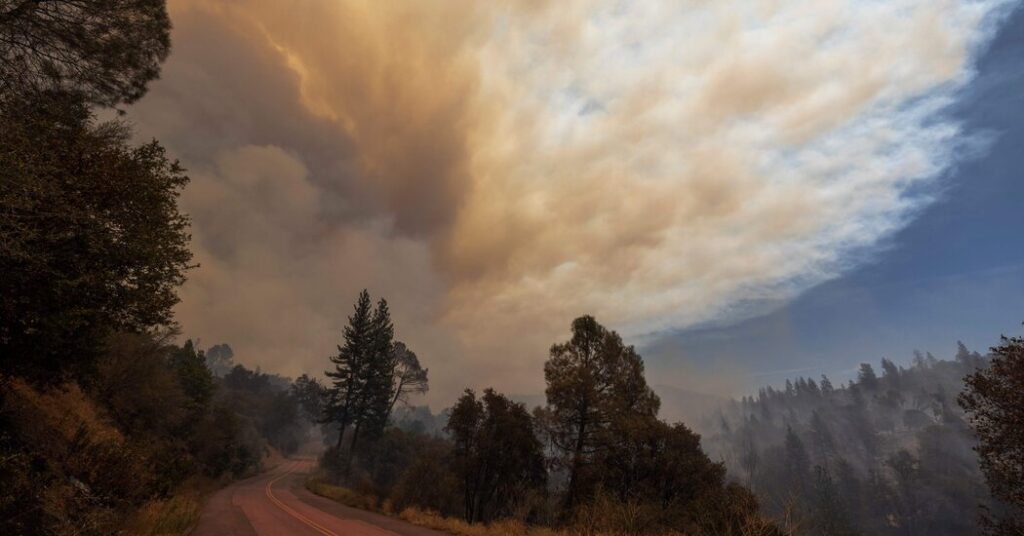
The loss of our beautiful ponderosas, which like the sequoia have adapted to fire over millions of years, is a testament to the lethal combination of hotter fires, droughts and a rapidly warming climate.
The Frijoles fire, which burned more than 15,000 acres in forests 25 miles north of Santa Fe, N.M., by early September, reminds us that a lightning strike, arson or a careless act can threaten the region’s watershed. The burned areas are susceptible to erosion and flooding, which can contaminate water and affect the quality of life.
Several years ago I walked the John Muir Trail for three weeks through the northern Sierra Nevada and was engulfed in smoke for days. Having hiked, skied and foraged for mushrooms in the Santa Fe National Forest over the past three decades, I have noticed more cumulative tree die-off in the past year.
The article’s description of the Jemez Mountains northwest of Santa Fe as “nearly barren of trees” was not my experience. While the area has been hit by huge wildfires, it is substantially forested at all elevations, though it is imperiled by drought and heat.
Those of us who love our forests and grieve their devastation also live in fear of the great trees that surround us. Lit with a single spark, they can transform lives in the increasingly precarious conditions of the drought-stricken American West.
Eric Radack Santa Fe, N.M. The writer is a former certified arborist and was a state director of the Access Fund, a national climbers organization.
To the Editor:
The article about bigger and hotter fires would have us believe that after wildfires trees are not growing back, despite stacks of studies and seedlings contradicting this claim.
While humans are definitely having an effect on the climate, pine trees have been around for 130 million years and the modern ponderosa pine for five million to 23 million years, which means, at the very least, 4.7 million years longer than humans. They have survived extreme weather, fire and shifting climate.
Over millions of years, these trees have adapted and evolved to cope with changing conditions. The only action that makes trees disappear is logging, now often referred to as thinning or fuels reduction, which has been ramping up over the past decade.
If we stop cutting down our forests — pretending it will stop fires or save trees — nature will continue to show us what she can do. Prepare to be amazed.
Rachel Fazio Ridgecrest, Calif. The writer is the associate director and staff attorney for the John Muir Project, which is dedicated to protecting federal public forests.
To the Editor:
Having just completed a book about California fire policy and the short-lived Sierra Nevada Framework, I need to point out that these catastrophic fires are not — or at least were not — inevitable. While climate change and humans affect fire risk, aggressive logging and fire suppression have left these forests choked with small shrubs and trees, primed for fires.
In the 1990s, the Forest Service tried to protect these forests, applying cutting-edge research and reintroducing controlled burns to manage the ecosystem. The framework, approved in January 2001, was soon overturned by the George W. Bush administration, which promoted logging as a way to protect old-growth forests and reduce catastrophic fires, though loggers target the most mature and fire-resistant trees. Clearly, things have not gone as planned.
If the Forest Service had reintroduced fire into other parts of the Sierra Nevada, as it did in the Caples Creek watershed in 2019, the forests might have had a fighting chance. Two years later, the Caldor fire burned around the fire-treated Caples area, leaving behind a green rectangle of protected forest as it blazed toward Lake Tahoe.
California’s fire-dependent forests evolved in concert with regular, low-level fires. Paradoxically, they require more fire on the landscape, not less, to survive.
Diane Smith Missoula, Mont. The writer was a postdoctoral research historian at the Forest Service’s Missoula Fire Sciences Lab.
The Value of the College Admissions Essay
To the Editor:
Re “A.I. and Politics Are Altering College Admissions’’ (news article, Aug. 30):
While some of the nation’s most selective colleges rush to eliminate their supplemental admission essays, I wonder why they are discarding one of the few remaining opportunities in which students get to speak directly to the institution they hope to join.
Admission officers spend enormous amounts of time and energy chasing “fit.” That elusive alignment between a student and a campus is one of the main factors in the college selection process for most students.
The supplemental essay is precisely the tool built to understand that fit. It asks students to reflect on why they chose this school, what they hope to gain and what they intend to contribute. No transcript or test score can answer those questions.
If the true goal is reducing stress, then the solution is making these essays optional, not eliminating them outright. Even in an age when artificial intelligence can draft a personal statement, the supplemental essay should be seen by students and schools as one of the most important human-to-human connections in the college search process.
Removing it doesn’t reduce a barrier; it removes a bridge.
John T. McLaughlin Clinton, N.Y. The writer is the vice president for enrollment management and the dean of admission at Hamilton College.
Shameful Stories of Deportation
To the Editor:
Re “Deportees Flown to Africa Tell of Shackles and Agony” (front page, Aug. 31):
“Have you no sense of decency?” That question, posed by Joseph Welch, the Army chief counsel, to Senator Joe McCarthy during the 1954 Army-McCarthy hearings, must be asked of the Trump administration in light of the cruel and dehumanizing behavior described in this article.
That behavior diminishes us in the eyes of the world. More important, it diminishes everyone who believes in the dignity of all human beings and is committed to the fundamental principle that the personhood of every individual, regardless of background or circumstance, must be respected and affirmed.
For any American who tries to live by this principle, the Trump administration’s actions can only be a source of rage, despair and, most of all, shame.
Richard Stopol New York
Knicks vs. U.S. Open
To the Editor:
Re “The Open Brings $1,200,000,000 to New York” (Sports, Sept. 3):
In this article’s attempt to determine what is of greater value to New York, the Knicks could lose to the U.S. Open in the financial analysis. But for those who feel that everything comes down to money, the past few months can help us recognize other factors that measure value.
So many New York residents were captivated by and experienced joy during the championship run by the Knicks this past spring. That feeling persists, evidenced by the number of people on the streets wearing the team caps and shirts. I know I am not alone in continuing to view those uplifting videos of OG Anunoby’s dramatic game-winning tip-in to cap the Knicks’ 29-point comeback in Game 4.
Even if the three-week U.S. Open generates more money for the city, I think for a sizable number of New Yorkers, many of whom cannot afford to attend either sport, their hearts are with the Knicks.
Jeffrey B. Freedman New York
The post Fires Can Destroy, or Save, America’s Great Forests appeared first on New York Times.