At first we called it “the pile,” but after some months, those of us who worked there started calling it “the pit.” I spent almost a year in a nearby trailer, doing administrative work for one of the construction companies clearing the site, so I watched the whole process day by day.
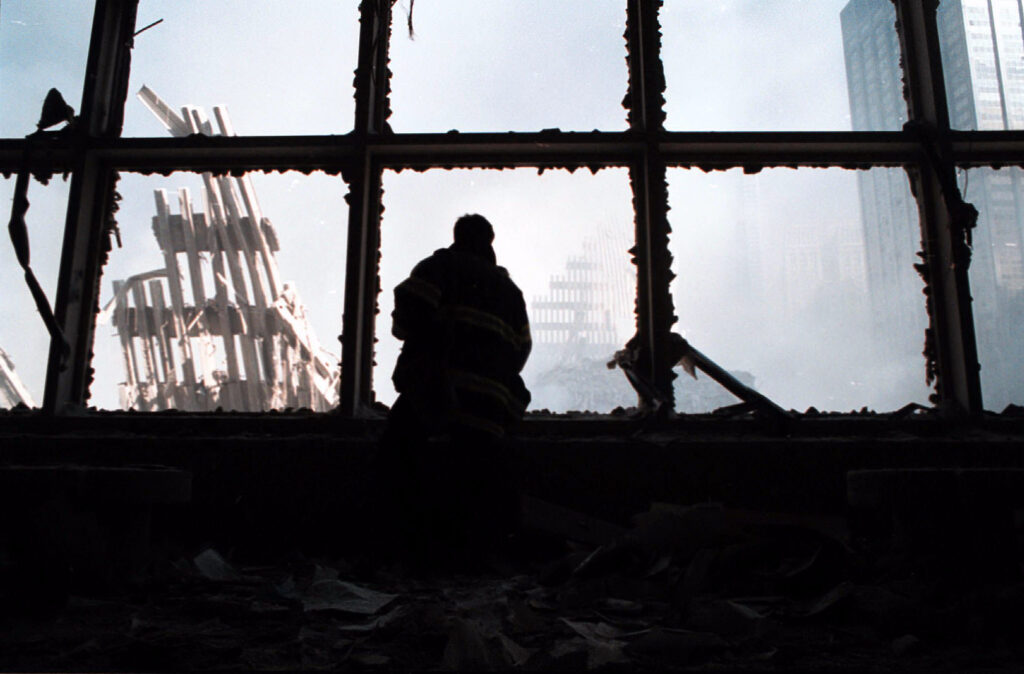
The collapse of the twin towers on Sept. 11, 2001, created an unfathomably large heap of smoking debris, including shards of the buildings that jutted dramatically skyward. One of them was almost four stories high. I can still see exactly what that sheet of twisted steelwork looked like when I first saw it a few days after the towers fell, misted by rain and framed against a brooding sky.
I stared at that shard for a good half hour and still couldn’t believe it, even though I could smell the noxious smoke streaming off the pile. It looked like something out of a movie, and I kept expecting the director to call cut.
For days after I arrived at Ground Zero, firemen and police and medics swarmed over the rubble with construction workers, desperately hoping to find survivors. They never did. Genelle Guzman-McMillan was the last person found alive, a day after the buildings collapsed. Soon they were looking for bodies or keepsakes that could be matched to one of the missing faces that appeared on flyers posted all over the city.
Over the next few months, the pile shrank. The flyers were taken down or blew away, and eventually the workers got past the basements and subbasements, where some of the last human remains were recovered from the pile. Now it looked like any other construction site, unless you happened to know that the sunken space where the engineers were fretting about the slurry wall was the hole in our country where the twin towers used to be.
Periodically, VIPs would come to see the site, and occasionally, one of the other “office girls” or I would be asked to give a tour. That spring, as I was leading a party around, I realized that I was appalling them with my cheerful descriptions of the work that was ongoing and my casual references to “the pit.”
If you are too young to remember the towers, it is hard to explain how that group must have felt. America had always felt like a safe place, nesting between two broad oceans, and now it wasn’t. Almost 3,000 people died in the terrorist attacks. The victims could have been any of us, except that they happened to work in the wrong building or get on the wrong plane. A kind of innocence had been torn from us, and it seemed as if everyone’s life would forever be divided into two halves: before and after.
Those visitors had come trying to comprehend this terrible thing that happened to our country, and all they found was a construction site where some young lady was chattering about slurry walls. I understood how they felt.
I, too, had struggled to comprehend it. I would walk around the site and look at the wreckage, waiting for the enormity of it to hit me. It never did, because that site was too big to be comprehensible. The grief I expected came instead when I was walking out of the subway station at Union Square and came face-to-face with hundreds of “Have You Seen Them?” flyers posted by families of people who never came home. I suddenly found myself on my knees, weeping hysterically, while commuters skirted around me at a respectful distance. Grief, I’d discovered, does not scale.
And neither does it sustain itself indefinitely. As the pile disappeared and the hole took shape, it became familiar to me. Perched in a trailer at the pit’s edge, we told jokes, suffered through breakups and ate snacks. It had to happen, I suppose, but when I saw how those visitors reacted to my casual air, I shared their revulsion.
I had known three people who died in the towers. I had watched the towers fall on television, not knowing whether my boyfriend was inside, and later saw the smoke from the roof of my apartment building, still not knowing. I rushed to the Red Cross to give blood, only to be turned away because they had too many donors and too few survivors. In the weeks afterward, I heard the horror in the voices of friends as they described standing across the street, helplessly watching trapped people leap to their deaths. Through all of it, I felt a fear and sadness and rage that I could not have imagined possible on Sept. 10. How could I forget all that, even for a moment?
As the 25th anniversary approaches, that question occurs to me again. I barely hear 9/11 mentioned, and when I do, the invocation is casual, a historical reference, the way you’d refer to Gettysburg or Pearl Harbor.
Intellectually, I understand that this, too, had to happen. The people who remember that awful day keep dying, and new ones keep being born who cannot know how it felt. Subsequent calamities created new befores and afters. As did better, more personal things, like babies and bachelorette parties and the nation’s 250th anniversary. Life went on, as it had to. Even the darkest grief cannot stay fresh forever.
Yet emotionally, I cannot accept it. Life didn’t go on for 2,977 people. The photographs on the flyers were intended to commemorate the happiest days of their lives — weddings, birthdays and graduations. Instead, those snapshots became a memorial to the last and the worst day they ever lived. Eventually, that memorial was taken down and thrown away, or preserved as a museum exhibit that will never convey a fraction of what was lost. As I reflect on that fact, after 25 years, I find I am still capable of the most terrible grief.
The post I worked at Ground Zero. This question still haunts me. appeared first on Washington Post.