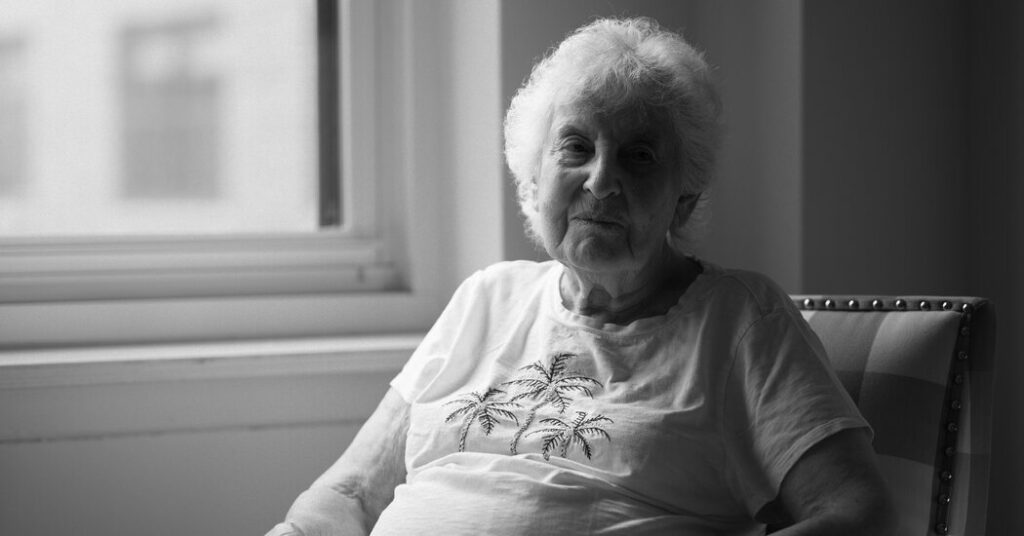
It was a kind of note that Joan Birman had received many times: a plea from a high school student, asking for help learning mathematics.
After enjoying freshman geometry class, the student wrote, she had recently read her first real mathematical proof. It made her think there might be something more to math than what she was learning in school. Perhaps Dr. Birman could show her what she was missing.
Messages like this had arrived with such regularity during Dr. Birman’s career that she had come to suspect they were assigned by high school teachers. They kept arriving via email, though perhaps not as frequently, even after she retired from Columbia University in 2004. Now, in the summer of 2019, she was 92 years old, and she had no interest in being a babysitter.
Still, she messaged the student back and said that she’d think about it.
The truth was, she wanted to keep doing math. Her husband, Joseph Birman, had died two years earlier, leaving her alone in the house in New Rochelle, N.Y., where they had raised their three children. She had decided to move back to the city, choosing an apartment on Riverside Drive because it was not far from the office she still kept at Columbia. She wanted to be a cab ride away at all times from a mathematical conversation.
And here was this email — which, when she thought about it more, seemed unusually sincere, not coerced, as if the girl actually did want to do math. After a few days, Dr. Birman replied and said she was willing to meet. She told the teenager to find a textbook, I.N. Herstein’s “Topics in Algebra,” a standard torture device for aspiring graduate students.
The girl arrived that July in the lobby of Dr. Birman’s Upper West Side apartment building, a postwar co-op on Riverside Drive. Her name was Vasudha Bharathram, and she had just turned 15 that month. She was a rising sophomore at Riverdale Country School in the Bronx, but it so happened that she and her family also lived on Riverside, just 10 blocks away in Manhattan. Seeing her for the first time, Dr. Birman was struck by how small and childish she looked: “She hadn’t gone through her growth spurt yet,” she recalled. Her father had escorted her on the walk through the neighborhood.
They sat in the lobby armchairs, and Dr. Birman asked Ms. Bharathram about her move from India two years earlier, and what she liked about high school geometry. Her own subfield of mathematics was called topology, Dr. Birman explained; it, too, involved shapes, but ones that were fluid and stretchy, not pinned down by rigid coordinates. Dr. Birman took out a pencil and drew an example, called a braid, which twirls around just like the hairstyle. She sent the student off with an assignment to read a chapter of the textbook.
She was surprised when, a few days later, Ms. Bharathram sent her another email, this time with photographs of her notebook. There were pages and pages of solutions, written in a messy teenage scrawl that the elder mathematician could barely decipher. Dr. Birman was startled, first and foremost, by the girl’s intrepidness; problems from Herstein were no one’s idea of a good time. Then she looked more closely at the notes and realized that Vasudha had solved the problems, mostly proofs about basic concepts in abstract algebra, by sketching out unusual paths to the right answer. At their next meeting in the lobby, she asked her to explain her thinking.
There was something original here, Dr. Birman realized.
She decided right then on their path forward. She had a problem in mind, one that had escaped her own grasp for decades. In fact, as they moved through the textbook, they were already working to solve it — though her new student had no idea yet.
The lessons soon moved to Dr. Birman’s apartment. She had dispensed with most of her things in the move, but a few artifacts remained of her old life in the big house in New Rochelle. Shelves of scientific biographies, mostly collected by Joe, a prominent physicist. A pair of hooded gargoyles, purchased on a whim in France in the late ’60s, unwanted by Sotheby’s. (She and Joe had driven by the antique store, met eyes, and knew exactly what the other was thinking.) The stone figures watched over an oak dining table where she and Vasudha would talk about the problems. The girl now typed her answers, after Dr. Birman complained about her “godawful handwriting.”
Dr. Birman’s first move to New York had been 80 years earlier, at age 12. Her parents thought their four daughters would stand a better chance of finding husbands there than out on Long Island. At her all-girls public high school, she discovered a love of geometry, math that she could actually see. With a clique called the “math girls,” she lobbied for harder problems — a demand beyond what their teacher, Ms. Mahoney, could satisfy. Her parents were supportive. Their idea was that their four girls would all get an education, which they did, and then marry off in birth order, which they almost did. (The youngest sister declined to marry off at all.)
Joan worked part time as an engineer while raising three children, but the work eventually lost meaning. Still, she fully expected to return to it when, at 34 years old, she started taking evening math courses at N.Y.U. to “polish my mind,” as she put it. She passed the Ph.D. qualifying exam without realizing what the test was for. “I thought, either I’ll make a mess of graduate school or make a mess of my life,” she said.
Granted a scholarship, she used it to pay for a babysitter; now, she could sit all day and look out the window, thinking about topology. Decades later, her children would joke with one another about being “in the doghouse” for failing to understand exactly what their mother did, and why it took up so much of her attention.
One interest was knots, which in topology are defined as single strands that loop and twist upon themselves in ways that cannot be undone. Their flexibility makes them deceptive. A major question in knot theory is telling whether two different-looking knots are actually the same. As anyone who has untangled a necklace knows, even the worst snarl will eventually unfurl into a circle — an “unknot.” To decipher their true nature, mathematicians translate shapes into algebra. Expressions called polynomials help identify knots as unique, making the wriggling forms solid.
Braids, meanwhile, are defined as multiple overlapping strands that don’t form loops, instead running off the page like the tracks flowing in and out of a train station. What makes them special is that you can do calculations with them directly — algebra with pictures. The study of braids was considered a “backwater” when Dr. Birman completed her Ph.D. in 1968. But this suited her fine as a 41-year-old looking for her first academic job, at a time when rejection for being “the wrong sex” was not occasion for a scandal. It gave her an opening.
She joined the faculty of Barnard College and quickly became known for connecting the powerful algebra of braids to other topics in the world of mathematics, from knots to chaos. Her office on the Columbia campus became a way station. In 1984, when the mathematician Vaughan Jones uncovered a new polynomial in the course of studying braids, he came to Dr. Birman to sort out whether it might be useful. She quickly helped him see how it could distinguish one knot from another — a holy grail for the field. When Jones was later presented with the Fields Medal, awarded only to mathematicians younger than 40, Dr. Birman introduced him.
Women in math sometimes would sequester themselves, she noticed. She didn’t approve — it bothered her, in fact, when Barnard and Columbia failed to merge as expected. The women found her anyway. What she wanted was to see her “mathematical daughters” actually do mathematics, uncovering a world of hidden structure that was available to everyone. When one of those daughters, an undergraduate sick with a set of bad kidneys (just how sick Dr. Birman hadn’t known), died soon after they started working together, what gnawed at her decades later was that she had failed to push harder to make progress. “I let her down,” she said.
After that, she had sworn off taking on younger students — until Vasudha, who now would email her to set up a meeting each time she finished a Herstein chapter. They were moving quickly. By early autumn, they were done with that book, and they soon moved on to Dr. Birman’s own book on braids, considered the seminal work of the field. Their conversations, Dr. Birman realized, were as stimulating as any she’d get from a $17 cab ride to Columbia.
Eventually, Dr. Birman directed Vasudha to a chapter in which she described a special way to represent braids with large sets of polynomials. Known as the Burau representation, it came with a question: whether or not information was lost in this translation from shapes to algebra. This is known as “faithfulness.” Burau was known to be faithful for braids with three or fewer strands, and unfaithful for braids with five or more; at that point, the braids become too complicated to wrangle.
That left four strands. For about as long as Dr. Birman had been alive, no one had been able to come to any conclusions about whether Burau would be faithful in that case or not. Mathematicians couldn’t even decide which path was more likely. To embark on a proof in either direction would be to leap from a plane, unaware of whether or not you were wearing a parachute.
Dr. Birman had decided many months before that they would jump. Soon after the pandemic began, she suggested that Vasudha start by taking another look at the well-established three-strand case. Perhaps if she could find a new way to prove it, they would see a path that others had missed.
Vasudha was born not far from Riverside Drive, at NewYork-Presbyterian/Columbia Hospital. But her family had moved to India when she was 3, returning to New York when she was in eighth grade. Delhi was where her lifelong friends were, where she would play soccer for hours and cheer for the Bengaluru cricket team; a poster for the team now hung on the wall in her bedroom in Manhattan.
Her decision to send the email was almost happenstance: She had looked at the Columbia faculty page, seen Dr. Birman’s name near the top, read an article about her work and then figured she’d reach out. Her parents were surprised to hear she had done it, and even more bewildered when the mathematician responded. Vasudha’s favorite subject in school, the family joked, had always been recess. But as far as a choice of teenage obsession went, it was hardly the worst they could imagine. She didn’t speak much of math to her parents, though, as the details became more complicated. Only to “Professor Birman.”
With the arrival of the pandemic, she could now sit for hours in bed blasting Pink Floyd while she thought about mathematics. She did not understand many of the papers Dr. Birman had given her. But she was fine with not knowing. If she encountered an unfamiliar formula or concept, she could try to look it up, or stow away the idea for later. At Dr. Birman’s direction, she began taking college courses, which were newly online. So was high school. When she needed to focus on a math problem, her teachers now came with a mute button.
The meetings with her mentor continued over Zoom, through a sudden collapse on the street and surgery for a pacemaker. By the time they could meet in person, initially on a bench in Riverside Park, they had made progress. Vasudha was formulating a new way to prove the faithfulness for three-strand braids using a special type of polynomial. It was an unusual choice, because the polynomial had played a role in proving why Burau was unfaithful for braids of five or more strands. She now believed it would help her prove why the four-strand case was faithful. Dr. Birman thought that sounded like a good idea.
It was just an intuition, though, formed after months of visualizing braids in her mind. Not a proof. “They had an argument, but it was not possible yet for someone else to understand it,” said Dan Margalit, a topologist at Vanderbilt University who reviewed their early work. He was skeptical they would succeed, but he encouraged Dr. Birman over their many conversations, seeing no harm in the mathematician and her apprentice’s obsession with this interesting, if perhaps impossible, problem.
It was clear, however, that they could use some backup. One day during Vasudha’s senior year, Dr. Birman invited Tara Brendle, one of her final graduate students at Columbia, to join them in the apartment and take a look at their work. She quickly spotted an error in one of their diagrams — at that moment, Dr. Birman knew they had found a collaborator.
Dr. Brendle, who was then in her late forties and a professor at the University of Glasgow, was hesitant to take on Burau, a notorious rabbit hole that she advised her own Ph.D. students to avoid. But Ms. Bharathram’s approach was so interesting, she recalled later, that “I went home and told my children about it.”
She was surprised, too, by how well the pair got along, with a shared intensity that could easily read as bluntness. Topics that others deem personal, about family or hobbies or music, seemed to live at the polite periphery of their conversations. But they shared a taste in mathematics — and that, Dr. Brendle said, is as personal as anything.
When it was time for Ms. Bharathram to think about college, Dr. Birman took control. She wrote a letter to Princeton, “where all the math wizards go.” And that was that. It was the only school Vasudha applied to.
Her eventual adviser, David Gabai, warned Dr. Birman that most precocious students don’t work out. Accustomed to zipping through calculations and winning trophies at math competitions, they find that the yearslong wilderness of an unsolved (and perhaps unsolvable) problem is not for them, that it is better to code A.I. software or join a hedge fund.
Dr. Gabai quickly saw, however, that Vasudha’s work with Dr. Birman had molded her differently. “She’s mature enough to recognize if you throw in an idea, the chance of it working is not so great,” Dr. Gabai said. “But so what? Just throw in another idea.”
Their origin story had astounded him. Dr. Birman’s decision to reply to Ms. Bharathram’s cold email recalled, he said, G.H. Hardy’s response to a letter from the largely self-taught Indian mathematician Srinivasa Ramanujan in 1913, an act that plucked Ramanujan from obscurity and led to a near-mythical partnership.
From Day 1 at school, Ms. Bharathram was leading a parallel life with her collaborators in New York and Scotland. She felt that she had finally learned enough basic math to make true progress. The music had consequently gotten louder; more than once, the campus police were called to her dorm room to find a young woman doing math problems to a prog-rock playlist.
Occasionally, the three met in person for “math camp” in Dr. Birman’s apartment, where Dr. Brendle would take the spare bedroom. They were satisfied with the new three-strand proof and had moved on to four, using the same polynomial to describe the overlapping twists and turns of the strands. The problem was that certain terms in the polynomial would sometimes cancel out one another, implying that information was potentially lost, i.e., unfaithfulness.
Their task was to show that enough of these cancellations never piled up to cause a problem. But showing that this was always the case would involve thousands of hand-drawn diagrams of various braids and intensive calculations. During hourslong Zoom meetings, as her two students scribbled diagrams and formulas on their iPads, Dr. Birman, now well into her late 90s, privately worried that she was falling behind. (The others claimed they didn’t notice.) She also wondered, more outspokenly, if it was clear enough that they had found a solution and should get on with making it public. Their time was hardly infinite.
This winter, a realization altered their course. Rather than laboring case by case, they could instead change their approach to imagine their four-stranded braids as having five strands — a move that Radmila Sazdanovic, a knot theorist at North Carolina State University, would later call “super, super elegant.” In this world of five-stranded possibilities, they could perform a fix that would make all the cancellations disappear from the polynomial. Watching them vanish was, Dr. Brendle said, “the most satisfying moment of my mathematical career.”
Soon after, they considered the problem solved. But they were still hesitant to go public, spending months tinkering with the language to describe their private logic. Even if colleagues like Dr. Margalit now understood the result, many of the ideas were counterintuitive and had yet to undergo rigorous peer review. But such is the nature of the process. This July, they posted the paper.
On a recent summer morning, Dr. Birman sat at the big oak table with a copy of “A Beautiful Mind” — “totally butchered” by the Russell Crowe movie, she declared — which she was rereading for her building’s book club. She gesticulated with her iPhone as she spoke. A prolific texter, she lets A.I. clean up after her arthritic pointer finger.
One thing she had given up on keeping up with was her email inbox, which had been overflowing since the paper. It will take months for experts to fully digest the result, a process that could still turn up errors. But for knot theorists, any new result from Joan Birman was exciting. That it was this result, one that so many had chased for decades, was thrilling.
The paper was “remarkable in many ways,” said Emmanuel Breuillard, a mathematician at the University of Oxford, with a method that built on old theories (some dating to Dr. Birman’s Ph.D) but with new ideas. Dr. Breuillard had been leading an effort to solve the question with the help of an A.I. chatbot. That humans appear to have sorted it out first — and these three particular humans — “almost feels like a blessing,” he said.
It was a big result, sure — most likely one of her best ever, Dr. Birman said. She was feeling her age, though, in a way that she didn’t seven years ago. Her hearing, a problem ever since contracting mumps from her children, has been acting up again. A valve in her heart is deteriorating. There is a surgery to fix it, but after one of her sons discovered the operation came with a high risk of stroke, “we decided no stroke,” Dr. Birman said. The prior week, she had acquiesced to a wheelchair.
At 99, doing math “is what keeps her going,” Dr. Margalit thinks. It’s no different from when she was 92 and replied to Vasudha. “Most of mathematics is in our minds, not in textbooks,” he said. “It’s an art, and it gets passed down. It’s altruistic in a sense, but it’s also selfish in a sense, because we have these ideas and this tradition that we really want to pass down.”
There was a knock on the door, and Ms. Bharathram walked in. The child who first visited this apartment seven years ago was gone, replaced by (as Dr. Birman had proudly put it, out of her earshot) “a tall, elegant woman” starting her first year of graduate school. She was headed to Philadelphia for the International Congress of Mathematicians, and she had only a few hours to spare before her train. Dr. Birman would be going too, she said, if she weren’t still figuring out the wheelchair.
Ms. Bharathram sat down, tapping her silver rings on the oak table. Looking back, she’s not sure if the girl who sent that email could have articulated why she did it. She just did it. It is easy to imagine a version of herself, she said, who had never found math. Perhaps if Dr. Birman had not responded, or even if they had not turned out to be neighbors. She hadn’t felt any nerves that first day in the lobby, because there were no stakes that she was aware of.
Not that it mattered now. “From the moment I started reading that book and talking to Joan, I just loved it,” she said.
She had set aside finishing other proofs to focus on Burau, her first and most personal problem. But now she was eager to talk with Dr. Birman about that other work, which was tied to questions raised in her mentor’s old papers.
Dr. Birman smiled. She knew exactly which papers, and which questions. “The way that came about was this,” she began. She recalled a snowy night in Buffalo in the 1980s, when a younger colleague had asked her to tell him her “mathematical dream.” Her dream all along, she had realized, after her work on the Jones polynomial, was to “connect knots and braids,” and there was so much more for her to say about it, so much more math to be done. She and that colleague spent the next few years writing papers that would help others see exactly what she envisioned.
Many of the questions in Joan Birman’s dream had been answered. But Vasudha Bharathram was now carrying that work from our three-dimensional world into Dimension 4, a space where knots become almost impossible to visualize and virtually “nothing is known,” she said.
Dr. Birman urged her to go on. She was eager to hear where the dream would take them next.
Gregory Barber is a reporter based in Portland, Oregon, covering math, science and technology. He is a former recipient of the Walter Sullivan Award for Excellence in Science Writing, and he was a finalist for the 2026 Livingston Awards.
The post The 92-Year-Old Mathematician and the Teenage Apprentice appeared first on New York Times.