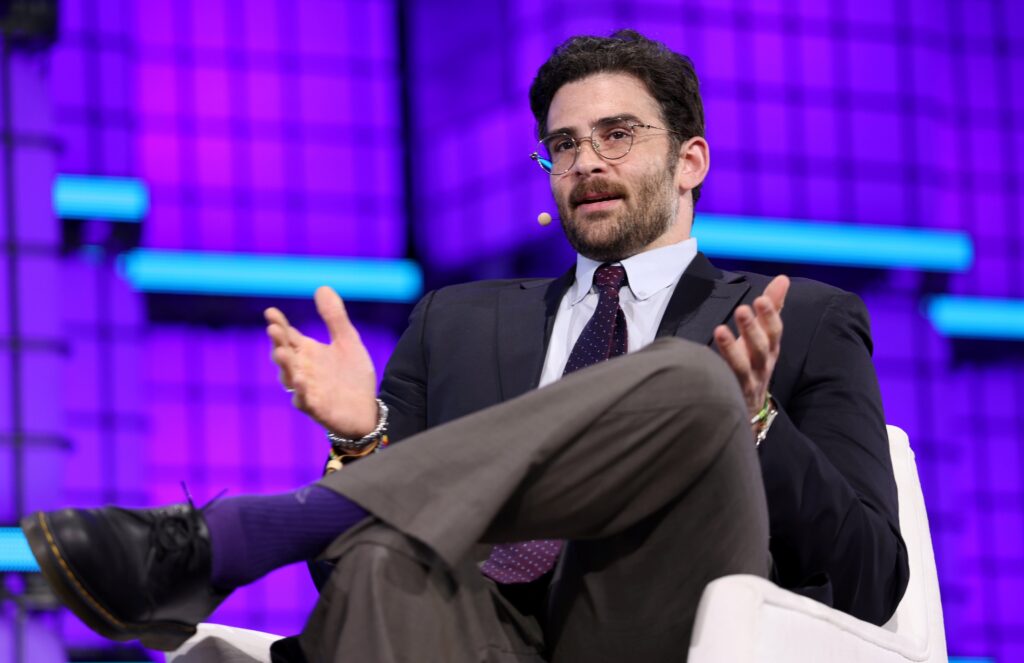
Late last month, left-wing firebrand Hasan Piker showed his Twitch viewers a social media post quoting a supposed audio recording of a Jewish American politician saying that the primary objective of his campaign was to aid Israel.
Piker displayed the post during a monologue on American Jews and Israel that has since roiled the Democratic Party and upended a U.S. Senate race in Michigan.
But even now, weeks later, it is still not publicly known whether the audio recording in question is even real.
The politician the audio is attributed to, Michigan state Sen. Jeremy Moss (D), has said the clip was manipulated or fabricated and “peddles in offensive tropes” about dual loyalty. Digital-forensics specialists who examined it for The Washington Post found no evidence that it was AI-generated or manipulated but could not establish who recorded it, whether the voice was definitively Moss’s or whether the excerpt had been stripped of relevant context.
That ambiguity has helped the episode fester and highlights how artificial intelligence tools can destabilize the information ecosystem voters rely on to make their decisions. Those tools have made it easier to imitate a person’s voice or likeness, while their very existence has also made it easier to dismiss potentially authentic material as fake.
The episode is still smoldering, with the party continuing to debate the line between antisemitism and opposition to the Israeli government, as well as the role of online influencers in elections.
Murky origins
The purported Moss audio took a particularly circuitous path.
The comments surfaced last November, when a user on a Reddit forum called TrackAIPAC posted a 25-second audio clip of a person identified as Moss saying that the entire purpose of his campaign was to ensure continued U.S. support for Israel. The speaker also says it’s not wrong for American Jews to want to put Israel first, because American Jews have been victims of antisemitism and the United States “is not our homeland.”
The recording wasn’t widely spread, however, until July, when Moss’s then-Democratic primary opponent in the race for Michigan’s 11th Congressional District posted it to her X account.
Weeks later, Moss addressed the recording publicly, calling it “manipulated and unsourced” political disinformation that “peddles in offensive tropes and lies” and contains “things I never did and never would say.” He wrote that circulating the clip was eroding democracy.
His statement did not address whether he believed the entire recording to be false or just parts of it.
The origins of the recording are murky. The group whose name matches the subreddit where they were initially posted, TrackAIPAC, said the subreddit where the comments were posted is an impostor and not affiliated with its group, which tracks and opposes the pro-Israel lobby.
Moss’s Democratic opponent, Aisha Farooqi, who posted the recording months later, said she could not share anything about the audio’s origins or who recorded it.
Another political group opposed to the American Israel Public Affairs Committee (AIPAC), the American Independence Project, made its own post about the clip, appending misleading captions to the video claiming the speaker says Israel uses the U.S. as a “pawn,” which cannot be heard in the clip. That post racked up at least 1.5 million views on X. (TrackAIPAC’s official X account amplified the clip, as well, in July.)
Piker’s show
When the comments reached Piker’s show, on Aug. 20, he was being asked by a viewer how best to persuade fellow Jewish people at synagogue to oppose Zionism. Piker had displayed a social media post containing Moss’s alleged comments and started talking about the dangers American Jews face if the public believes Judaism is synonymous with support for Israel and its government’s actions.
“If Jews in America keep putting this idea out there that they’re singularly invested in Israel, eventually someone is going to come around and take action — not against Israel, mind you, but against American Jews,” Piker said.
Those comments drew rebukes from top Democrats as well as Republicans and sparked Abdul El-Sayed, the Democratic Senate nominee in Michigan who had campaigned with Piker, to distance himself from the streamer, saying Piker did not speak for him. Some of El-Sayed’s critics said he should have issued a stronger condemnation.
Piker’s stream also drew another denial from Moss, who told the Detroit News that the clip “is manipulated, either stitched and edited together or just a complete fabrication.” He linked the clip to a toxic political culture in which he had been personally targeted, including by a bomb threat on his home last year.
No evidence of AI alteration
Experts in detecting digital fakes who reviewed the audio clip told The Post they were not able to find evidence that the clip was altered by AI.
Hany Farid, a leading expert in digital forensics and chief science officer at GetReal Security, which detects deepfakes, analyzed the clip using the company’s model that is trained to distinguish real from AI-generated voices and found no evidence of AI generation. The audio does not sound as if it were spliced together, either, Farid added, and the clip’s metadata suggests it is an iPhone recording.
Henk van Ess, an investigator with expertise in detecting AI-generated content, said a commercial audio detection tool, Hive, did not flag that the clip as AI generated. A leading voice technology firm, ElevenLabs, said the clip was not made with their tool, he added.
The origins of the clip are unknown, however, and neither expert could authenticate the recording. AI detection tools are not 100 percent foolproof, and neither analyst performed a biometric match to confirm Moss’s voice.
A spokesperson for Moss declined an interview request. She did not answer whether Moss denies making specific statements in the clip, including that the entire purpose of his campaign was to ensure U.S. support for Israel.
‘Liar’s dividend’
The episode illustrates how AI-generated videos and other content in politics have made it harder for voters to know what to believe — a distrust that political actors can take advantage of in multiple ways.
At least one candidate for Congress, Rep. Derrick Van Orden (R-Wisconsin), has promoted an AI-generated video of his Democratic opponent calling voters “peasants” and herself “the anointed one,” which Democrats slammed as an attempt to trick voters.
And in 2024, a political consultant paid for an AI-generated robocall of Joe Biden’s voice urging Democrats not to vote in the Jan. 23, 2024, presidential primary. The consultant, who said he was only trying to raise awareness of the perils of AI, was ordered to pay a $6 million fine in the case.
The existence of AI can also benefit candidates who want to cast doubt on the authenticity of a damaging story, said Greg Bowen, a Democratic political consultant in Michigan.
“It’s now getting to the point where there’s controversies that pop up and it’s easy for people to dismiss them as fake,” Bowen said.
Politicians are increasingly doing so. Last month, Rep. Randy Fine (R-Florida) was captured on surveillance video rifling through a voter’s mailbox while door-knocking in his district. His office confirmed to TMZ the video showed Fine, but later, when asked by a reporter, Fine said he thought the video could be fake.
“It might have been an AI video,” he said.
President Donald Trump has also invoked AI to cast doubt on events, including when he told Fox News that images showing evidence of a U.S. strike on an Iranian school could have been faked.
Researchers have called this phenomenon a “liar’s dividend,” where politicians can distance themselves from a negative story with little downside.
Claire Wardle, an expert in misinformation at Cornell, said the difficulty people have in 100 percent proving that a recording is either authentic or AI-generated risks leaving voters feeling hopeless about finding the truth.
“This case is going to be repeated in every single congressional district in different ways, and it’s just making people say: ‘No, I can’t. I can’t be part of a process where I don’t have the certainty that I need to have,’” Wardle said.
Moss’s opponent in the congressional race, Troy Mayor Ethan Baker (R), said in a statement that the level of hatred directed at Moss about the recording is “unhealthy” and damaging and urged people to de-escalate their rhetoric. But he also said Moss should explain the comments that have concerned “many people of the 11th Congressional District,” saying his denials may have been referencing the inaccurate captions appended by one group to the recording online.
The recording’s other comments “have yet to be clearly refuted or explained,” Baker said.
The post The mystery behind an audio clip that helped upend a Senate race appeared first on Washington Post.