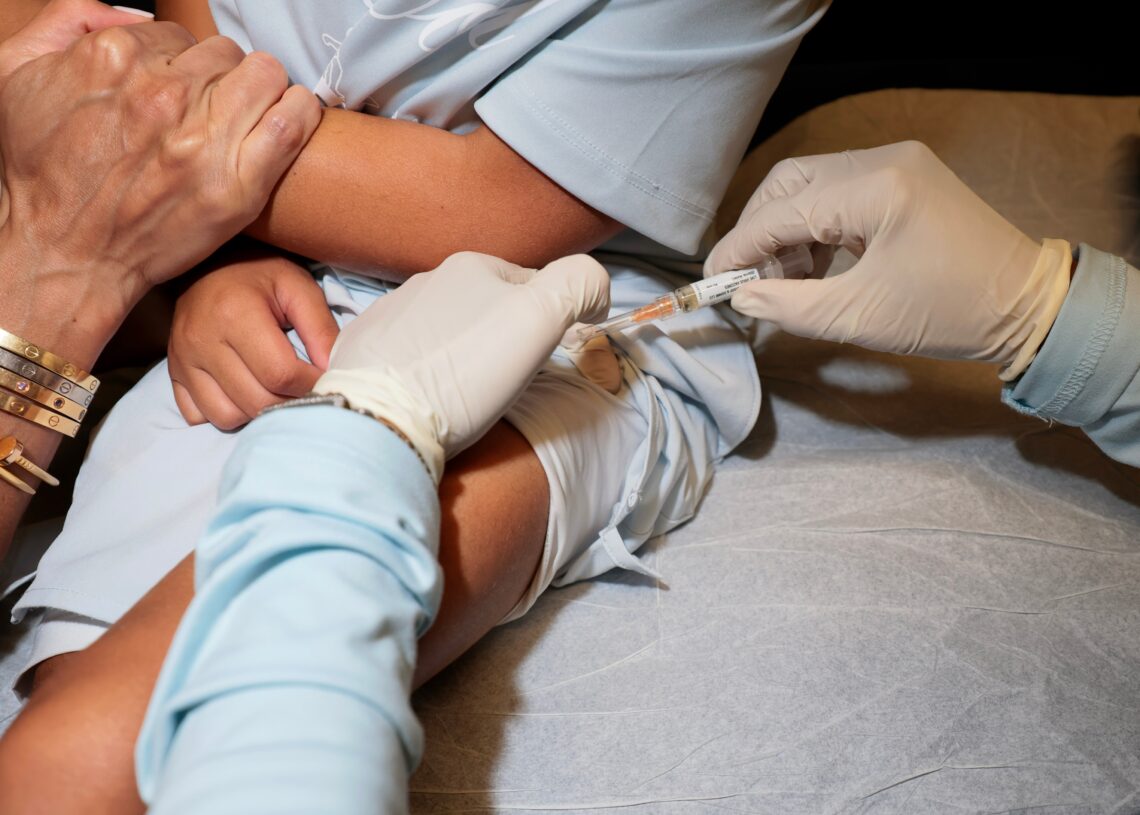
Pennsylvania health workers confronting the country’s largest ongoing measles outbreak have been trying a behind-the-scenes strategy: administering vaccines around a family’s kitchen table, inside the privacy of their own home.
The approach is deliberate, doctors say, relying on word of mouth for some immunization clinics rather than advertising locations that may draw reporters or protesters. Pop-up clinics are happening inside fire stations, places of worship and on a neighbor’s front porch. The effort reflects the great lengths officials are taking to contain an outbreak flaring in a state where officials say two people who died, including a newborn, were infected with measles.
In Lancaster County, which has 45 percent of the state’s cases, some children have never received a vaccine — not because their parents specifically oppose vaccination or are hesitant, but because some Plain communities, including the Amish and conservative Mennonite groups, rarely seek routine medical care, according to doctors who live and practice in the area.
As of Friday, 577 people had contracted measles in the current outbreak, which began in late April and has spread to more than half of the state’s counties, with 115 new cases reported in the last week. In a year in which the United States has recorded its highest number of measles cases in 35 years, doctors and health officials in Pennsylvania say the true case count in the state is much higher — with some estimating that the tally could be three times as many as publicly reported.
Health officials and clinicians are racing to vaccinate people whom conventional public health campaigns cannot always reach, but their efforts have been overshadowed and further complicated by a bitter political dispute between the state’s Democratic governor and the nation’s top health official over the recent deaths.
On Friday, the Lancaster County coroner said for the first time that a child in the outbreak had died as a result of a measles infection. “The child contracted measles, and measles caused the death of the child,” Stephen Diamantoni said in an interview.
The 6-week-old died Aug. 18 at home, after being in palliative care soon after birth. The infant was born with a rare genetic condition that is not generally found outside the Amish community, Amish lethal microcephaly, Diamantoni said. Most babies with that condition live only four to six months, he said.
Medical and public health officials expect the outbreak will only get worse. In the coming weeks, children are going to get sick with illnesses commonly seen during the fall and winter. The symptoms of such illnesses can look similar to those of measles, making it hard to detect cases early and isolate children, said Nathan Keller, a pediatrician who has practiced in hard-hit Lancaster County for 12 years. “It makes it really hard to tease out what’s what, so having cases in the community and having some cases go unidentified could just prolong things.”
Pennsylvania Gov. Josh Shapiro (D) and Health Secretary Robert F. Kennedy Jr. have sparred over the two deaths that the state health department last month said were associated with measles. Shapiro accused Kennedy, the founder of a prominent anti-vaccine group, of having a lengthy history of sowing confusion about vaccines that has contributed to measles outbreaks. Kennedy has argued that Shapiro is using the moment for political gain. The health secretary cast doubt on measles as the cause of death for the two Lancaster County residents, suggesting they “may even have been altogether fabricated.”
State health officials are relying on community partners in their efforts to increase vaccination rates, according to a Pennsylvania Department of Health official who spoke on the condition of anonymity because they were not authorized to speak publicly. Sometimes those efforts are publicized. Other times, they come together quickly from somebody inquiring about getting more vaccines into their community, or a resident coming to a clinic and saying their neighbors want to get vaccinated and offering up their home as a nontraditional pop-up clinic.
The official declined to answer questions about the two deaths.
State health center staff have administered more than 5,700 MMR vaccine doses to residents across Pennsylvania in 2026, according to the health department. That includes more than 600 doses administered to Lancaster County residents since measles cases were first identified there in late April, more than triple the number of doses given in the county for all of 2025.
Vaccination was already an increasingly fraught subject in pediatricians’ exam rooms. Doctors say the political dispute over the two Pennsylvania deaths has further complicated conversations with families about measles and how to protect against it.
Diamantoni, a Republican family doctor first elected coroner in 2007, has said a pathologist who examined a newborn in a separate death investigation told him the primary cause of death was a spleen laceration hours after birth on Aug. 14. The coroner said that the child tested positive for measles but that the pathologist did not believe the virus played a role in the baby’s death. Measles can cause significant inflammation to the spleen, making it more fragile and susceptible to life-threatening rupture, the state health department said last week.
For some patients, the confusion has heightened their fear of measles. For others, it has fueled fears about the vaccine, Keller said.
“When medicine becomes political, it makes it really tricky,” he said. “It’s weaponizing fear, and it makes it really tough for families caught in the middle.”
As a result, some families are seeking the early dose of the MMR vaccine, which can be given to infants between 6 and 12 months if they live in an outbreak-affected area. But others are holding off, he said. The first dose is typically given between 12 and 15 months.
Hospitals hit hard
Penn State Health Golisano Children’s Hospital, in Dauphin County bordering Lancaster, has admitted a dozen measles patients, all from families who recently had measles. Most have been babies such as newborns and those who are 2 and 3 months old, too young to be eligible for their first routine measles shot, said Jessica Ericson, chief of the hospital’s division of pediatric infectious diseases.
They have arrived dehydrated and sick enough to require hospitalization, but not with severe disease. They stay in the hospital for a few days on average to receive IV fluids and some oxygen support, Ericson said.
In Pennsylvania, at least three hospitals have listed public notices of possible exposures: an intensive care unit for infants, the lobbies of two children’s hospitals and a cafeteria.
Representatives from hospitals and the state health department on a call last week discussed anecdotally seeing patients whose close family members had similar symptoms but weren’t sick enough to come to the hospital, said Elizabeth Werley, medical director for the emergency medicine department at Penn State Health Lancaster Medical Center.
That has led her and other officials to believe there are more cases in the community than are being publicly reported. Patients arriving at her hospital with measles symptoms have spanned generations, from healthy young adults to people in middle and older age. Children are also evaluated at the medical center, but those who require hospitalization must be transferred to a pediatric facility.
“I have never seen this before in my career,” said Werley, who said she’s one of the older physicians in her group. “There’s a lot of physicians who have only ever seen it in a textbook.”
Measles was eliminated from the U.S. in 2000. So for many clinicians, it has long been something they learned about in medical school rather than a disease they encountered in exam rooms.
Andrew Pavia, an infectious-disease physician in Utah who has been consulted on measles cases during outbreaks there and elsewhere, said he has fielded calls about pregnant women with measles who were about to give birth — forcing doctors to work out how to protect an entire obstetrics unit from a highly contagious patient in labor while arranging an antibody treatment and isolation for the newborn.
About a week ago, while Pavia was teaching a course for physicians preparing for infectious-disease board certification, a Pennsylvania doctor sought his advice for treating a young patient with measles and encephalitis, a dangerous swelling of the brain. The case was complicated enough that Pavia referred the physician to another specialist on the rare but ultimately fatal neurological disorder known as subacute sclerosing panencephalitis, which typically emerges years after a measles infection in infancy.
Pennsylvania state health officials and the state chapter of the American Academy of Pediatrics are planning a webinar this month — one of several educational events the state is planning — for clinicians to learn the basics about measles, said Toni Richards-Rowley, president of the state AAP chapter: “How to diagnose, how to test, how to quarantine, the nuts and bolts.”
Measles can spread four days before the telltale rash appears, and four days after. Because the virus can remain suspended in the air for up to two hours, doctors’ offices, clinics and hospitals need to create detailed protocols to safely evaluate, isolate and treat patients.
Those precautions can begin before a patient walks through the door. Keller’s practice designated a separate entrance for patients with suspected measles exposure to avoid passing through a waiting room and potentially exposing other patients.
Memories of a past outbreak
Before last year, the largest previous measles outbreak in the United States took place in Philadelphia in 1991 and infected 1,400 people, including nine who died. The epidemic centered on two fundamentalist churches whose members refused vaccines as well as medical care for their children.
Bonnie Zehr was a fourth-year medical student doing a rotation on a pediatric infectious diseases unit that was caring for a sick 18-month-old. The child had encephalitis and pneumonia, two severe complications of measles. The parents were part of a church that did not believe in medical care. The child died.
“I will never forget it,” Zehr recalled.
The current outbreak has spread heavily through Lancaster County’s Plain communities, including Amish and Mennonite families with low vaccination rates, doctors said.
Lancaster is home to the nation’s largest Amish community, which had a vaccination rate around 25 percent several years ago, according to state data.
“The Plain Mennonites don’t typically seek out routine pediatric care,” said Zehr, who has lived and practiced in Lancaster County for more than three decades. “So by nature they’re not as highly vaccinated. Many don’t have anything against vaccines. They just really don’t think about it; they don’t get regular medical care. They will seek care if sick.”
The share of kindergartners vaccinated against measles in Pennsylvania fell from 96.4 percent in 2019 to 93.2 percent in 2025, and vaccination rates have similarly plummeted across much of the country since before the coronavirus pandemic.
In Lancaster County, that drop was much steeper, with the rate falling from nearly 95 percent — the level experts consider necessary to prevent an infection from triggering an outbreak — to about 87 percent in the 2025-26 school year. Over this same period, the share of families seeking philosophical and religious exemptions from vaccine requirements doubled to 4.7 percent and 5.9 percent, respectively.
The vaccination gaps extend well beyond Pennsylvania’s Plain communities. In Bucks and Montgomery counties, where a handful of cases has been reported, pediatricians are trying to reach Russian- and Ukrainian-speaking families with low vaccination rates, including by seeking help from physicians who can speak directly to those communities, said Richards-Rowley, who cares for patients there.
Richards-Rowley said that in South Carolina, where nearly 1,000 people were infected with measles before the outbreak was declared over in April, the Slavic community was heavily affected.
Doctors in South Carolina have said that attitudes toward vaccination in the Slavic community are shaped less by personal opposition and more by experiences many immigrants carry with them from Ukraine and Russia, including deep mistrust of government-run institutions.
That history includes a widely publicized incident in 2008, when a teenager in Ukraine died of bacterial meningitis shortly after receiving a measles vaccine during a mass immunization campaign. Although investigators found no evidence that the vaccine caused the death, public confidence in vaccination dropped sharply.
But the recent outbreak in Pennsylvania has prompted some families hesitant about immunizations to go ahead and get the measles vaccine.
About a month ago, Zehr saw a mother and her 3-year-old child for a well-child visit. The girl was not up-to-date on all of her childhood vaccinations. But because of the measles outbreak, the mother agreed to have the child receive a first dose of the MMR vaccine, Zehr said.
“They are a little bit more fearful,” Zehr recalled. “They didn’t get any of the other vaccines. I was so excited that I actually, in the room, jumped up and down, and then I felt like that’s not very professional of me. But I told the mother, ‘I’m very excited. I want to protect your child.’”
At least with the one dose, if the child is exposed to someone who’s infectious, the child is at least 93 percent protected, she said. Two doses provide 97 percent protection.
Zehr said she gave the MMR vaccine to the child’s older sibling, whom the mother had brought along to the appointment that day and who had received no prior immunizations.
For her, it was a huge win.
Caitlin Gilbert contributed to this report.
The post The behind-the-scenes effort to contain the nation’s worst ongoing measles outbreak appeared first on Washington Post.