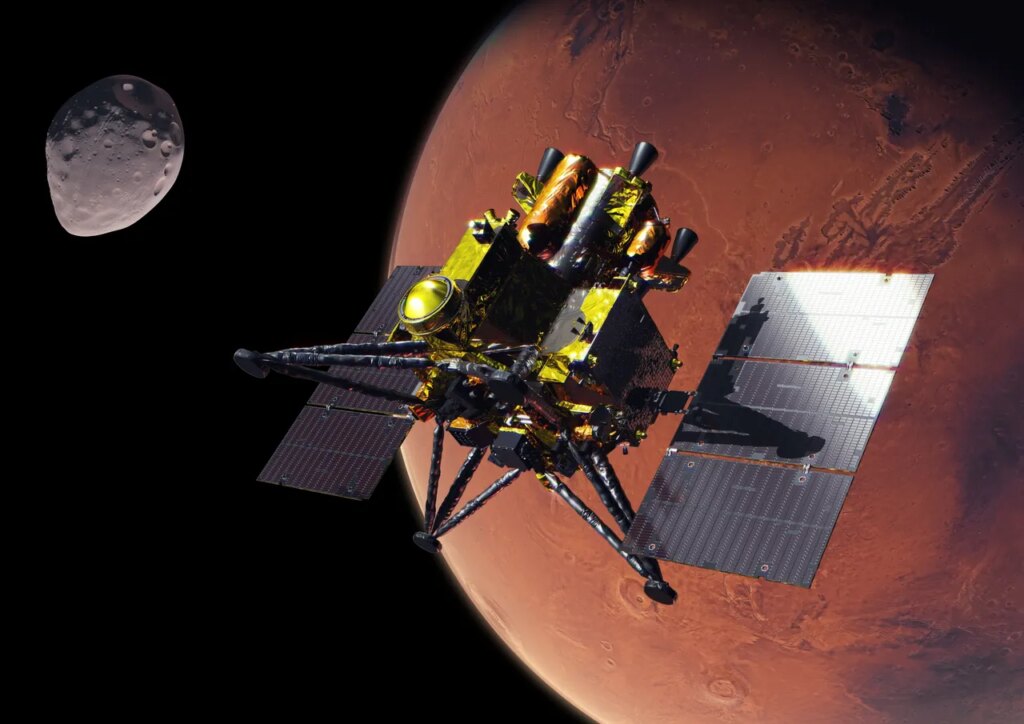
A Mars probe from the Japan Aerospace Exploration Agency (JAXA) may answer some longstanding questions about the Red Planet and its moons. The mission—dubbed MMX for “Martian Moons eXploration”—aims to collect at least 10 grams of samples from Phobos, one of two moons orbiting the planet, and if successful, these will be the first rocks from a Martian moon ever brought to Earth.
They won’t arrive quickly, however. The MMX probe will take approximately one year to reach Mars. It will then collect samples during three years of operations while orbiting the red planet before taking another year to return to Earth. If all goes well, scientists expect to receive the moon rocks in 2031.
One of the most interesting questions the probe can answer is how Mars’ moons, Phobos and Deimos, formed. There are two main possibilities. One is that the moons condensed from material ejected during a massive collision with Mars. The other hypothesis is that the moons were asteroids from the outer solar system that were captured by Mars’ gravity.
The moons are dark in color, and their light-reflecting properties closely resemble those of asteroids rich in water and carbon. Their orbits, however—which are nearly circular along Mars’ equatorial plane in the same direction as the planet’s rotation—are better explained by the giant impact hypothesis. Comparing samples from Mars’ moons to those previously collected from the Martian surface could help settle this debate.
To get the Martian moon rocks and transport them back to Earth, however, means overcoming some significant technical challenges in space flight and communication. At launch, the spacecraft will have a mass of 4,480 kilograms (9,900 pounds). More than half of this weight will be fuel, divided into three reserves: one for the outbound leg, one for exploration, and one for the return leg. Once in the vicinity of Mars, MMX will jettison the outbound module after its propellant is exhausted; following the flyby of Deimos, the exploration module will also be jettisoned.
The probe, designed by Mitsubishi Electric, will then land on the surface of Phobos, a delicate procedure given the moon’s size, with an approximate radius of just 11 kilometers. (In comparison, Earth’s moon has a radius of more than 1,700 kilometers.) Descent methods used on Earth’s moon rely on its specific gravity, which is about 300 times as strong as that of Phobos. However, Phobos’ gravity is approximately 50 times greater than that of the asteroid Ryugu, where JAXA has previously landed probes. Landing on Ryugu involved prolonged hovering, a typical method for landing on smaller celestial objects, but this is not feasible for MMX as it would consume too much fuel given Phobos’ greater pull.
To overcome this challenge, the probe is equipped with high-precision autonomous navigation, which it will need, given that there will be a delay of up to 20 minutes for radio signals to travel between Earth and MMX. The probe must therefore autonomously decide on and execute the descent, landing, and later takeoff sequences.
During the descent, the probe will compare the terrain to data on the topography of Phobos’ craters, using this information to adjust its position toward the target landing site. Once it’s reached an altitude under 300 meters, the probe will also detect whether parts of the surface have changed in elevation, labeling significant discrepancies as hazardous areas. This mechanism allows the probe, if necessary, to change the landing site or abort the landing and temporarily ascend.
Just ahead of the main spacecraft’s landing, the IDEFIX rover—jointly developed by the French and German space agencies—will be deployed onto the surface of Phobos to conduct approximately 100 days of independent exploration. This preliminary survey by the rover will serve as a scout to ensure a safer landing.
Once on the surface, a robotic arm will drill cylindrical tubes into the surface to collect samples. The probe is also equipped with a device first developed by NASA that uses a stream of nitrogen gas to collect fine particles from the very top layer of dust. Whether or not Phobos originated from an impact with the planet, experts believe Martian sand can be obtained from the lunar surface. Over time, meteorite impacts have blasted materials off Mars, coating its moons. Scientists expect about 0.1 percent of the samples collected will be debris from Mars itself.
Costing about $345 million US, this mission marks Japan’s first Mars probe launch in 28 years. Beyond the scientific insights it’s expected to provide, from an engineering perspective, the mission aims to test new technologies that could aid future sampling and round-trip travel to Mars.
MMX is scheduled to launch from the Tanegashima Space Center on October 20, 2026.
This story originally appeared on WIRED Japan and has been translated from Japanese.
The post Japan Is Launching a Probe to Collect the First-Ever Samples From a Martian Moon appeared first on Wired.