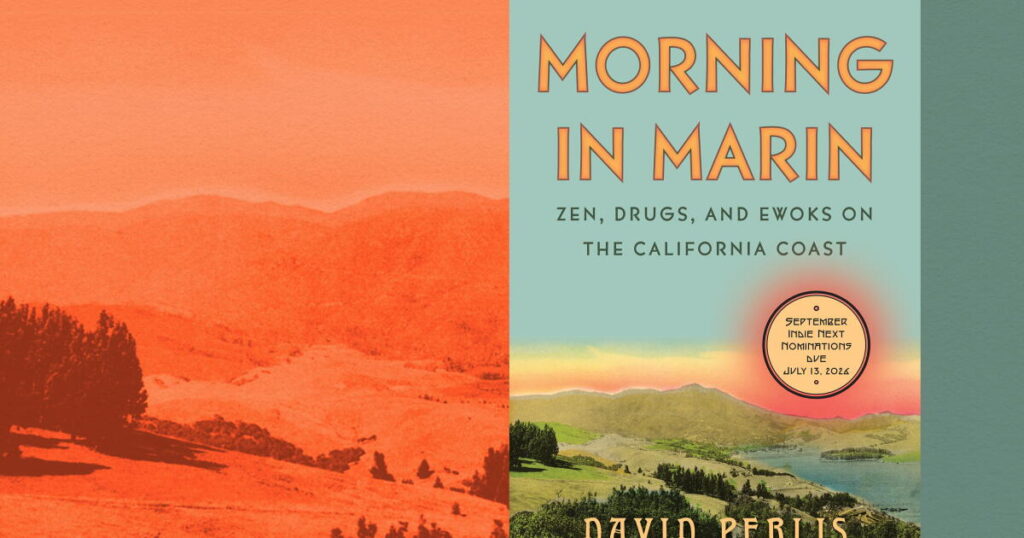
Good vibes weren’t invented in Marin County. But reading “Morning in Marin,” David Perlis’ history of the place and its outsize cultural influence for much of the 20th century, you get the sense it served as America’s leading countercultural way station.
Hosts of spiritual-minded sorts called it home: Alan Watts popularized Zen Buddhism in the ’60s, alongside poets Gary Snyder and Kenneth Rexroth. Francis Ford Coppola decamped there to write his script for “The Godfather,” and it’s where his compatriot George Lucas conjured up the “Star Wars” universe. (The cuddly Ewoks in “Return of the Jedi” were named after the region’s Miwok tribe.) Jack Kerouac sought enlightenment there; his compatriot Neal Cassady was imprisoned there, in San Quentin. It was the Grateful Dead’s retreat, Robin Williams’ launchpad, and the solid ground upon which Philip K. Dick questioned reality.
Why all these people, in this place, at that time? Perlis, an artist, radio host and Marin native, doesn’t strive for sociological or demographic explanations. His strategy is to sinuously move from moment to moment, artist to artist, as if in one continuous tracking shot, pausing only for a moment to catch some of the interesting characters he spots along the way. Over there, film critic Pauline Kael; and there, poet and sitcom star Suzanne Somers; and look, there’s bar-band singer Hugh Cregg, who’ll eventually use the stage name Huey Lewis.
Still, Perlis breaks the flow just enough to offer a few reasons why the region became America’s affluent bohemia. It is, of course, gobstoppingly gorgeous, with Mount Tamalpais, Stinson Beach, Point Reyes and Bolinas practically designed to be edenic retreats. (Fairfax, he writes, is “ribboned with waterfalls, tufted with moss.”) Its isolation made it a counterculture haven for those looking to avoid San Francisco’s bustle: Gay poet Elsa Gidlow made her home there in the 1940s, among the first of many misfit pioneers. Wreckage from the 1906 earthquake was used to build the first “arks,” houseboats in Sausalito, providing a quirky infrastructure. Add some slow-growth initiatives, and you get artsy scrimping arrivistes; add LSD, legal until 1966, and you have a party.
So by the late ’60s, Marin had become a haven for a particular type: creative, interested in Eastern spirituality and profoundly disinterested in social convention (not to mention conspicuously white). Perlis’ portrait of the county at the height of the decade suggests a region that had escaped — or at least refused to look at — the worst of America’s turmoil. “Despite atomic bombs, rampant racism, political violence, and the war in Vietnam and Marin, there is hope, a sincere, emphatic belief, in an imminent inner revolution,” he writes. “When Zen, acid, or whatever your trip is, opens enough minds that people can outgrow this absurd, unwinnable conflict with nature and themselves.”
Perlis writes that with a slight smirk — of course nobody outgrew the conflict. Sure, a lot of people made a mint on the dream of transcendence: The Grateful Dead became a premier touring act, Lucas taught the country the ways of the Force and Sausalito’s Record Plantbecame the studio of choice for Sly Stone, Fleetwood Mac and more. But in the process, Marin became a kind of parody of itself, satirized by the writer Cyra McFadden in her 1977 novel, “The Serial.” In a world of what Perlis calls “swimmable wealth,” enlightenment sure looked a lot like narcissism in caftans. “I have no idea how I manage to do it,” Dick muses about his productivity at one point, prompting Perlis to bluntly break into the narrative: “I do. Drugs.”
Perlis could have gone further than that. One of the peculiarities of the Marin cultural scene, at least in Perlis’ reckoning, is that it hardly seems like a scene at all. Otis Redding and Frank Herbert and Linda Ronstadt and Anne Lamott and Shel Silverstein and Van Morrison all had little in common and interacted even less; if Marin was an incubator, it’s one where every egg hatched a different, brand-new species. Communal activity seemed relegated to the checkout aisles where locals kibbitzed over “The Serial,” or druggy extravaganzas that would in time claim Dick and various Dead members and associates as victims.
The irony, as the region stumbled into the ’80s, is that between its wealth and carefully cultivated isolation, Marin came to exemplify the ethos of conformist America: every man for himself. The actor Peter Coyote resisted: “When a Buddhist is thinking about shooting out traffic lights, it’s time to leave,” he quips. Others dug in: Huey Lewis and the News climbed the charts with a song titled “Hip to Be Square,” though to his credit, he explains to Perlis that it was meant to be a song about the difficulty of reconciling affluence and bohemian values. The man knows where he lives.
Perlis’ book isn’t a dismissal of Marin’s cultural moment, or even really a critique of it: His story is more something to be wondered at, like fog rolling over Mount Tamalpais. And Perlis’ storytelling skills make it seem like good fun as he pingpongs from artist to artist, each somehow inventing a meaningful, or at least recognizable, cultural touchstone. Marin gave us New Age music and Pablo Cruise; it also gave us Jim Carroll’s indelible punk classic, “People Who Died.” But one of the things to wonder at amid the good vibes is whether a different, more coherent, more sober scene would have been more meaningful, more enduring.
A regular contributor to The Times, Athitakis is a writer in Arizona and the author of “The New Midwest.”
The post Ewoks, LSD and ‘swimmable wealth’: Inside Northern California’s lost bohemian dream appeared first on Los Angeles Times.