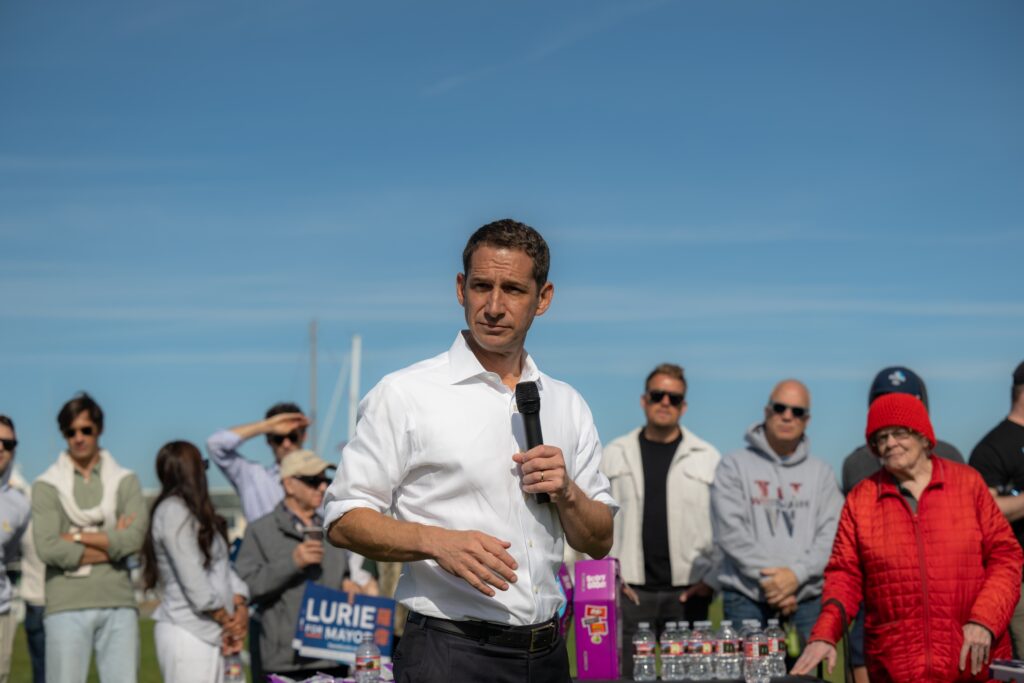
In her Aug. 30 column, “Daniel Lurie, San Francisco’s quiet radical,” Kate Andrews was right that San Francisco’s mayor represents a quiet revolution within the Democratic Party. Recent Manhattan Institute focus groups that I’ve run in California suggest that San Franciscans have noticed — and they help explain why his approach is working.
Compared with voters we interviewed in Los Angeles, the San Francisco participants were markedly more optimistic about their city’s direction. They still described robberies, car break-ins, public drug use, severe mental illness and an unaffordable housing market. Several had been victims of crime. Yet they also sensed that conditions were improving and repeatedly pointed to Lurie as a reason for hope.
The participants wanted the government to help vulnerable people, but they also wanted accountability, public order and evidence that their tax dollars were accomplishing something. That combination is central to Lurie’s appeal. His focus on policing, treatment, clean streets, fiscal discipline and economic growth offers an alternative to progressive mismanagement and fatalistic assumptions that great American cities must accept permanent decline.
The national lesson for Democrats is straightforward. The party’s activist wing increasingly defines ambition through ideological spectacle. Lurie has embraced a more genuinely radical proposition: Government should perform its basic duties competently and be judged by results.
The bluest city in America appears eager for precisely that kind of politics. Voters elsewhere might be, too.
Jesse Arm, Washington
The writer is vice president of external affairs at the Manhattan Institute.
Wyoming didn’t reject conservatism
Regarding Henry Olsen’s Aug. 27 column, “Republicans in America’s reddest state just sent their party a message”:
Voters did not reject conservatism. They rejected politicians who claimed the conservative mantle but regularly failed to govern by its principles.
I know something about that distinction. I served in the Wyoming House before becoming the Wyoming state director of Americans for Prosperity. Some of the lawmakers that voters sent home supported restrictions on private landowners’ ability to sell their own property. Others stood in the way of a proposed nuclear energy investment that ultimately went to Tennessee. Those are not the actions of a movement being punished for its devotion to limited government.
Wyoming voters gave these lawmakers a chance to govern, then judged them by what they did rather than what they called themselves. Wyoming still elected conservatives. It rejected pretenders.
Tyler Lindholm, Sundance, Wyoming
The writer is state director for Americans for Prosperity and a former Republican state representative for Wyoming.
Christian values belong in politics
In Eric Teetsel’s Sunday Opinion commentary, “There’s only one way progressive Christians can reclaim God,” he stated, “Coalition building, trade-offs and compromise are necessary to achieve reasonable policy wins consistent with a Christian understanding of the good.” As a fellow Christian, I believe such pragmatism requires an honest accounting of trade-offs, especially because the evangelical victories Teetsel celebrates have come at a severe human cost under President Donald Trump.
Indeed, undocumented immigrants with no criminal records have been deported through cruel methods, many sent to countries with inhumane conditions. Cuts to U.S. foreign aid have devastated communities around the globe, reportedly leading to thousands of deaths. And domestically, the One Big Beautiful Bill Act has enriched the wealthy while diminishing the social safety net poor Americans depend on, such as Medicaid and food assistance.
Theologian Reinhold Niebuhr, whom Teetsel cites, once said, “We must always seek the truth in our opponents’ error and the error in our own truth.” Teetsel rightly highlights a political truth: Progressive Christians have erred by not moderating on cultural issues to build viable coalitions. Conversely, I hope evangelical Trump voters can confront a moral truth: Their political victories have inflicted ungodly harm on some of the world’s most vulnerable people.
T. Michael Spencer, Washington
When you write your religious beliefs into law, you force everyone to adhere to those beliefs, whether or not they share them. This is what the Taliban does in Afghanistan and theocrats do in Iran. This is why separation of church and state is a good idea.
It is perfectly fine if civil law is consistent with religious principles, but it must not in any way depend on them for justification. For example, laws against murder and robbery are entirely consistent with, but in no way dependent on, religious law. So, if the religious right wants to see civil laws that restrict LGBTQ rights, for example, it should not use their religion as a justification for them.
No one with any respect for his own religious beliefs should want them to be enforced by the heavy hand of government.
Vic Bermudez, Springfield
Eric Teetsel writes that, for evangelicals, “an irreligious leader whose policies more closely align with biblical principles is superior to a pastor committed to a progressive agenda at odds with our understanding of faith.”
I note that the Bible calls for everyone to care for the marginalized in society and recognize the innate dignity of all people. In Genesis, human beings are also charged with being stewards of creation. Sadly, the Trump administration gets failing grades on these points.
R.E. Brevetti, Washington
Letter submissions
Send letters to [email protected].
Submissions must be exclusive to The Post and should include the writer’s address and day and evening telephone numbers. Letters are subject to editing and abridgment. Please do not send letters as attachments. Because of the volume of material we receive, we are unable to acknowledge submissions; writers whose letters are under consideration for publication will be contacted.
The post The quiet radicalism of competent government appeared first on Washington Post.