The devastating human toll from Russia’s war in Ukraine, now in its fifth year, is well known. But it has also been a catastrophe for the country’s wildlife.
Ukraine is home to an estimated 70,000 plant and animal species, some of them rare and found nowhere else. Its landscapes stretch from ancient pine forests and vast steppes to sprawling wetlands. Though it has less than 6 percent of Europe’s land mass, Ukraine accounts for 35 percent of its biodiversity, according to the Convention on Biological Diversity and the United Nations Development Program.
Millions of livestock are known to have been killed in the war, but the number of wild animals destroyed is impossible to track with any precision. Some of the suffering, though, is plain to see.
Birds, deer, foxes and other animals are often caught in thousands of miles of anti-drone netting installed over roads in Ukraine’s war-ravaged eastern Donbas region, or in webs formed by the hair-thin fiber-optic cables used to operate certain kinds of drones. Only a lucky few of these animals are rescued.
Across the country, fires — started by artillery strikes, incendiary weapons, land mines and debris from shot-down drones — have gutted habitats and displacing wildlife.
“It will take several decades to restore all the damage that has been done,” said Serhiy Premachyuk, director of the Sviati Hory National Park in the Donbas, where fires from the fighting have charred thousands of acres.
Fires sparked by combat have also struck the Chernobyl Exclusion Zone, the site of the 1986 nuclear meltdown, posing the unique additional danger that radioactive particles left from the disaster could become airborne in the smoke. In early May, according to official reports, two drones were shot down and crashed in the area, igniting fires in the dry vegetation. Thousands of acres burned.
Days later, a baby moose that had fled the fires lay on a small operating table in a nearby safari park. Veterinarians cut dead tissue away from its burned hooves.
With the government focused on the war, a loose network of rangers, veterinarians, conservationists, volunteers and sanctuaries has emerged to try to rescue wildlife. Some treat wounded birds and foxes; others have taken in lions, bears and primates displaced from zoos near the front or rescued from private homes. Ecological parks have become refuges for creatures brought in with wounds and trauma.
UAnimals, one of Ukraine’s largest animal welfare organizations, has combined such rescues with efforts to document the environmental destruction, in the hope that it might be used in future prosecutions.
Valentina and Leonid Stoyanov, married veterinarians, often get calls from soldiers who have found injured animals at the front. They have traveled to dangerous places to rescue the creatures, many of which they have nursed back to health and released into the wild.
“Our whole clinic was full of birds,” Valentina Stoyanov recalled of the weeks after an oil spill in the Black Sea this year. “A huge number of them died from that spill, it was a big ecological disaster, and it took a long time to rehabilitate the ones we could save because we had to wait for their feathers to molt,” she said.
The conservation work done by rangers at national parks has been profoundly transformed. It now includes fighting fires, evacuating people and animals and removing unexploded mines. Rangers also collect soil samples and other material to assess the war’s environmental effects.
Across the 750-mile front in eastern Ukraine, the landscape has been drastically changed by trenches, anti-tank ditches, minefields, razor wire and anti-drone netting. All of this disrupts animals’ habitats and migratory patterns, to say nothing of those that become entangled and starve or bleed to death.
Even in areas far from the front — such as Nobel National Park, on part of Ukraine’s border with Belarus — wetlands, forests and lakes are scarred by heavily fortified defense lines. “There are three lines of defense along the border, and many kilometers of razor wire and trenches,” said Volodymyr Dikovytskyi, the park’s director. “It has affected the wildlife greatly here.”
The area has one of the biggest populations of European moose, and more than 20 dead cervids, the family of mammals that includes moose and deer, have been found in the fortifications. Many more are presumed to have died. Before the war, wolves and lynxes were often spotted by rangers. Now those predators have largely disappeared.
From a ranger’s tower overlooking Tuzly Lagoons National Nature Park, Ivan Rusev scanned with binoculars, looking for birds. The park’s location on Ukraine’s Black Sea coast has put it in the cross hairs of the fighting, which has driven away many of the migratory birds that feed and nest there.
“Many of them have disappeared, and because other migratory corridors around Ukraine are experiencing similar levels of disturbance, they have not found appropriate nesting grounds,” said Dr. Rusev, 67, a biologist specializing in wetland ecology who leads the park’s research department.
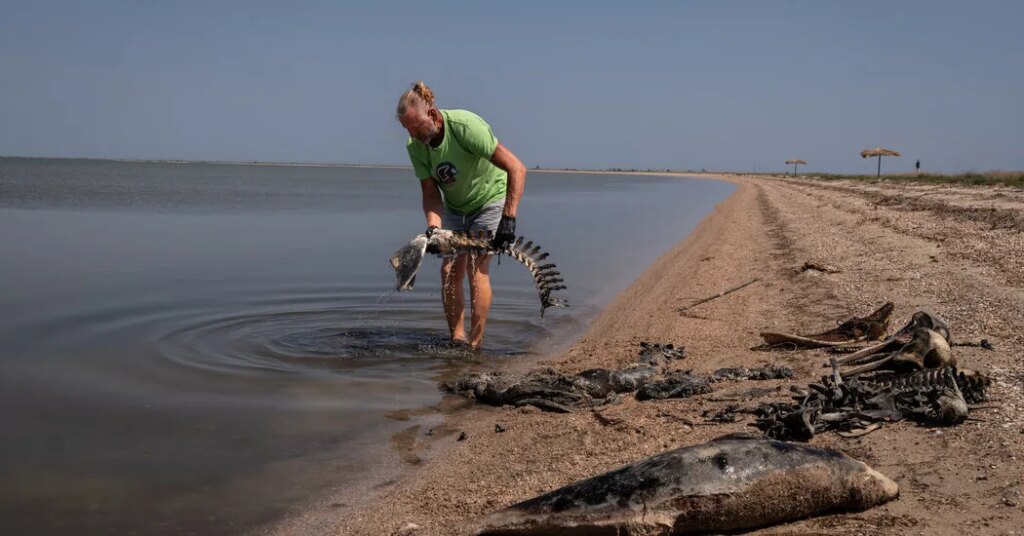
He has also warned for years about the war’s effects on dolphins, porpoises and other cetaceans.
He estimates that more than 50,000 died in the conflict’s first year alone. Naval activity, oil spills and a dense network of sea mines have affected their habitats and migrations, when not killing them outright. Between May and July, Dr. Rusev and other scientists counted 84 cetacean carcasses along the coastline.
“We see maybe only 5 percent of the deaths, the rest drift to the bottom of the sea,” he said.
On one stretch of beach, yellow-brown foam with an oily odor had washed up. Dr. Rusev said it was from a Russian strike weeks earlier on a tank that stored sunflower oil, more than 60 miles up the shore.
Months before that, an even larger strike — part of a Russian campaign targeting sunflower oil production in the region — caused a spill that killed thousands of birds and untold numbers of aquatic animals, according to Vladyslav Balynskyi, a biologist. Ukrainian attacks on Russian oil facilities have also caused spills in the Black Sea.
Near the eastern city of Kharkiv, not far from the front, hundreds of displaced animals were being sheltered at Feldman Ecopark, a wildlife refuge. In January, a Russian glide bomb struck the park’s aviary, killing 80 percent of the birds. Some criticized the park for keeping animals so close to the fighting, but staff members said there was nowhere else to take them.
Months after the aviary strike, the park was still open to visitors, even as Russian drones had been targeting civilian traffic on a road running through it. As families walked from cage to cage, an occasional explosion sounded in the distance.
In a temporary aviary, birds with missing wings or other injuries — most caused by anti-drone nets — were tended to by the park’s ornithologist. Elsewhere, a rescued fox slept, and a white Bengal tiger lounged in the sun.
As the war drags on, scientists say, it will further degrade biodiversity and the environment’s resilience in the affected areas. “Nature has no borders, and what happens here will affect the rest of the world,” said Olha Matsko, who leads the strategic initiatives department at UAnimals.
Even Ukraine’s national bird, the stork, has not been spared. In wetlands, on farmland and in villages, the birds, which are deeply ingrained in Ukrainian folklore, have lost their nesting sites.
Tetiana Burianova contributed reporting.
The post The War Is Ravaging Ukraine’s Wildlife, Too appeared first on New York Times.