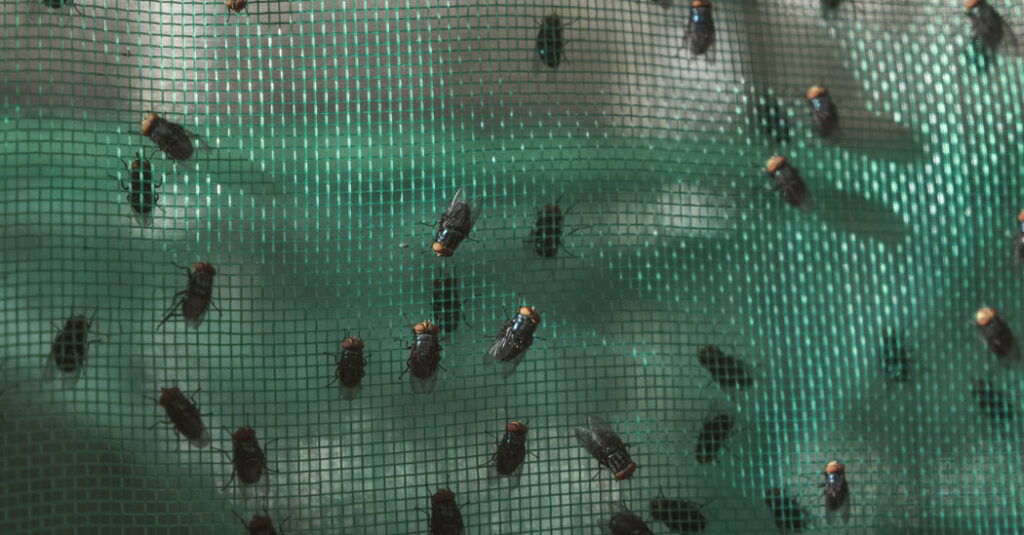
The New World screwworm is a flesh-eating fly that preys on livestock and other animals. Now imagine an entire plant producing millions of such insects a week. The larvae feasts on a mixture of cellulose, egg, milk and cow’s blood that mimics flesh.
The result is a pungent, sickly sweet odor of rotting tissue — one that invades your nostrils and lingers.
“You get used to it,” said Dr. José Luis Quintero, who helps run such a laboratory in Mexico. “It’s part of the job.”
Mexican officials have been racing to combat the first major screwworm infestation in the country in decades, one that has already disrupted a strained cattle industry in both Mexico and the United States. Screwworms were largely eradicated in the region by the early 2000s, but a combination of factors has allowed the flies to make an unwelcome comeback, shutting the U.S. border to Mexican cattle imports last year and contributing to high U.S. beef prices.
In the town of Metapa, which sits along the Mexican border with Guatemala, a newly refurbished plant has become Mexico’s main solution to the parasite that has already resulted in more than 34,000 cumulative cases in all but two of Mexico’s 32 states since the first incidence was detected in November 2024. The outbreak is estimated to cost billions of dollars combined in losses and the measures to fight it.
The site, inaugurated in late June, is the only such plant in Mexico that produces sterile flies, a process that involves breeding enormous quantities of flies, sterilizing them by exposing them to radiation and then releasing them into the wild. Wild female flies then mate with the sterile male insects and slowly reduce the population size.
The goal is to produce 100 million sterile flies a week by November so that the insects can be distributed, starting with Texas and northern Mexico on down, and contain the outbreak.
The livelihoods of many depend on this multinational effort to eradicate a fly that can wreak extreme havoc.
Adult females lay their eggs, roughly 200 per batch, in the open wounds or orifices of warm-blooded animals. When the eggs hatch, the larvae burrow into the wound, consuming the animal’s tissue, thus the name screwworm. Untreated infections can kill animals within a week.
“It really is a concerning issue,” said Hunberto Gomes Velasques, who oversees the sterile fly plant in Metapa and admitted feeling the time crunch.
Late last month, the United States began a phased reopening of the border to cattle imports, though officials said the screwworm problem will persist for a while.
President Claudia Sheinbaum of Mexico, who originally opposed the border closing and attended the Metapa plant’s inauguration, said officials cannot say for sure how long the eradication will take but noted that the plant will help contain the spread.
“It was eradicated once before and that is why experts say we can eradicate it a second time,” she said.
Experts have estimated that eradication could take up to 20 years. When asked, Dr. Quintero pointed to history: The fly was a serious livestock scourge in the region in the early 20th century. But the United States was declared free of wild screwworms in 1966 and battled a vicious outbreak the following decade. By 1991, Mexico was also free. Ever since, with help from a U.S.-funded sterile fly production plant that opened in Panama in 2006, efforts pushed the flies back down to the Darién Gap.
It was in 2023 that cases surged in Panama and Costa Rica, and then began spreading steadily north through Mexico and eventually the United States. The Darién Gap, a narrow, jungle land bridge that connects Panama and Colombia, was the biological barrier that normally kept the screwworm at bay.
Experts said there could be several reasons the screwworm returned. Pablo Liedo, a researcher and entomology expert at the College of the Southern Border, suggested that there could have been hiccups with or a lack of attention by the authorities on the sterile insect programs.
But he also said that the hundreds of thousands of migrants who crossed the Darién Gap and headed for the U.S. border under the Biden administration might have also contributed to the latest outbreak.
“It was a very closed jungle,” Mr. Liedo said.
Flies may have hitched a ride on animals transported by humans, he said. He also pointed to illegal animal trafficking throughout the region that evades inspection, which U.S. officials have repeatedly complained about.
To tackle the new screwworm scourge, the Mexican authorities decided that the fastest way to get a sterile fly production site up and running — in a year — was to retrofit a plant in Metapa that was built in the 1970s to breed and sterilize the Mediterranean fruit fly. The Mexican government contributed $30 million to the upgrade, while the United States pitched in $21 million.
Mr. Gomes Velasques said the plant includes a sealed ventilation system so flies cannot escape and a sterilization process for any waste. There is new equipment to produce the worms’ food in-house. There are rooms heated up to 101 degrees Fahrenheit and with 80 percent relative humidity for the larvae to incubate. The plant will run 24 hours a day, 365 days a year, he said.
In July, the site was still ramping up initial production, so many sparkling new rooms sat empty. But in one, trays of pupae — a stage in the flies’ life — awaited while a constant buzz came from six nearby cages that held nearly 300,000 flies.
Mr. Gomes Velasques said then that the plant was producing about 10 million sterile flies per week. They are taken to northern Mexico, where they are dispersed by plane.
Combined with the Panama site, experts said, this wasn’t enough to fight the current regional outbreak. They estimated that at least 500 million sterile flies per week were needed. The U.S. Department of Agriculture said a new plant in Texas would open in early 2027 but would not reach full capacity, 300 million sterile flies per week, until the end of 2028.
Eduardo Farfán, the vice president of a state association of veterinarians and a veterinarian in Pijijiapan, a small Mexican town three hours from the Guatemala border, said the Mexican government was “trying to block out the sun with a finger.” The response has not been ample or fast enough, he said.
“Can it be eradicated? Yes. But it’s a question of having more,” he said. “The worm ate our time.”
Until then, frontline veterinarians like Mr. Farfán and ranchers like Francisco Javier Rodríguez have to battle the screwworm daily. Chiapas is the Mexican state most affected by screwworm, while northern Mexico along the U.S. border has had relatively fewer cases.
On a recent afternoon, Mr. Farfán accompanied Mr. Rodríguez, 38, to his plot of land to see a 3-day-old calf named Coneja that had already been infected.
The flies are difficult to combat because they are numerous, mobile and small. They can detect even tiny amounts of blood, such as a scratch on a dog’s ear or a tick bite on a horse. For ranchers, it is necessary but tedious work inspecting all their animals. (They can also use deworming medication preventively.)
Even though Mr. Rodríguez said he had applied a disinfecting solution after the calf’s birth, the site where its umbilical cord had been attached hadn’t scarred over yet, and screwworms had already burrowed in.
Mr. Rodríguez grabbed Coneja, held her down on the back of a truck as Mr. Farfán applied a blue antibacterial powder to the spot. He used tweezers to pull out 20 worms.
“There’s probably way more,” Mr. Farfán said.
Of his 50 animals, Mr. Rodríguez said, nine have been infected by screwworms over the past year, the majority of them calves. While none have died, he said, some of the cattle needed weeks to recover because the infection affected their appetites and milk production.
“I have to check every day,” he said.
The post Inside the Fight Against a Flesh-Eating Fly in Mexico appeared first on New York Times.