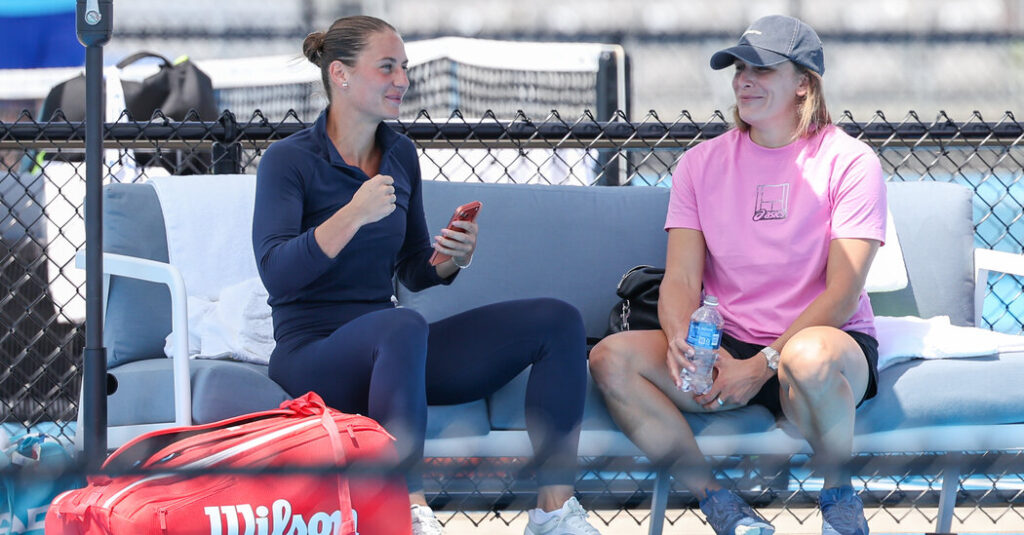
Marta Kostyuk and Sandra Zaniewska vividly recall the moment they knew that their player-coach relationship was on the right track.
It was during a training session in Monte Carlo just after Wimbledon in 2023. Kostyuk, then ranked outside the top 30 on the Women’s Tennis Association Tour, was practicing with the former world No. 1 Caroline Wozniacki. Kostyuk, frustrated at her inability to perform at her desired level and troubled by Russian war developments in her native Ukraine, repeatedly dissolved into tears.
“I was doubting my whole existence,” Kostyuk said by phone last month. “I was sitting on a bench crying, and she [Zaniewska] knelt down in front of me and started asking me questions. It was incredible, such a sign of mutual respect. Before her, men coaches would just tell me to stop crying. They would stand over me, which was a way to show their power. She just let me cry. That’s how I knew I wanted her to be my coach.”
Women’s professional sports have exploded over the last decade. Attendance has soared at W.N.B.A. and Professional Women’s Hockey League games. Networks are airing N.C.A.A. games in prime time. But as player participation climbs, women’s coaching opportunities have not kept pace.
It’s been about two years since the hockey league started. But for the 2026-27 season, just five of the 12 head coaches are women. One of them is Carla MacLeod, a Canadian who coaches the Ottawa Charge.
“There are plenty of women out there, they’re just not given a lot of opportunities,” MacLeod, who led Canada to Olympic gold in 2006 and 2010, said by phone last month. “We were just late to the party.”
MacLeod said she believed that it’s a “delicate dance” when differentiating between male and female coaches.
“It shouldn’t be a comparison of men to women,” she said. “We’re all unique. Women are always talked about from an emotional perspective, how compassionate we are. How about our technical skills? I can out skate most of the male coaches, but I’ve never been given enough credit for my technique.”
Lisa Bluder, who retired in 2024 after coaching the Caitlin Clark-led University of Iowa women’s basketball team to back-to-back N.C.A.A. final appearances, thinks that there were more opportunities for women coaches decades ago when teachers were hired by high schools and told they also had to coach a sports team. She understands the disparate approaches among the genders.
“With women coaches the most important thing was communication, patience, nurturing, compassion and team-building skills, things that innately men don’t bring,” Bluder said in July. “Men get things done quickly and sometimes don’t care what people think.”
Bluder feels that even when women are named as head coaches they too-often hire male assistants to placate male athletic directors.
“I am pro-women, so I damn well better hire women because you know the men are hiring men,” she said. “When the job was something nobody wanted, it was all women. But as soon as there was money involved, that’s when the men came into our world. I believe we’re losing ground rapidly.”
In the Unrivaled women’s pro basketball league, five of the eight head coaches are women. The W.N.B.A. this season features seven female and eight male head coaches.
Kendall Coyne Schofield, captain of the P.W.H.L.’s Minnesota Frost and a gold medalist at the 2018 and 2026 Winter Olympics, has had success with male and female coaches.
“The best are the best, regardless of gender,” Coyne Schofield said by phone in July. “The best coaches are the ones who got to know me as a person before a hockey player. You don’t have to be a man or women to do that.”
In professional tennis, there is a tremendous disparity in female-versus-male coaches. In 1990, the former top-10 player Tim Mayotte hired Billie Jean King to bring him out of a slump. The two-time Wimbledon champion Andy Murray broke ground when he hired the former W.T.A. No. 1 Amélie Mauresmo to serve as his coach in 2014. Mauresmo also coached Lucas Pouille in 2018, but there has not been a female head coach among the A.T.P.’s top 100 since.
Even on the W.T.A. Tour there is a paucity of female head coaches. Of the 128 women entered in the main draws of the recent 1000-level tournaments in Toronto and Cincinnati, only 19 players in Toronto and 20 in Cincinnati listed women as their head coach.
Three of the most prominent pairings are Kostyuk and Zaniewska, Mirra Andreeva and the coach Conchita Martinez, and Caty McNally coached by Kathy Rinaldi.
McNally has known Rinaldi since she was a developing junior. McNally also disputed the notion that men make more successful coaches.
“There are so many amazing women coaches in the world,” she said in a phone interview last month. “I don’t like how people prioritize men as being bigger and stronger. It’s just about building the relationship.”
When Rinaldi began working as a national coach with the United States Tennis Association in 2008, she was one of only two women. She would like to see more young women seeking out female coaches. “It’s important that females begin at young ages so that it becomes normal,” Rinaldi said.
To address the dearth of women coaches, the W.T.A. and the U.S.T.A. have introduced programs aimed at helping women break into the business. The W.T.A. started its worldwide Coach Inclusion Program in 2022 aimed at mentoring female coaches who are interested in working at the highest levels of the game. The program, designed for college players and recent graduates, trains women in subjects including coaching philosophy, biomechanics, match analysis and sports science.
“A lot of men gain entry to women’s tennis because they come in as hitting partners for the women and then meet other coaches,” said Mike Anders, the W.T.A.’s director of member services and coach program. “A lot of coaches keep recycling themselves so it’s hard for the women to gain access and move up.”
The U.S.T.A. began its teaching initiative last year. Through U.S.T.A. Coaching more than 17,000 aspiring coaches — many of them teaching pros, program directors, collegiate players and youth leaders — have participated in online lessons on how to develop the skills to work with everyone from elite to recreational athletes. A U.S.T.A Coaching conference held in New York City on the eve of the U.S. Open attracted about 500 current and aspiring coaches.
“It’s all about increased visibility,” said Megan Rose, the U.S.T.A.’s managing director of coaching. “What are the barriers for women? There is not inclusive access in the hiring process and decision-making because most of the club owners are men so there is an implicit bias. Women need more lead-in programming and networking with each other.”
Zaniewska never intended to be a full-time coach. When her playing career ended in 2017, she was sick of traveling. But after the fellow pro Petra Martic asked for some advice, she liked what she heard and hired Zaniewska.
Within two years Martic’s ranking had jumped and Zaniewska realized she had found her calling. Teaming up with Kostyuk was even more enlightening.
“Like Marta, I am an emotional player,” Zaniewska said by phone last month. “I never perceived that emotion was something bad, it just needed to be channeled. With me, Marta has the space to get out her emotions. Some male coaches would behave this way, but many wouldn’t. They would tell her that crying is a sign of weakness.”
For some, there is no difference between male and female coaches. Others, like Micky Lawler, the Unrivaled commissioner who also was previously the president of the W.T.A., know there is.
“Working with women, I had to think five times as to how what I said would affect their confidence,” she said. “For a guy it’s much more straightforward. ‘What’s the bottom line? How is this going to help me? Period.’ With women it’s a much more nuanced, sensitive approach.”
Rinaldi’s rule of thumb is more basic. “To me, it’s all about connecting,” she said. “My motto is: ‘A good coach can change a game; a great coach can change a life.’”
The post The Rise of Women Coaches appeared first on New York Times.