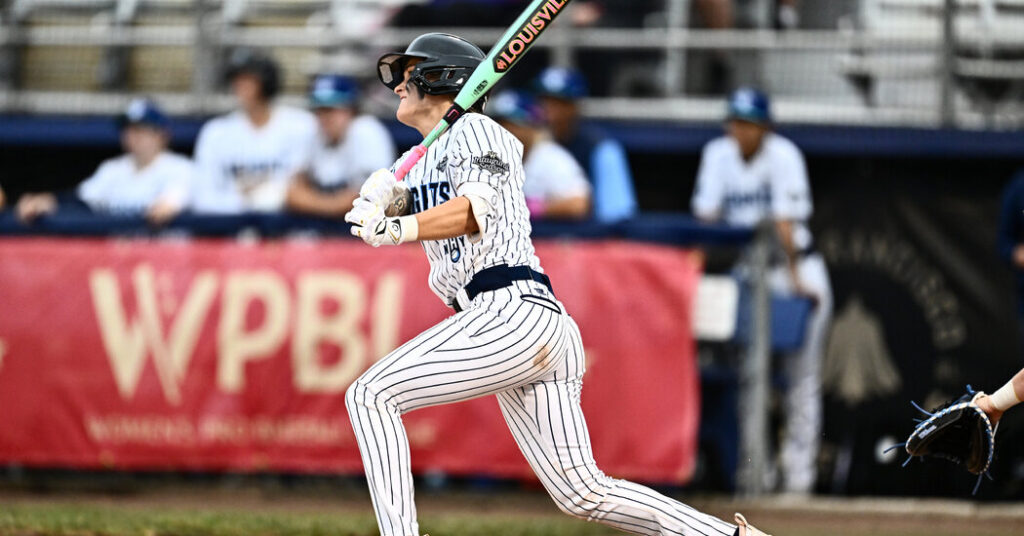
With the clang of the metal bat, the New York Heights catcher Denae Benites crushes the ball some 300 feet over the left center-field fence of Robin Roberts Stadium, and the crowd jumps to cheer her latest home run in a new league popping with power.
“It’s a dopamine kick,” said one beaming fan, Nicole Seaver, 43, describing the offensive bonanza of the inaugural four-team Women’s Pro Baseball League. She and her mother, Vanita, 73, were at the ballpark in Springfield, Ill., wearing Rockford Peaches jerseys to mark their town’s team in the World War II-era All-American Girls Professional Baseball League, made famous in the movie “A League of Their Own.”
Some 70 years later, women’s pro baseball is back in the United States, bringing start-up energy — and stark reality — to the stacked sports marketplace.
Baseball is one of 10 new professional women’s leagues debuting since 2024, including: the Professional Women’s Hockey League, Athletes Unlimited Softball League, Major League Volleyball and League One Volleyball, Unrivaled, 3XBA basketball and the Upshot League, the Women’s Lacrosse League, Women’s Elite Rugby and, sometime next year, a flag football league sponsored by the National Football League.
They join the grande dame of the group, the Women’s National Basketball Association, celebrating its 30th season, and also the National Women’s Soccer League, in its 14th season.
“We are the newbies, but I think women’s sports is such a huge movement right now, across not just the U.S. but across the world,” Benites, 24, said in an August interview from the Illinois park. “And I think it’s a perfect time for us to have the spotlight and to have these opportunities to show people that women do play baseball.”
Money is flowing to women’s sports, as investors see growth opportunities from a confluence of factors: the W.N.B.A.’s and N.W.S.L.’s media rights deals (Nielsen recorded 28.6 billion minutes of views of women’s sports in the first half of 2026), attendance, merchandise sales, athlete-driven social media, advertising, million-dollar expansion fees and billion-dollar franchise evaluations. According to Deloitte, revenues from women’s sports are expected to exceed $3 billion globally by the end of the year.
Being the Best
But even in this era of proliferation, these new leagues may not all last. The race is on for start-ups — especially those competing in the same sport in the same market — to find a sustainable business model to keep their fans, athletes and investors happy.
Already in 2026, there have been casualties. Athletes Unlimited, founded in 2020 by the financiers Jonathan Soros and Jon Patricof, recently announced a “pause” to their volleyball and basketball leagues. Instead, they said they would focus on building on the success of their professional women’s softball league.
In its second year, the Athletes Unlimited Softball League had six teams in six cities with 25 sellout crowds. Average viewership increased 152 percent across ESPN platforms from 2025, and Game 1 of the championship series averaged 732,000 viewers on ABC, a record for pro softball.
Major League Baseball became an investor in 2025, leading to investments from the Milwaukee Brewers. Kim Ng, the A.U.S.L. commissioner and the former Miami Marlins general manager, said that because of M.L.B. backing, “the product that we’re able to put on the field is world class.”
The timing helps, too. “We’re also drafting off of the W.N.B.A. and N.W.S.L. in terms of the popularity of women’s sports,” she said.
The end of A.U.’s volleyball league left two leagues to battle. In 2025, League One Volleyball started its six-team pro league after years developing a youth club system. Major League Volleyball, started in 2024, consolidated teams from the former Pro Volleyball Federation and recently expanded to 12 teams that are locally owned. Five of those cities overlap with L.O.V.B., including Omaha and Minneapolis-St. Paul.
Michelle Haines, the president of the expansion Minnesota Forge of Major League Volleyball, acknowledged the competition next door. “We’re in sports, right?” Haines said. “So any one of us who works in this space, we want to be the best at what we’re doing.”
Volleyball is the No. 1 team sport for girls, with nearly a half-million U.S. high school players. Additionally, there are more than 300,000 players in the USA Volleyball club systems.
Ariel Investments, an asset management firm, bought a stake in L.O.V.B. in 2025, and then created Project Level, a new fund to invest in women’s sports leagues and businesses.
It recently bought the expansion Denver Summit of the N.W.S.L.
“When we look at the leagues that could be next, we place our bets where there is high participation in youth sports,” said Jason Wright, the managing partner and head of investment for Project Level.
As for the future of volleyball, “a merger is definitely in everybody’s best interest,” Wright said. “But you can’t force it.”
Two leagues becoming one is standard in American men’s sports. When the women’s American Basketball League couldn’t compete with the start-up W.N.B.A. and its N.B.A. backing, it folded in 1998. Fast forward three decades (past plenty of growing pains) to the W.N.B.A.’s landmark collective bargaining agreement that led to revenue sharing with the players from 15 teams and $1 million-plus salaries. The league’s 11-year media rights deals are reportedly worth $3.1 billion.
Tapping Potential
Still, the N.B.A.’s media rights deal is about $75 billion. “The dollars are a fraction of what the men’s dollars are,” said Betsy Morgan, co-founder of SWISH Partners, a fund investing in women’s sports. In August, Apollo Sports Capital invested $2.6 billion in the Yankees.
“There is enough money in the sports ecosystem to support the current slate of women’s leagues,” said Fielding Kidd Jamieson, the co-founder and managing partner of Tipt Ventures, which invests in companies supporting women’s sports. “Getting that capital is a different story.”
Jamieson said she had met with male investors who told her bluntly: “Women’s sports will never work.’”
But recent data disagrees. “We have not yet tapped the potential of this new sports fan,” Wright said.
Women’s ice hockey has found new fans, and other leagues are eager to hear how. As the P.W.H.L enters its fourth season expanding to 12 markets (double that of its original six), Amy Scheer, the league’s executive vice president of business operations, has been sharing best practices with her start-up counterparts. One hot topic is the barnstorming model that has worked to attract new fan bases and franchises.
“Women always have to fight for what we want, fight for what we deserve, fight for what we’ve earned,” Scheer said, “and I would hate to have to prop myself up or try to win by putting another women’s league down.”
In the case of the new Women’s Pro Baseball League, however, the fighting appears to be internal. In 2024, Justine Siegal, the founder of Baseball for All and a longtime advocate for women in baseball, co-founded the league with Keith Stein, a Toronto sports entrepreneur. Muse Capital, which invests in women’s sports, raised $3 million in initial funding and at first served as an adviser, with Stein as chief executive.
In August, a board member and investor, Mina Kim, sued the W.P.B.L. for release of financial records in a Delaware court filing, claiming a lack of transparency and a conflict of interest in hiring practices. In a statement, the league said it had “participated fully” in the request for records and said the “vexatious litigation is distracting.”
Assia Grazioli-Venier, the co-founder and managing partner of Muse Capital who had also served as W.P.B.L. chairwoman, said in a statement that the firm was no longer in an advisory or board capacity with the W.P.B.L.
Amid the leadership conflict, the W.P.B.L. is fighting for visibility on the field. Unlike the hockey league, which broadcast its games free on YouTube in the first year, the W.P.B.L. announced a digital streaming deal with ESPN+, a subscription channel, to air 30 regular season games and playoffs. Only games outside the United States are shown on YouTube. Eleven are on U.S. television through Scripps Sports Network.
A spokeswoman for ESPN said in an email that it did not “typically release streaming numbers.”
The league has one transparent metric it thinks could be game-changing: nearly 850,000 followers on its combined social media channels. The top women’s stars bring their own followers with dynamic content boosted by playing in the popular Banana Ball league.
“People don’t realize that women play baseball, so there was that proof of concept,” said Siegal, who serves as the commissioner of the W.P.B.L.
Putting on a Show
Of the 66 players in the league, half come from the United States, with the rest from Canada, Japan (which until 2021 had a women’s league), Mexico, Australia, South Korea and Curaçao.
The sport still has big gaps in its U.S. feeder system that emerging pro women’s leagues like softball and volleyball enjoy. That’s systemic. A 1974 court ruling allowed girls to play on Little League Baseball teams, but the response from officials was to create Little League Softball specifically for girls.
Girls baseball is not a high school sport, and only about 1,400 girls play on boys’ teams. M.L.B. runs youth camps for girls, but women’s baseball is not a collegiate scholarship sport.
Although the teams represent cities (the San Francisco Firebells, Los Angeles Queens, New York Heights and Boston Hunters), the league signed a one-year lease to play at a remote neutral site for the eight-week season that concludes next month. The W.P.B.L. sold out opening day (4,000 tickets), but no games since. Tarps cover empty seats in the bleachers.
The W.P.B.L. said it was averaging more than 2,000 tickets sold per game, though crowds during two mid-August weekend games seemed smaller.
Still, fans who come to Springfield from these team’s cities (or from as far away as Arkansas and Seattle), are finding an all-ages, inclusive community. Many fans wore “Everyone Watches Women’s Sports” shirts or their W.N.B.A. and N.W.S.L gear; others stood in innings-long lines to buy W.P.B.L. merchandise. The league said it had surpassed $1 million in sales, 57 percent from online purchases.
Michelle Marcus, 51, was cheering with friends from St. Louis, where she once played for the SLAM, a professional women’s football team. “There needs to be an example for young girls to see what is possible,” she said.
The four teams are crushing the ball, using metal alloy bats and aided by the outfield fences brought in to 310 feet in center field; teams are averaging 7.4 runs per game. In a made-for-media story line, Benites, a catcher, is locked in a home run duel with the No. 1 overall pick, the pitcher/outfielder Kelsie Whitmore of San Francisco.
“We’re happy to put on a show,” Benites said, but she added: “We can’t settle. You got to always fight and push for more. That’s how you grow the game.”
The post Women’s Sports Leagues Have Exploded Around the Nation appeared first on New York Times.