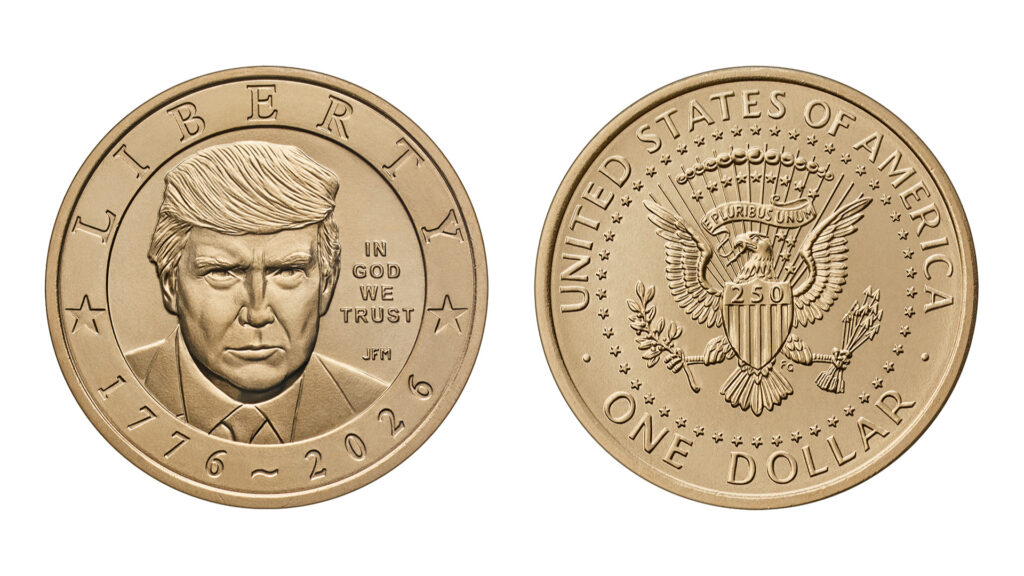
The U.S. Mint said Wednesday that new golden $1 coins featuring President Donald Trump’s image are now in circulation, marking only the second time in U.S. history that a living president has appeared on U.S. coinage.
The Trump coins, intended to mark the United States’ 250th birthday, were first proposed last year and drew controversy and questions about their legality.
One side of the coin features an image of Trump’s face and is inscribed with “Liberty,” “In God We Trust” and “1776-2026.” The other side of the coin depicts an eagle holding an olive branch and arrows in its talons, along with a banner that reads “E Pluribus Unum.”
The U.S. Mint will begin selling the Trump coins on its website at noon Wednesday at a markup of more than 50 percent above their face value. Rolls of 25 coins will cost $61 and bags of 100 coins will cost $154.50, according to its website.
When the coins were first proposed last year, draft images showed Trump’s image on both sides of the coin. At the time, a bipartisan committee that reviews U.S. coin designs balked at taking up the proposal, with members saying that putting a sitting president on currency would break with democratic norms.
GOP and Democratic members of that committee — the Citizens Coinage Advisory Committee — also warned the U.S. Mint not to move forward with any plan to put Trump’s face on coins.
“The CCAC has not been presented with a Trump gold coin for review. If they make it without our review, it will be illegal,” Donald Scarinci, a Democrat whom Senate Minority Leader Chuck Schumer (D-New York) named to the committee, told The Washington Post in June.
Mint officials argued that because the committee declined to consider the coin, the administration was not bound by its review, and pressed forward with the coin’s production.
Under a law passed in 2020, the Treasury Department can mint $1 coins during 2026 to mark the 250th anniversary “with designs emblematic of the United States semiquincentennial.”
However, according to U.S. Code, “[o]nly the portrait of a deceased individual may appear on United States currency and securities” — a law that sprung from a Colonial-era tradition against putting current presidents on American coins, to distance them from the British monarchy.
Treasury officials have defended the Trump coin’s design, noting that the image of President Calvin Coolidge appeared on a coin for the United States’ 150th anniversary.
In 2005, President George W. Bush signed the Presidential $1 Coin Act, directing the U.S. Mint to issue a line of dollar coins honoring past U.S. presidents in the order they served — but only those who had been deceased for at least two years. The U.S. Mint suspended issuing those presidential coins in 2011.
The post U.S. Mint puts golden $1 coin with Trump’s image into circulation appeared first on Washington Post.